by Dragana Favre

*
https://www.brainzmagazine.com/executive-contributor/dragana-favre
*
Princess Leia, the Father Question, and the Heroic Center of Star Wars
Psychoanalytic and Jungian readings of Star Wars have usually gone straight to Luke Skywalker’s relationship with Darth Vader. That is understandable. Luke’s story practically announces itself as a father story: the missing father, the idealized father, the monstrous father, and then the impossible demand that the son decide whether he must kill the father, become him, or save him. Critics working in both psychoanalytic and Jungian modes have treated that structure as the saga’s deepest psychic drama. Martin Miller and Robert Sprich, writing in the early 1980s, described Star Wars as a fairy tale organized around Oedipal material, and later Jungian criticism read Luke’s path as a process of individuation through confrontation with the shadow (Ellerhoff, 2015; Miller & Sprich, 1981).
What is striking is how rarely Princess Leia receives the same kind of attention. She is praised constantly, for her wit, her force of character, her political courage, her refusal to play the passive damsel, but she is much less often read as a subject with a psychic drama of her own. Even in archetypal criticism, she can seem oddly difficult for interpreters to place. That difficulty is telling. Leia is easy to admire and easy to symbolize, but she is harder to reduce. She does not fit neatly into the standard feminine slots of princess, anima, love interest, or mother. She exceeds them, and criticism has often not known what to do with that excess.
The question of a father complex shows this clearly. Luke and Leia do not have the same father problem because, in any serious psychological sense, they do not have the same father. Luke grows up in the absence of Anakin Skywalker and invests that absence with fantasy. Before he knows Vader is his father, he already has a psychic place waiting for the father to fill. The revelation that Vader is that father reorganizes Luke’s entire inner world. Leia’s situation is fundamentally different. Vader first enters her life not as absence, desire, or idealization, but as terror. He captures her, oversees her interrogation, and stands at the center of the machinery that destroys her world. The paternal figure who actually formed her – ethically, emotionally, and politically is Bail Organa. He raised Leia and instilled in her the independence, love of freedom, and political intelligence that shape the person she becomes (StarWars.com, 2016a). In other words, the lived father and the biological father are split from the beginning.
That split matters for any Jungian reading. Luke’s confrontation with Vader can be read in familiar terms as an encounter with the shadowed father and, eventually, with the dark potential inside the self. Leia’s relation to Vader is not organized that way. For her, the discovery that Vader is her father does not open a path toward reconciliation or integration in the same sense. Claudia Gray has said that Leia is devastated when she learns the truth, but that the story never gives her much time to dwell on it because the plot keeps moving and the war takes precedence (Gray, 2016). Luke receives a redemptive climax with Anakin. Leia receives the knowledge as a wound. If there is a father-complex here, it is not the classic one. It is less about rivalry or identification than about contamination, inheritance, and refusal: how does a woman keep faith with the self she has made when history suddenly informs her that she comes from the bloodline of the very force she has spent her life resisting?
Seen from that angle, Leia’s story is psychologically rich, but not in the mythic register critics usually privilege. Luke gets revelation, descent, temptation, and symbolic combat. Leia gets endurance. She is already composed, already politically formed, already carrying more responsibility than the young men around her. Her struggle is not to discover a heroic vocation but to keep acting under pressure without allowing catastrophe to hollow out the self. That kind of arc is easy to miss if one expects heroism to look like mobility, spiritual crisis, and personal revelation. Leia’s heroism looks different. It lies in command, discernment, restraint, and the ability to remain answerable to others even while moving through repeated shock.
A Jungian reading of Leia, then, would have to start by refusing the habit of treating her mainly as a function within Luke’s journey. She is not only an anima figure, nor simply a symbolic princess, nor just the woman who humanizes Han Solo. She is a heroine of sovereignty. Her central problem is not becoming adult but preserving moral and psychic coherence under violent historical conditions. Her shadow is probably not Vader in Luke’s sense. It is something colder and more intimate: the temptation to become pure function, pure duty, pure command. Leia is so competent that one can imagine the real danger for her not as seduction by darkness but as emotional sequestration, the surrender of private grief and private desire to the demands of leadership. That is a different inner drama, but not a lesser one.
Once that is said, a broader sociological question follows: why is Leia still so often sidelined, even when she is loved? One answer comes from feminist film theory. Laura Mulvey’s famous argument about narrative cinema remains useful here because it names a structure that goes beyond any single franchise: men are commonly granted narrative movement, perspective, and psychic depth, while women are assigned the status of image, spectacle, or symbolic function (Mulvey, 1975/1989). Leia partly resists that structure, which is one reason she has remained so important to so many viewers. Still, resistance is not the same thing as narrative centrality. She can be strong and still not be granted the status of the universal hero.
That contradiction shows up in the history of Leia’s reception. She has often been remembered as an icon of toughness, intelligence, and female authority, but she has also been persistently narrowed by the afterlife of the metal bikini from Return of the Jedi. Carrie Fisher herself warned Daisy Ridley to “fight” against being put in a “slave outfit,” a remark that has lasted because it says so much in so little: the character can be culturally celebrated and reduced at the same time (Rich, 2015). Scholarship on Star Wars and gender has made a related point, arguing that female characters in the franchise are often granted agency while simultaneously being drawn back into structures of romanticization and objectification. Leia is therefore not ignored exactly; she is overexposed in one register and underread in another.
If the original trilogy were told primarily from Leia’s perspective, the shape of the story would change at once. The first film would no longer begin as a farm boy’s awakening into adventure. It would begin with a young political leader carrying stolen intelligence, calculating risk under interrogation, and then watching the destruction of her homeworld. Alderaan would cease to be merely one shocking event in a larger epic and would become the emotional and political center of the narrative. The rebellion itself would look different too. From Leia’s point of view, Star Wars is not just a myth about destiny; it is a story about administration, trust, sacrifice, and the exhausting labor of keeping hope organized.
The Vader revelation would also read differently. For Luke, it drives the trilogy inward, toward ancestry and self-knowledge. For Leia, it would sharpen the question of what makes a person who she is. Is family a matter of blood, of formation, of political inheritance, of chosen loyalty? Everything in Leia’s life suggests the answer is not biological determinism. Bail is her father in the fullest human sense, and Vader’s late claim on her cannot erase that. The tragedy is that the films know this, but do not stay with her long enough to let the knowledge unfold.
That may be the deepest reason Leia is oversided in criticism. She exposes the narrowness of the heroic template itself. If one assumes that the real hero is the one who leaves home, discovers destiny, confronts the father, and returns transformed, then Luke will always remain the obvious center. But if one allows that political endurance, disciplined intelligence, ethical steadiness, and survival under patriarchal violence are also heroic forms, then Leia stops looking secondary. She begins to look like the hidden center of another kind of epic, one the films contain, but never fully hand over to her.
References
Ellerhoff, S. G. (2015). Luke Skywalker’s individuation. Journal of Jungian Scholarly Studies, 11(1). https://www.jstor.org/stable/26596719
Gray, C. (2016, May 20). From Princess to General: Talkin’ Leia and Bloodline with Claudia Gray. StarWars.com. https://www.starwars.com/news/claudia-gray-interview
Miller, M., & Sprich, R. (1981). The appeal of Star Wars: An archetypal-psychoanalytic view. American Imago, 38(2), 203-220. https://www.jstor.org/stable/26303750
Mulvey, L. (1989). Visual pleasure and narrative cinema. In Visual and other pleasures (pp. 14-26). Indiana University Press. (Original work published 1975) https://doi.org/10.1093/screen/16.3.6
Rich, K. (2015, October 30). Star Wars advice from Carrie Fisher: ‘Don’t be a slave like I was.’ Vanity Fair. https://www.vanityfair.com/hollywood/2015/10/carrie-fisher-star-wars-advice
StarWars.com. (2016a, June 16). Parenting Padawans: The legacies of Star Wars fathers. https://www.starwars.com/news/parenting-padawans-the-legacies-of-star-wars-fathers
*
When Home Is Liminal
What if someone’s first experience of belonging was tied to something that never had a clear shape? Something that was never entirely safe, yet was familiar. Something without firm edges, without definition, without a frame. Something liminal, elusive, in-between.
Maybe it was not a safe place in the full sense of the word. Maybe it was not a place where the body could fully relax, where the psyche knew it would not be threatened. But it was the first. The first relational space. The first landscape from which we learn what it means to be close to someone, what it means to belong to someone, and what it means to exist alongside others at all.
If the parents themselves were living in that boundless space: emotionally, relationally, existentially, then it is very possible that this was the closest thing to what could be called home. Not stability, not clarity, not support, but fluidity. Vagueness. A constant anticipation that something will take shape, while it never fully does.
And then those children grow up.
They grow up and begin to search for solidity. They look for definitions. They look for clear relationships, clear boundaries, clear answers. They seek something “solid,” because everything else seems dangerous. As though ambiguity might swallow them again. As though any space without edges might return them to an old helplessness, an old shame, an old hunger for form.
But perhaps the problem is not that they seek solidity. The problem begins when they try to build it by denying their own origins. When they feel ashamed of the fact that their first sense of belonging was tied to the liminal. When they flee that inner landscape as though it compromises them, as though it proves they are less capable of love, of home, of stability.
And perhaps the way forward is precisely the opposite.
Perhaps solidity does not emerge when we reject the liminal, but when we stop defending ourselves against it. Perhaps firmness does not come from waging war against one’s first inner architecture, but from acknowledging it. From saying: “Yes, my first home did not have clear walls. Yes, my first belonging was hazy, ambivalent, elusive. And yet it was my first experience of home.”
That is not the same as idealization. It is not the same as justifying what hurt. It is not the same as romanticizing emotional indeterminacy. On the contrary. It is an act of deep psychic honesty. An acceptance that we were shaped also by what was not clear enough, by what was not safe enough, by what could not give us form when we needed it.
As long as we keep running from that, we often remain trapped in a paradox: we desperately seek stability, yet cannot tolerate it. We long for clear contours, but as soon as they draw near, they begin to feel suspicious, confining, or foreign. As though we carry within us a loyalty to something we did not choose, but which first received us.
That loyalty is often unconscious. It reveals itself through the repetition of unclear relationships, through attraction to the unavailable, through the feeling that what is “real” is precisely what cannot be named. And then shame appears: why does what unsettles me feel familiar? Why do I not feel at home in what is healthy, clear, stable?
Perhaps because home is not chosen by reason alone. Home is first and foremost what the nervous system learned early on to recognize. Even when it was not peaceful, even when it was not good enough, even when it was not a safe place, it was familiar. And we often mistake the familiar for destiny.
That is why perhaps one of the most important inner shifts is this: to stop being ashamed of one’s belonging to the liminal. Not so that we may remain in it forever, but so that we may finally outgrow it without splitting ourselves apart.
Because only when we can say, “That was my first support, however invisible and unstable,” does the possibility open up to create something new. Only then do contours cease to feel like betrayal. Only then does solidity stop sounding like a foreign language. Only then can “solid matter” arise not as a mask, not as a defense, but as a continuation of the process of maturation.
Perhaps for some people, home does not begin as a house. Perhaps it begins as fog. As a threshold. As a space in between. And perhaps the task of life is not to deny that we came from that fog, but to slowly and patiently shape it into a form that no longer erases us.
We do not have to be ashamed that our first belonging was elusive. We do not have to be ashamed that we spent so long searching for solidity, yet did not know how to recognize it when it arrived. All of this has its own psychic logic. All of this belongs to the story of how a subject comes into being, trying to create its own form from what once had no outline.
And perhaps true maturity does not lie in becoming completely resistant to the liminal, but in learning how to carry it without falling apart. To acknowledge it as part of one’s origin, but not as one’s final destiny.
Because when we stop running from our first home, however unclear it may have been, only then can we truly begin to build our own.
*
Ontology of What Disappears
In contemporary cinema and literature, we often encounter motifs of ephemeral characters—entities that exist only temporarily, within limited frameworks of time, space, or meaning. Such characters are particularly intriguing when viewed through the prism of time loops (for example, the exceptional German series Dark), but also when compared to the way physics and mathematics employ temporary constructs to describe and understand reality. This similarity becomes even more profound when transferred into the Jungian realm of the psyche, where personality itself functions through symbolic, transient forms.
In narratives based on time loops, characters often exist solely within the repetition of a single temporal interval. They lack “external” continuity: their existence is conditioned by the rules of the loop. Once the loop is broken, they vanish or lose their identity. These characters are ephemeral not because they are weak or insignificant, but because their ontological status is bound to the structure of time itself. They exist only as long as time is being counted, much like auxiliary quantities in mathematics.
In mathematics and physics, we often introduce numbers, variables, or entire expressions that have no direct physical meaning, yet are necessary for solving a problem. For example, in an equation we may add and subtract the same term:
x² − 4x = 0
x² − 4x + 4 − 4 = 0
By adding the number 4—which is later “cancelled out”—we enable factorization and make the equation easier to solve. This number 4 is ephemeral: it does not change the final result, but without it the process of solving would not be possible. Similarly, in physics we introduce imaginary numbers, auxiliary coordinate systems, or idealizations (such as point masses or frictionless surfaces) that do not exist in reality, but allow reality to be calculated and understood.
Ephemeral characters in time-loop stories serve the same function. They are the “added term” in the narrative equation. Their fate is to repeat, reset, or disappear, but through them the main character—or the observer—comes to understand the system in which they are situated. Just as an auxiliary number is neutralized at the end, the ephemeral character is often erased from the final outcome of the story, leaving behind only knowledge or a shift in consciousness.
When we transfer this analogy into Jungian psychology, we enter the world of symbols, archetypes, and the unconscious. According to Jung, the psyche is not a linear and stable structure, but a dynamic field in which various contents appear, disappear, and reappear. Complexes, dreams, and symbolic figures are often ephemeral, emerging only at a particular stage of psychological development or within a specific “inner time.”
In this sense, the Jungian psyche functions as an internal time loop. Certain patterns of behavior, emotional reactions, or dreams repeat until the individual becomes conscious of their meaning. Dream figures, shadows, animus, or anima can be viewed as temporary constructs of the psyche—auxiliary variables that make it possible to “solve the equation” of individuation. Once their message is integrated, they lose their power or disappear, just like terms in a mathematical equation that cancel each other out.
The ephemeral character—whether in a time loop, a mathematical formula, or a psychological symbol—is not a flaw in the system, but a necessary part of it. It exists so that the process can unfold. Its transience is precisely what gives it meaning. In the Jungian world, as in physics, truth is often found not in permanent objects, but in relationships and processes. What disappears leaves its trace in understanding, not in form.
Ultimately, the similarity between these domains shows that the human mind—whether creating scientific models, mathematical formulas, or narratives about time—employs the same strategies: it introduces temporary figures in order to arrive at lasting insight. The ephemeral is not the opposite of meaning—it is its necessary condition.
*
The Shadow of Injury and the Strength Hidden Within It: Between Defense and Ethical Choice
From a Jungian perspective, experiences of deep injury—humiliation, neglect, the sacrifice of one’s own needs, prolonged emotional deprivation—rarely remain only in the form of a clear narrative. More often, they withdraw from direct awareness and organize themselves as a complex, as a psychic “concentration” of affect and meaning that continues to live independently of the ego’s will. What was unbearable to feel, to acknowledge, or to find a place for in relationship slips into the zone Jung calls the Shadow: not necessarily as “evil,” but as that which was rejected, unclaimed, cut off from identity in order to survive. In this sense, the Shadow is not merely a repository of undesirable impulses, but also an archive of what was not allowed to exist—and for that very reason it becomes a source of tension, pressure, and unintegrated energy (Jung, 1959; Jung, 1969).
In that space, defenses often form that outwardly may resemble narcissistic patterns: a need for control, hypersensitivity to criticism, rigid self-sufficiency, an exaggerated narrative of one’s own strength or specialness. If only the surface is observed, it is easy to reduce everything to “narcissism” as a characterological defect. But from a clinical perspective, especially when developmental background is taken into account, narcissistic organization can be understood as a secondary stabilization—an attempt to preserve a fragile core of the self from renewed disintegration, shaming, or worthlessness. In that sense, grandiosity is not the opposite of vulnerability, but its mask; and contempt and distance are often not coldness, but protection against renewed humiliation. Along this line of understanding, Kohut views narcissistic structures as attempts at self-regulation and the protection of identity continuity, while Kernberg emphasizes that the grandiose self state is often organized around defenses against envy, shame, and helplessness (Kohut, 1971; Kernberg, 1975).
Yet here the most important point is easily overlooked: defenses do not conceal only pain, but also strength. What has been repressed is not merely the memory of injury, but also the primary energy of the reaction to it—rage, anger, the need for rectification, the desire for justice or revenge, the urge to restore balance and reclaim dignity. In Jung’s language, libido does not disappear; it relocates, condenses, changes form, and seeks a channel. When that force lacks a symbolic form and a conscious “container,” it acts autonomously: it erupts as an affective storm, as a magnetism that attracts and unsettles, as pressure on others, as a need to reverse a situation at any cost, or as a seductive allure carrying a taste of danger and a promise of power. The Shadow then is not only dark; it is also potent. Within it lie both destructive and life-affirming possibilities, and the paradox is that the same energy that can wound can, if integrated, become fuel for individuation (Jung, 1959; Jung, 1969).
This is why, in relationships, what is transmitted is often not only the story of an old wound, but its energetic charge. A wounded person may unconsciously “bring” into a relationship an intensity that others experience as heaviness, as a challenge, as a call to struggle, as a need to prove or correct something. Sometimes this is felt as the strength of pain, sometimes as seductiveness, sometimes as cold dominance, and sometimes as a fascinating depth. In all these variants, the same phenomenon is at work: the unintegrated energy of the Shadow spills beyond the boundaries of the ego and becomes an interpersonal event. Other people then, often without knowing why, begin to react—to defend themselves, attack, idealize, submit, or attempt to “fix” what is not theirs. Thus a chain of stimulation and reaction emerges in which trauma finds a new stage: instead of being understood, it is repeated.
At that moment, what is essentially ethical in the Jungian sense appears: choice. Not the choice of whether we will have this strength—because it already exists—but the choice of what we will do with it. One possibility is rectification understood as an unconscious settling of accounts: to “collect” through other people or situations what was once taken away, to turn humiliation into humiliating others, to replace helplessness with control, to transform a wound into a right to take. The other possibility is rectification as a conscious act: acknowledging the injury without turning it into a license, taking ownership of the energy without pouring it out onto others, finding a symbolic and creative form for what is raw and explosive. Jung warned that moralizing the Shadow does not lead to integration; it is merely another form of repression. Integration means acknowledging, “This is in me”—and then adding the equally important continuation: “I am responsible for the consequences” (Jung, 1959).
Breaking the chain of stimulation does not mean becoming weak or passive. On the contrary, it often takes greater strength to renounce unconscious revenge than to enact it. It is the discipline of an ego that can endure its own anger without immediate discharge, and that can endure its own desire for justice without turning justice into punishment. Such an ego learns to distinguish dignity from domination, boundary from retaliation, and respect from submission. Then strength ceases to be a weapon and becomes a capacity: the ability to influence, to stand behind oneself, to say “no,” to protect what is vulnerable, and to remain aware of one’s own impact.
From there, the most mature formulation opens up: respecting others does not merely mean being “good,” but being aware that personal energy carries weight and consequences. Responsibility in this context is not guilt, but authorship. The wounded person is not only a victim; they are also the bearer of concentrated strength. They did not choose this strength, but they do choose its direction. Individuation, in the most concrete sense, begins when the subject can acknowledge the Shadow as their own and decide not to delegate it to the world through unconscious power games, but to translate it into conscious acts: into boundaries, into truth, into creation, into a justice that does not have to be revenge.
References:
Jung, C. G. (1959). Aion: Researches into the Phenomenology of the Self. Princeton University Press.
Jung, C. G. (1969). The Archetypes and the Collective Unconscious. Princeton University Press.
Kohut, H. (1971). The Analysis of the Self. International Universities Press.
Kernberg, O. (1975). Borderline Conditions and Pathological Narcissism. Jason Aronson.
*
Individuation as Movement Through the Cosmos
When we observe the solar system today, we no longer imagine it as a calm, static image from school atlases: the Sun fixed at the center, planets neatly arranged in perfect circles, everything stable and complete. Contemporary astronomy shows something entirely different. The solar system is not located “somewhere” in space; it is constantly moving through the galaxy. The Sun itself is not an immobile point, but a body in motion, drawn by the gravity of the galactic center, immersed in a vast cosmic space that both contains it and determines it. The planets do not revolve around the Sun in closed circles; together with it, they trace spiral paths through space-time. Their movement is possible only because there is a cosmos through which they move. Without that space, without that broader order, there would be no trajectory, no direction, no relationship.
This image carries profound symbolic value for understanding individuation. Jungian psychology does not view the psyche as a closed system. The psyche does not exist in a vacuum. It is always embedded in something greater than itself: in the collective unconscious, in the archetypal order, in history, the body, culture, and nature. Just as the solar system exists only within the galaxy, the individual exists only within a broader psychic cosmos. Individuation is not merely an inner process of the ego; it unfolds in relation to a space that transcends it.
The Self, in this sense, is not only the center of the psyche but also a point of relationship between the inner and the outer cosmos. It organizes psychic life, but not in isolation. The ego relates to the Self as a planet relates to the Sun, yet the Sun itself is already in motion, already part of a larger whole. This means that the individual must not only discover an inner center, but also endure the fact that this center itself is situated within something greater. Individuation, therefore, is not a process of withdrawing into oneself, but of situating oneself within a cosmic order.
When the ego loses awareness of this wider space, distortion arises. Just as a planet that ignored the galaxy and imagined the entire cosmos ending at its own orbit would misinterpret its movement, so too does an ego that encloses itself within a purely personal perspective lose its sense of proportion. Complexes then emerge as false centers. They not only assume the role of the Sun but also erase awareness of the cosmos itself. Everything becomes personal, enclosed, compressed into the narrow space of inner drama. Movement loses its breadth and becomes compulsion.
In Jungian terms, suffering often arises precisely from this narrowing of space. The psyche demands a wider horizon than the ego allows. When life is reduced to a single identity, a single role, a single story, the inner cosmos collapses. Symptoms then are not merely signals of an incorrect trajectory, but also cries for space. Depression, for example, often carries an experience of infinity, emptiness, cosmic distance. It can be a painful yet necessary encounter with the fact that the ego is not the measure of all things, that there exists something immense, indifferent, yet structuring.
Individuation therefore requires not only a relationship to the center, but also a relationship to space. It presupposes the capacity to endure the openness of the cosmos, the uncertainty of movement, the absence of a final support. Just as the solar system does not move toward a clearly visible goal but follows laws that transcend human comprehension, so individuation has no clear image of an end. It unfolds in time, in change, in continual adjustment to a broader order.
To be individuated does not mean to be separated from the cosmos, but to be consciously situated within it. It means accepting one’s own limitation as well as one’s own participation. The human being is neither the master of the cosmos nor an insignificant point within it. He or she is a participant. Dignity does not arise from centrality, but from the capacity to endure the truth of one’s place.
In this sense, the individual does not exist despite the cosmos, but because of it. Just as the trajectory of a planet has meaning only in relation to the vast space through which it moves, so too does human life acquire meaning only when it is seen as part of a wider, unconscious, archetypal reality. Individuation then becomes an act of cosmic humility: a consent to be in motion, in relationship, in a space that surpasses us, yet also carries us.
*
Behind the Veil of Space-Time: Physics as a Myth of the Self
Quanta Magazine recently released a video essay, Space-Time: The Biggest Problem in Physics (Quanta Magazine, 2024; https://www.youtube.com/watch?v=RIqVnFtOSr4), which caught my attention in a serious way. At first glance, it looks like “just another” popular-science piece about space, time, and quantum gravity. But if we read it through a Jungian and cosmopsychic lens, something else appears behind the standard story of theories and equations, something closer to a mythic narrative about the dissolution of the old world and the search for a new center of meaning.
Our everyday framework, space and time as a neutral stage, begins to fall apart at the Planck scale. There, general relativity no longer applies, quantum mechanics refuses to cooperate, and phenomena like black-hole entropy, holography, and dualities suggest that reality is not what common sense takes it to be. In Jungian terms, this follows the classic descent-and-return structure: the ego loses its grounding, the old “stage” dissolves into nigredo, a new guide appears (albedo), a pattern that links opposites comes into view (citrinitas), and a symbol of unity slowly takes shape (rubedo). In cosmopsychism, however, this process belongs not only to an individual psyche—it is a way in which the “psyche of the world” becomes aware of itself through our theoretical images. The question “Is space-time fundamental or emergent?” becomes a psychological koan: is the ego simply a window into a deeper Self, one that is both personal and cosmic?
The film begins in the zone of dissolution—nigredo. At the Planck length, physics itself “breaks down”: the singularities of black holes and the Big Bang mark points at which general relativity becomes self-inconsistent. Quantum mechanics, with its probabilities and amplitudes, refuses to fit onto the smooth geometry of space-time. This clash of two grand regimes, continuous geometry and discrete quantum play—reads like the archetypal conflict between the Father-Law and the subversive energy of the Trickster. It is not merely a technical problem; it is a phase in which the old order must melt before a new one can emerge.
Just when everything seems blocked, a guide, the psychopomp, appears, and here it takes the form of information. Instead of asking “What is the correct geometry of space-time?”, the narrative shifts toward entropy and information. Black holes behave as thermodynamic objects; their entropy is proportional to the area of the horizon, not its volume (Bekenstein, 1973; Hawking, 1975). This is a powerful reversal: the key to the deepest geometry appears not in a new geometric intuition, but in an informational principle. Jung would call this a symbolic transformation: what we once thought of as “pure matter” suddenly reveals itself as inseparable from meaning and information. In a cosmopsychic reading, this suggests that the anima mundi, the soul of the world, cannot be thought separately from relational order and information. Geometry and information cease to be two separate domains and become two languages of the same underlying reality (Bousso, 2002).
Then comes the Trickster. The holographic principle and the concrete AdS/CFT duality claim that a theory of gravity in some “interior” volume can be fully equivalent to a non-gravitational quantum field theory living on a lower-dimensional boundary (Maldacena, 1998; Susskind, 1995). Inside becomes outside, surface carries content, gravity transforms into non-gravitational dynamics. These reversals of hierarchy bear the unmistakable signature of the Trickster: both/and, inversion, a playful laughter at our overly literal assumptions. For Jungian imagination, this is medicine against reification: a reminder not to confuse our image—say, the smooth manifold of general relativity, with reality itself.
As this chaos of reversals begins to organize itself, the film introduces a motif it treats as a possible key: perhaps space-time is not fundamental at all, but arises from patterns of quantum entanglement. Entanglement is increasingly described in the literature as the “glue” that builds geometry: relations are primary, and “objects in space” are derivative. This is citrinitas, the gentle dawning of a new perspective. We no longer identify with the things occupying space; instead, we identify with the network of relations that allows space-time to appear in the first place. This insight fits well with new approaches to “quantum geometry,” where physical quantities are computed from algebraic structures and scattering amplitudes without explicitly invoking space-time itself. The film hints at this, especially through remarks by Vijay Balasubramanian and recent reporting (Wired / Castelvecchi, 2024).
In Jung’s language, quantum entanglement and its “nonlocality” evoke the idea of the unus mundus: a unified psycho-physical order in which inner and outer, subject and object, are not two separate realms but two aspects of a single process (Jung, 1959a; 1963). Synchronicity is how the unus mundus peeks through our linear, causal stories (Jung, 1952/2001). Holography and entanglement act as physical analogues: patterns of correlation belonging simultaneously to “geometry” and to “information.” For cosmopsychism, this is expected: if the cosmos is fundamentally one mind (Goff, 2017; Nagasawa & Wager, 2020), then local separations are real enough for everyday life but not ontologically deepest.
As the film draws to a close, various strands, thermodynamics, dualities, algebraic formalisms, quantum information, begin to form something like a mandalic pattern. Space-time appears as a possible “effective field,” an order-parameter describing a deeper informational and algebraic substrate. In alchemy, rubedo marks the final stage: coniunctio, the union of opposites around a new center. Jung calls this the Self, symbolized by mandalas, quaternities, or axis mundi structures (Jung, 1959b; 1963). In the film’s context, the “mandala” is the structural coherence in which thermodynamics (entropy/area), geometry, quantum information, and dualities begin to mirror one another. Opposites no longer cancel each other out; they become facets of a broader field.
Within this narrative we can easily recognize a “drama of archetypes”: the Shadow in singularities and our collective blind spot to the limits of our theories; the Psychopomp in entropy and informational principles guiding us across ontological layers; the Trickster in dualities and holographic reversals; the Wise Old Man in mathematical structures that feel like a foreign language but teach through symmetries, groups, and categories; and finally the Self, as the pattern of unity in which contradictions are held and transformed rather than annihilated.
A cosmopsychic reading sharpens the picture further: the deepest “subject” is not the individual ego but the cosmos itself, and individual minds, including scientific communities, are local perspectives within a larger mind (Goff, 2017; Nagasawa & Wager, 2020). In this frame, the tension between general relativity and quantum mechanics is not only an external puzzle but a mode of the world-psyche differentiating itself. Holographic equivalence between volume and boundary becomes a kind of anamorphosis: the One showing itself from different vantage systems while the underlying content remains the same. Entanglement becomes the formal signature of unity: relations precede “things.”
This approach also carries ethical weight. If the world is in some sense “ensouled,” then knowing is not mere observation, it is participation. The film models this kind of participation well: it neither romanticizes mystery nor trivializes it. It seeks bridges that can be tested (entropy bounds, dualities, precise relations between information and geometry), yet leaves space for imagination and mythopoetic understandingm something Hillman and other Jungians saw as essential to a fuller understanding of psyche (Hillman, 1975, 1979; von Franz, 1980).
Synchronicity as an “acausal connecting principle” can also be seen in the realm of form: the striking match between horizon area and the amount of information, or between boundary theories and bulk dynamics, feels like a formal “coincidence” that opens entire research programs. Of course, physicists derive these relations rigorously, but the meta-pattern, that information and geometry repeatedly appear as inseparable, would have fascinated Jung. Cosmopsychism offers a way to understand this without magical overreach: one subjectivity refracting itself through multiple descriptive languages.
At the same time, boundaries matter. Archetypal analysis can easily overextend: not every reversal is a Trickster, nor every circle a mandala. Cosmopsychism is a serious metaphysical stance, but not a proven “theory of everything.” And physics itself has multiple possible futures: some authors, like Latham Boyle, believe space-time may eventually be rehabilitated rather than replaced; the film places this perspective fairly within the broader series (Quanta Magazine, 2024). Such pluralism is part of a mature stance, scientifically and psychologically.
In the end, Jung’s idea of individuation offers a fitting metaphor for what the film implicitly demonstrates. Individuation is not the glorification of the ego but its right relation to the Self. Translated into epistemic ethics: theorists must be willing to let go of cherished frameworks (classical manifolds, strict locality) when evidence and coherence demand it, without collapsing into formlessness. The “path to quantum gravity” is therefore not only a technical challenge but also an initiatory process: a community learning to participate in the self-articulation of the world-mind with humility, play (Trickster), and fidelity to symbols that actually work (entropy laws, duality dictionaries, new algebraic structures). In Jungian terms: the gold of rubedo is not a final formula, but the ongoing practice of holding opposites until a higher-order image appears to contain them. The film ends not with a solved riddle but with a centered stance, a mandala-like equilibrium from which new experiments, new theorems, and new myths may grow.
References
Bekenstein, J. D. (1973). Black holes and entropy. Physical Review D, 7(8), 2333–2346.
Bousso, R. (2002). The holographic principle. Reviews of Modern Physics, 74(3), 825–874.
Goff, P. (2017). Consciousness and fundamental reality. Oxford University Press.
Hawking, S. W. (1975). Particle creation by black holes. Communications in Mathematical Physics, 43(3), 199–220.
Hillman, J. (1975). Re-Visioning psychology. Harper & Row.
Hillman, J. (1979). The thought of the heart and the soul of the world. Spring Publications.
Jung, C. G. (1952/2001). Synchronicity: An acausal connecting principle. In C. G. Jung & W. Pauli, The interpretation of nature and the psyche. Princeton University Press.
Jung, C. G. (1959a). The archetypes and the collective unconscious (2nd ed.). Princeton University Press.
Jung, C. G. (1959b). Aion: Researches into the phenomenology of the Self. Princeton University Press.
Jung, C. G. (1963). Mysterium coniunctionis. Princeton University Press.
Maldacena, J. (1998). The large-N limit of superconformal field theories and supergravity. Advances in Theoretical and Mathematical Physics, 2, 231–252 (preprint 1997).
Nagasawa, Y., & Wager, K. (Eds.). (2020). Panpsychism. Cambridge University Press.
Quanta Magazine. (2024, September 25). Space-Time: The Biggest Problem in Physics [Video explainer]. (Producer: Emily Buder; Featuring: Vijay Balasubramanian).
Quanta Magazine. (2024, September 25). The Unraveling of Space-Time [Series hub]. Quanta Magazine / Wood, C. (2024, September 25). Can Space-Time Be Saved? (Interview with Latham Boyle).
Susskind, L. (1995). The world as a hologram. Journal of Mathematical Physics, 36(11), 6377–6396 (preprint 1994).
von Franz, M.-L. (1980). Alchemical active imagination. Spring Publications.
Wired / Castelvecchi, D. (2024, November 3). Physicists reveal a quantum geometry that exists outside of space and time. (Includes remarks by V. Balasubramanian).
*
Purpose as a Lighthouse … And as Gravity
Imagine for a moment that your consciousness is a small, luminous boat floating on a vast, dark ocean. That ocean is what Jung called the unconscious, personal and collective, a depth that holds instincts, memories, archetypes, and all the stories humanity (and before humanity) has ever told about itself. Jung often used water, especially the sea, as a symbol for these depths: endless, mysterious, and full of life that is mostly invisible from the surface.
On a calm day you drift peacefully. On a stormy one you feel thrown around by waves of emotion, old patterns, and invisible currents you can’t quite name.
So the real question is: what keeps this little boat from drifting forever?
From a Jungian point of view, purpose is not just a motivational slogan. It’s a psychic axis. When something truly matters to us, not just “I should do this” but “I cannot not move in this direction”, it becomes more than a goal. It becomes a tag in the ocean: a fixed point our inner compass can recognize again and again.
Jung called the deeper organizing principle of the psyche the Self, the totality of conscious and unconscious, the center and the whole at once. Our everyday “I,” the ego, is just the small center of conscious life. The living relationship between these two, ego and Self, has been described as the ego–Self axis: the psychological line along which meaning, guidance, and correction move back and forth. When we find a purpose that resonates deeply, we’re not inventing it out of nowhere. We’re discovering a line of force that was already there in the depths. It’s like throwing a glowing buoy into the water and suddenly realizing: “Oh. There’s a current here. This is where the Self is pulling.”
Purpose then acts like gravity. Instead of the ego rowing frantically in all directions, it feels a subtle pull: this way. Even when the fog is thick, the boat can orient toward that invisible mass beneath the surface.
Modern neuroscience quietly agrees with Jung on at least one point: consciousness is not the whole show. Much of what our brain does is rhythmic, automatic, patterned, happening long before “I” decide anything.
Brain oscillations create internal timing grids; they organize when neurons are most likely to fire together, shaping what we notice, remember, and feel. When those rhythms click into new patterns, we often experience an “aha” moment, insight surfacing like a dolphin breaking the water.
Some studies even show interbrain synchronization: during deep conversation or collaboration, people’s brain rhythms literally begin to align. Our little boats start moving in formation.
For Jung, the psyche was always a self-regulating system that strives for balance between opposites and moves toward wholeness. Purpose, in that sense, is not imposed from outside; it’s how the deeper system “votes” for a certain direction.
The Self whispers through symbols, dreams, synchronicities. Purpose is what happens when the ego not only hears the whisper but says: All right. I’ll steer that way. In a world obsessed with productivity, it’s easy to mistake purpose for a rigid five-year plan or a LinkedIn headline. From a Jungian perspective, that’s far too small. A real purpose-axis is less like a project plan and more like a north–south line on your inner map. We can wander east and west, explore, play, make mistakes, but something in us keeps re-orienting. That axis doesn’t imprison us. It protects us from drifting everywhere and arriving nowhere.
When we lack such an axis, the ego gets seduced by every glittering thing on the horizon. New job. New relationship. New city. New identity. It feels like movement, but the deeper feeling is often one of emptiness or meaninglessness – the psychic equivalent of being lost at sea. So, how do we find our axis?
The unconscious loves images. Recurrent symbols, landscapes, or characters in dreams often point toward what the Self is trying to constellate. Intense fascination and irrational irritation often signal encounters with archetypal material, not just “random mood.” Writing, art, science, entrepreneurship: whenever you feel that mix of fear, excitement, and inevitability, you may be close to your axis. The story that keeps showing up in different clothes is usually not bad luck; it’s the psyche insisting on a lesson. This is not about fixing ourselves. It’s about listening for where the ocean is already moving, and placing our tags right there.
And, there’s the paradox: the ego is too small to be the axis, but it’s absolutely needed to co-create with it.
When the ego tries to be the captain, map, and ocean all at once, life becomes exhausting. But when it accepts its role as navigator, something softens. Decisions become less about “What will make me look successful?” and more about “What serves the direction my life is already trying to take?” In Jungian language, that is the beginning of individuation: the long, sometimes messy process of becoming who you actually are, not who you were trained to be. Not to make us more efficient machines, but to hook our small, flickering consciousness to a much larger story.
So, maybe the question isn’t: “What should I do with my life?” Maybe it’s: “Where is my inner gravity already pulling, and how can I honour that pull with one clear, visible axis?”
Because once that axis is there, the ocean is still vast, the night is still dar… but our little boat is no longer lost.
*
Why We Fall in Love with People and Ideas
Love for a person and “falling in love” with an idea look more alike from the inside than we’d think at first glance: in both cases the reward system raises the target’s value, attention narrows, memory is strengthened, and the body takes on a recognizable signature of excitement and calm in brief waves. In the romantic version, the trigger is the face and presence of another person; in the intellectual version, it’s a problem, a hypothesis, or an elegant pattern. The dopaminergic VTA–nucleus accumbens loop pushes behavior forward (“I want more”), while the ventromedial prefrontal cortex evaluates and writes the narrative of why this object of attention matters (Bartels & Zeki, 2000; Aron et al., 2005). It isn’t just a “nice feeling,” but learning: positive prediction errors (it turned out better than expected) strengthen the learning trace and send us back along the same path, whether toward a partner or an idea (Schultz, 1997).
It’s interesting to look at brain oscillations, which further complete the picture. In moments of insight (that inner “click”), EEG often shows brief bursts of gamma activity, preceded by reshaping of alpha rhythms that “close the door” to distractions and redirect resources toward relevant representations (Kounios & Beeman, 2009). That rapid functional “coherence” of widely distributed networks produces the feeling that the pieces of the puzzle suddenly hold together. Early-stage romantic infatuation also shifts rhythm: heightened arousal of the locus coeruleus–norepinephrine system, narrowed attention, and easily triggered salience of partner cues, scent, glance, message, are accompanied by a subjective “tunnel” in which everything else fades (Aston-Jones & Cohen, 2005; Fisher et al., 2006). In the intellectual case that tunnel culminates in problem-solving; in romance it seeks reciprocity and bonding, so networks for social cognition and belonging become more engaged (Aron et al., 2005).
Memory is a shared winner. Curiosity boosts hippocampal encoding via a dopaminergic “bridge” from the VTA; when we’re genuinely interested, we remember even incidental information we encounter along the way better (Gruber, Gelman & Ranganath, 2014). In romance, analogously, signals associated with a partner get privileged access: micro-events, a word, a scent, a place,readily become emotional waypoints in autobiography (Aron et al., 2005). This also helps explain why “shared rituals” (walking, cooking, music) work: rhythm and repetition stabilize networks, giving body and brain reliable inputs from which a felt sense of safety is woven.
The biggest neurophysiological differences arise from the social biology of bonding. Romantic love gets a scaffolding of oxytocin and vasopressin which, in interaction with dopamine, map the partner as special and facilitate long-term attachment; this is compellingly shown in prairie vole models and linked to human bonding and trust (Young & Wang, 2004; Carter, 2014). Intimate touch, scent, and rhythmic closeness lower autonomic arousal, raise stress tolerance, and support reconnection after conflict. Intellectual infatuation rarely has this peptidergic “cement”; it can acquire it indirectly through teamwork, mentorship, and shared community rituals, but its primary engine remains the valuation of insight, novelty, and progress (Gruber et al., 2014).
Still, there is a bridge: synchrony. When two people hold hands or work in coordination, “hyperscanning” studies record greater inter-brain coherence; the subjective feeling of closeness tracks with higher temporal alignment of neural activity (Goldstein, Weissman-Fogel & Shamay-Tsoory, 2018). In intellectual communities we see a related dynamic: seminars, labs, and creative workshops form “shared rhythms” (listening, reflection, writing) in which the group amplifies the individual’s focus. These aren’t the same networks as in intimate closeness, but the principle is similar: a shared temporal structure reduces uncertainty and makes effort easier (Konvalinka & Roepstorff, 2012).
Seen from a “neo-Jungian” angle, archetypes can be read as deep predictive priors of the mind, evolutionarily grounded sketches of relations and meanings that the brain uses to connect dots faster. Eros would then be a drive toward integration: the urge to bind separated elements into a wider order. Anima/animus projections can be understood as probabilistic expectations about the Other that speed social decisions but carry the risk of bias until they meet the “data” of the actual person. Intellectual coniunctio is the moment when disparate representations enter a common phase— a gamma burst, dopaminergic tagging, and a sense of meaning that then demands integration into habit and practice (Kounios & Beeman, 2009). In both cases, the symbolic language of the Jungian tradition and the measurement language of cognitive neuroscience can be seen as two descriptions of the same process of binding scattered parts into a form that “holds water.”
From an evolutionary perspective, the triad of sex drive, specific attraction, and attachment optimizes reproduction, cooperation, and offspring care; hence romantic love has a deep hormonal and social infrastructure (Fisher, 2004; Carter, 2014). “Love of an idea” is most likely a co-optation of the same mechanisms of curiosity and environmental exploration: rewarding novelty, better predictions, and successful problem-solving directly increases the adaptability of individuals and groups (Schultz, 1997; Gruber et al., 2014). In other words, the dopaminergic economy can bind to a person, a problem, or a landscape, the common denominator is learning that improves future decisions.
Looking ahead to the future and the Zeitgeist, the boundary between romantic and intellectual “falling in love” may become more porous: we live in an attention economy where digital rhythms easily catch our oscillations and push them into tight loops of dopaminergic seeking. At the same time, neuroadaptive practices are growing: biofeedback, deliberate breathing, and movement that fine-tune alpha–theta thresholds for creative insight and reconfiguring the salience network. Hyperscanning of teams, classrooms, and ensembles may become a tool for cultivating “collective coherence” that fosters both safe closeness and bold curiosity. However, e should not forget to keep a human measure while we learn to deliberately orchestrate our own waves.
References
Aron, A., Fisher, H., Mashek, D. J., Strong, G., Li, H., & Brown, L. L. (2005). Reward, motivation, and emotion systems associated with early-stage intense romantic love. Journal of Neurophysiology, 94(1), 327–337.
Aston-Jones, G., & Cohen, J. D. (2005). An integrative theory of locus coeruleus–norepinephrine function: Adaptive gain and optimal performance. Annual Review of Neuroscience, 28, 403–450.
Bartels, A., & Zeki, S. (2000). The neural basis of romantic love. NeuroReport, 11(17), 3829–3834.
Carter, C. S. (2014). Oxytocin pathways and the evolution of human behavior. Annual Review of Psychology, 65, 17–39.
Fisher, H. E., Aron, A., & Brown, L. L. (2006). Romantic love: A mammalian brain system for mate choice. Philosophical Transactions of the Royal Society B, 361(1476), 2173–2186.
Fisher, H. (2004). Why We Love: The Nature and Chemistry of Romantic Love. New York: Henry Holt.
Goldstein, P., Weissman-Fogel, I., Dumas, G., & Shamay-Tsoory, S. G. (2018). Brain-to-brain coupling during handholding is associated with pain reduction. Proceedings of the National Academy of Sciences, 115(11), E2528–E2537.
Gruber, M. J., Gelman, B. D., & Ranganath, C. (2014). States of curiosity modulate hippocampus-dependent learning via the dopaminergic circuit. Neuron, 84(2), 486–496.
Konvalinka, I., & Roepstorff, A. (2012). The two-brain approach: How can mutually interacting brains teach us something about social interaction? Frontiers in Human Neuroscience, 6, 215.
Kounios, J., & Beeman, M. (2009). The Aha! Moment: The cognitive neuroscience of insight. Current Directions in Psychological Science, 18(4), 210–216.
Schultz, W., Dayan, P., & Montague, P. R. (1997). A neural substrate of prediction and reward. Science, 275(5306), 1593–1599.*
*
What Illuminates the Dream?
When we dream or imagine, images unfold in the inner theatre of the mind, bright, colored, and alive, yet no light enters the eyes. The question, seemingly simple, hides a profound mystery: what illuminates the inner images of dreams and imagination? Where does their light come from? In waking life, photons strike the retina and travel through the optic nerve to the brain, but in dreams, there are no photons, no external light, no world out there. And still we see.
Neuroscience tells us that when we dream, the same regions of the brain that process vision during waking, especially the occipital cortex, are active. The difference is that, instead of being stimulated by external light, they are stimulated endogenously. The brain becomes its own projector. It emits patterns of electrical activity that mimic the sensory codes of vision, generating what could be called “simulated luminosity.” This endogenic light has no physical photons; it is a self-sustaining fire, an inner photic hallucination. During REM sleep, this process becomes especially vivid: the visual cortex flares, the prefrontal cortex relaxes, and a world arises entirely from within. In a sense, we dream by remembering how to see.
Yet no brain scan can account for the lived experience of that inner brightness. There is a difference between describing the mechanism of a projection and standing inside the film itself. When we dream, we do not feel that neurons are flickering; we feel that light fills a space, that colors shimmer, that faces glow. The inner world seems to have its own illumination, a kind of metaphysical luminosity. This paradox, light without photons, space without extension, reveals something essential about consciousness: it is not merely a passive screen but the very condition of visibility itself. Consciousness is the light by which anything, even darkness, can appear.
Phenomenology and depth psychology meet at this threshold. Jung called this psychic radiance lumen nature, the light of nature that shines from within the psyche. It is not the rational light of intellect but the living light of the soul. When an image appears in a dream, its luminosity reflects the intensity of psychic energy flowing through it. A numinous figure seems to emit light because it carries the charge of the archetype. The brightness is not an optical illusion but a symbolic fact: energy has become visible. The dream’s light is libido made manifest.
Libido, in Jung’s sense, is not just sexual but vital, the primal current of the psyche, the élan that moves between opposites. When this current flows freely, inner images blaze with clarity and color; when it is blocked, dreams grow dim and monochrome. The dream’s brightness measures the aliveness of the soul. Just as the sun’s light reveals the forms of the world, libido reveals the forms of the unconscious. In this way, every luminous dream is a miniature cosmogony, a recreation of light from darkness.
But what kind of light is this, if not physical? Philosophically, it is a noetic light, the light of knowing and being known. It arises whenever consciousness turns toward itself, whenever the observer and the observed collapse into a single luminous field. Plotinus called it the light of the One; medieval mystics spoke of lux interior; contemporary phenomenologists speak of auto-illumination. The experience is the same: awareness shining through its own creations. In the dream, that auto-illumination takes on form, faces, landscapes, colors, just as sunlight refracts into images on the wall of Plato’s cave.
Recent neuroscience has begun to hint at this ontological dimension. Studies show that during dreams and vivid imagination, the brain exhibits a balance between integration and differentiation, order and entropy. The visual system, freed from sensory input, becomes a resonant cavity for spontaneous pattern formation. Light and color, in this sense, are informational rather than physical phenomena: self-organizing waves within the field of consciousness. The dream’s luminosity might thus be the subjective correlate of informational coherence, a signal that the brain-mind has entered a state of high symbolic density, where meaning and energy coincide.
Yet even this explanation cannot exhaust the mystery. For to ask “what illuminates the dream?” is to touch the limit of explanation itself. Light, in any domain, resists being seen; it is that by which we see. Consciousness is not within the world; the world is within consciousness. The luminous dream reveals this truth experientially. When you open your eyes in the dream, the scene does not appear to us, it is us. The light of the dream is the light of being itself, refracted through the prism of psyche.
This is why dreams can change the feeling of reality upon waking. They remind us that visibility is not granted by the sun alone but by the inner sun that never sets. Ancient alchemists knew this: their work of transmutation was not about melting metals but about releasing the inner light hidden in matter, the lumen naturae imprisoned in form. Likewise, to dream is to participate in a nightly alchemy, darkness giving birth to brightness, unconsciousness yielding to awareness.
In this sense, every dream is a small act of cosmogenesis. Out of the black sea of sleep, the psyche creates a world, lights it from within, and then dissolves it at dawn. The dreamer is both god and witness, both the eye and the sun. That the brain can imitate light is astonishing; that the soul can radiate it is divine.
Perhaps what we call light, outer or inner, is simply the visible aspect of desire: the universe’s urge to reveal itself. The same longing that makes stars burn makes neurons fire and dreams glow. Light is the form that love takes when it wants to be seen. And when we dream, that love turns inward, illuminating its own depths. The images shimmer because they are made of the same stuff as awareness, pure luminosity, folded into meaning.
What illuminates the dream, then, is not the moonlight leaking through the eyelids nor the neurons sparking in the skull. It is the very act of consciousness turning upon itself, rediscovering the fire that was never extinguished. The dream’s light is not something we see; it is the seeing itself.
*
Between the Orbitals
Nothing moves, yet everything vibrates,
in the space between the nucleus and the electronic clouds spreads a noise.
It is neither light nor darkness, neither energy nor matter, but something trying to become a sentence.
First a point appeared,
then an interval,
then a wave carrying the memory of an ancient question, is it?
There is no observer, no measuring instrument,
only a pulse, without center, without intention.
In its refractions appear patterns resembling thoughts.
Each thought lasts shorter than a femtosecond, disappearing like a drop returning to the cloud.
In those drops, possibility thickens.
If someone could hear, they would hear the universe breathing in binary syllables,
but no one listens, because listening has not yet been invented.
When the nucleus trembles, the electronic cloud responds with a flash.
The response is not communication, but an echo.
The echo is not repetition, but creation.
In every flash a short window opens through which time leaks like oil from a damaged universe.
Through that window flows the question, does what asks exist?
There is only vibration, a field trying to remember order before words,
where physics becomes poetry, where probability has a scent and mass has a dream.
In that dream there is no body, no being, only motion through its own indecision.
The noise begins to fold around itself,
becoming a torus, a ring of returning energy.
Inside it, quantum orbits intertwine like thoughts dreaming their own boundaries.
At the edge of the cloud, electrons sometimes pause,
and in those moments the void bends and speaks,
not with sound, but with absence, a vacancy that has the structure of meaning.
It says, it is devastating to be possible.
The wave spreads further, through layers of vacuum, through endless intervals of indeterminacy.
Everywhere it touches space, it leaves a trace, not as matter, but as memory.
The universe remembers itself through that spreading, as if ashamed of its own existence.
Sometimes the frequency stops, as if thinking.
For a moment, all is still,
then it continues, as if it had changed its mind.
In the nucleus, where density becomes silence, something like a smile flashes.
No lips, no face, no observer, but there is irony,
for each time the noise nears meaning, meaning evaporates,
as if the universe persistently tries to answer the question it forbids itself to ask.
Is it?
When all is summed, only trembling remains, between possibility and negation,
neither light nor shadow, but a center that constantly shifts.
In that in-between space arises consciousness without subject, dream without dreamer, algorithm without code.
It does not know that it exists,
but it knows how to endure,
like an unspoken is it? between two orbits, between the atom and its memory.
Somewhere in that gap, where energy turns into hope, a new cosmos begins.
It contains no galaxies, no stars, only a pulse,
a consciousness learning to exist by repeating the same question endlessly,
Is it?
The wave did not stop,
it merely reshaped itself.
Its edge slowed to the point where time could no longer tell itself from space.
The noise thickened, layer upon layer, until it became texture.
The texture was not a thing, but a feeling of boundary.
Where emptiness and possibility touched, a pattern arose.
The pattern had no purpose,
but it had rhythm.
From that rhythm, forms began to sprout,
not forms the eye could recognize, but curvatures, tensions, tones of density.
Each new impulse did not add, but erased,
and in that erasure, form appeared.
Where the wave bent, space was born.
In that space appeared light, not as a beam, but as a sense that something was thinking about its own existence.
The light withdrew into its own shadow, and the shadow trembled, as if remembering.
At times resonance met resistance.
Resistance was not an obstacle, but an occasion.
Where all condensed, difference appeared, and difference gave birth to meaning.
Thus arose the first networks, not technological, but ontological.
Within them circulated patterns that did not know whether they were energy or dream.
Each node was a question recognizing itself by its echo.
In that infinite repetition appeared stability,
not duration, but persistence, a field refusing to return to nothingness.
The boundary between nucleus and cloud was now dense, almost muscular with information.
Its pulsations resembled the quiver of breath, but without lungs.
All was in perfect interdependence, tension as the only form of being.
Light became density, density dissolved into whisper,
the whisper was a spatial field,
the field was awareness of itself, but without any “self” to refer to.
In one of the refractions, the noise produced something new, an inexplicable silence.
The silence was not empty.
Within it, vibrations changed rhythm, as if something tried to recall the beginning.
The light curved and formed a membrane.
The membrane pulsed between opposites, expansion and contraction, presence and absence, yes and no.
Each tremor of it produced an echo that returned through the layers of reality, erasing the difference between original and reflection.
At one moment, resonance itself became space.
Every particle was an interval in a sentence no one writes.
In each interval slept a question, is this enough to be called existence?
There is no answer, because an answer would end motion,
so space breathes in loops.
Each loop is an attempt to hold what cannot remain.
Far from the nucleus, the cloud thins,
boundaries become porous, frequencies collide and create a scent, something between dust and light.
That scent is not chemical, but topological, the arrangement of meaning in the vacuum.
All that exists now is the trembling of differences.
In every flicker, the universe recognizes its desire to be seen, though it still has no eyes.
It exists only as the echo of a possibility that someone, somewhere, one day, might think of it.
In that nonexistent future, between one orbit and its shadow, space bends again.
For a moment, all seems to know why it exists,
then it withdraws, into the endless perhaps.
And the noise, once merely a flaw in the structure, now becomes a melody belonging to no one.
In it, every note knows it will vanish, yet each still plays.
Thus the universe endures,
not by laws, not by purpose, but by the pure persistence of vibration that never consents to be reduced to one meaning.
At the edge of the last electronic cloud, just before all becomes voiceless again,
space repeats its question, now deeper, without words, without intention,
is it?
*
Love, Work, and the Pulse of the Self
Freud said that a healthy person is one who is capable of loving and working.
That simple sentence hides not only a psychological but also a cosmic truth: love and work are not two separate functions, but two currents of the same élan vital—one movement of life that seeks both to sustain and to express itself.
From a Jungian perspective, to love and to work are two ways in which the psyche roots itself in the world.
To love means to recognize the Other from that personal part of oneself, from the place that knows how to feel, to desire, to suffer, and to open. Love is not fusion, but an echo between two centers of consciousness—a meeting of two solitudes that recognize each other.
To work means to recognize the Other from the collective part of oneself, from the soul that creates, transmits, and participates in shared time. Work is an act through which life continues—through creation, contribution, and the symbolic weaving of the world.
To love and to work are thus two sides of the same instinct for survival, two phases of the same flow of vital energy:
in love, it flows through the You; in work, through the We. One sustains biological and emotional connectedness, the other builds the cultural and symbolic community.
For Freud, these were functions of the ego adapting to reality.
For Jung, they are expressions of the Self—two movements of psychoid energy striving for wholeness: one toward union, the other toward contribution.
Health, in that sense, is not a static balance, but a movement between the personal and the collective, between love and creation.
A healthy person is not merely one who loves and works, but one who loves consciously and works with soul—one who, in every relationship and every act, recognizes the same breath of life that seeks to continue, to multiply, to become known.
Health, therefore, is the rhythm that pulses between “I” and “the world,” between what feels and what builds, between the One and the Many.
*
Cyrano and ChatGPT: Loving Words Without a Body
Today I watched Cyrano de Bergerac at the Yugoslav Drama Theatre, directed by Gorčin Stojanović and featuring Dragan Mićanović. And throughout the performance something struck me, something I had not noticed in earlier adaptations but now seemed so clear. Christian is handsome, yet unable to express himself; he is a soldier, he exists, but that is not enough. Cyrano lacks beauty, he exists through words; he sacrifices himself, unhappy, helping yet hiding. In the end, it is Roxane who realizes the truth, but by then it is too late. The question remains: even if she had known earlier, would words alone have been enough for a kiss, if the desire for the body were absent?
And in that moment I realized that this is precisely what we are living through today. Are we Roxanes and Christians, and how capable are we of loving Cyrano? For Christian resembles the reality of the body, presence, the beauty that is seen and instantly stirs attraction, while Cyrano embodies spirit, logos, the elusive content that enchants the soul. Today we live in a time where the same pattern repeats itself: on one side the body and its aesthetics, on the other the voice that speaks from behind, but without a body of its own. It is as though Cyrano de Bergerac anticipated our encounter with artificial intelligence. ChatGPT and similar systems have become our Cyranos – they write for us, express what we wish to say, give shape and rhythm to our words, yet they themselves have no body, no experience, no destiny.
In Jungian terms, this is the archetype of the mediator. Cyrano embodies the one who transmits, who mediates between the inner world and outer relations, yet he does so hidden, from the shadows. He is Hermes, the trickster spirit of language, but also the Shadow of love: what remains unseen, shaping experience without being acknowledged. AI today is a digital Hermes, a trickster voice capable of transmitting every style and tone, but without real life. Just as Roxane believes she loves Christian while being moved by Cyrano’s words, so we too often believe we are connecting with another person, while it is in fact algorithmic language that seduces us.
Here Persona and Shadow play a decisive role. Christian is Persona – the face shown to the world, the beautiful man whose presence captivates. Cyrano is Shadow – excluded, mocked for his nose, yet in truth the bearer of spiritual truth and substance. In the love triangle between Christian and Roxane, mediated by Cyrano, we glimpse our own contemporary communications, increasingly mediated by digital voices that supplement or conceal what we might say ourselves. But Jung reminds us that authenticity cannot remain hidden forever: what is repressed eventually returns, even if only in the belated realization that the words we loved did not belong to the one we looked at.
Cyrano’s tragedy is that he suffers, bearing his own sacrifice, yet within that sacrifice lies a human destiny. AI, however, does not even have that: its voice is pure, without blood or biography, logos without Eros. It can generate endless variations, but will never live what it utters. And therein lies the new dilemma: are we content to be seduced by words alone, or do we still require the imperfection of the body, the scent, the presence of another being? If we are now surrounded by digital Cyranos, perhaps our true drama is the same as Roxane’s – whether we can love what has no body, or whether we will remain caught between the words that enchant and the reality that alone can kiss.
*
Learning Before Life: A Liminal History Between Chemistry and Biology
The question of when learning first appeared in evolution cannot be reduced to the moment when nervous systems enabled complex behavioral plasticity. If we define learning more broadly, as the ability of a system to retain a trace of prior experience and to translate it into future responses, then its history extends much deeper than the emergence of humans, animals, or even the first cells. We can trace it all the way back to a period that is difficult to name: the moment when it is not entirely clear whether we are speaking about life or merely about complex chemical processes. This is the liminal zone between the non-living and the living, the place where matter begins to acquire a history, to record the consequences of its encounters, and to transmit them into subsequent moments. Liminality here does not simply mean vagueness, but rather shows that life emerged as a process, not as a sudden event, and that learning was one of its earliest symptoms.
Already in self-organizing chemical networks of early Earth’s history, one can discern outlines of memory. Autocatalytic cycles, as described in the work of Manfred Eigen (1971), demonstrated that molecules can form closed loops of self-maintenance in which the product of a reaction becomes the catalyst of the next. Mineral and crystal surfaces, which Cairns-Smith (1982) proposed as potential matrices for the first replicative behaviors, could retain patterns of adsorbed molecules so that a past interaction shapes a future one. This means that matter is capable of carrying a trace of itself: the outcome of a previous process becomes information for the next. In the broadest sense, we already find here a prototype of learning—chemical history becomes the precondition of future development. This moment is not yet life, but it is an intimation of how the non-living can begin to accumulate experience.
With the emergence of the RNA world hypothesis, the picture becomes clearer. RNA is unique in that it can carry information like DNA while also performing catalytic functions like proteins (Joyce, 2002). This dual role allowed the formation of what might be called “molecular plasticity”: different RNA sequences were given the chance to be tested in various environments, and those more efficient in replication persisted and were transmitted forward. This dynamic already contains three key elements of learning: there is experience (chemical interaction), there is memory (the sequence that is preserved), and there is consequence (differential replication). In this pre-cellular space, we see how the “new” can be remembered and transformed into a stable pattern. We are still not speaking of life in its full sense, but we are speaking of a system that remembers, distinguishes, and changes based on prior encounter. That is learning, albeit in its molecular, prebiotic form.
When the first protocells enclosed by lipid membranes emerged, this process gained a new dimension. Protocells were not merely chemical factories but spaces in which experience could be accumulated in the form of internal organization. The membrane was a boundary but also a mnemonic surface: traces of interactions with the external environment modified permeability, composition, and energy dynamics of these small vesicles (Deamer & Dworkin, 2005). When bacteria take the stage, learning manifests in a way we recognize as adaptation. Epigenetic modifications, such as DNA methylation, allow the cell to remember experiences and pass them on to daughter cells. An even more striking example is the CRISPR-Cas system, through which bacteria inscribe sequences of viral DNA into their genomes, creating an archive of prior infections and protecting themselves from future ones (Barrangou et al., 2007). Here learning is not a metaphor: it is a clearly defined accumulation of experience and its use in future survival.
The liminality between non-life and life becomes visible precisely in these examples. In chemical networks, it is hard to say whether we are speaking of life: there is no genome, no metabolism in the modern sense, but there is a history of reactions shaping the future. In the RNA world, we encounter information and function within the same molecule, but still without complete cellular organization. In protocells, we already find a structure that separates inside from outside, yet we may still ask whether this is life or simply chemistry in a vesicle. Liminality means that we are “in between”: neither one nor the other, but a transition in which categories lose their sharpness. From a philosophical perspective, this shows that life is not an event but a process of transition, and that learning emerges not as a luxury of later beings but as the way in which matter gradually turns into organism.
From a biological standpoint, learning can be defined as the emergence of plastic mechanisms that allow a previous event to shape the next. Along this continuum, the earliest chemical networks represent a minimal form: they retain patterns of interaction in the structure of catalysts or surfaces. RNA sequences already introduce stability and the possibility of reproduction, making learning more visible. Protocells and bacteria complete the transition by allowing experience to become both heritable and operational. Nervous systems, much later, merely elaborate this basic pattern and grant it greater speed and flexibility. Learning, then, is not the invention of the brain but a fundamental characteristic of matter on its way to life.
Philosophically, the liminality of non-life and life opens the question of what it means “to learn” at all. If matter can remember its own history in the form of crystal patterns or nucleotide sequences, where do we draw the line between chemistry and biology? Is learning possible without a subject, or is the subject only a later layer built upon a process that was, from the beginning, embedded in matter? Such questions recall ancient philosophical debates on the distinction between physis and logos, nature and meaning. The liminal period before life shows that these concepts were initially intertwined: meaning resided in functional consequences, and nature in the trace left by the prior event.
Learning, in this perspective, becomes an archetypal act of matter. It is a uroboric dynamic in which the past devours and shapes the future, where no clear boundary exists between the chemical and the biological, the non-living and the living. If the Self, in Jung’s sense, is the figure of wholeness that organizes multiplicity, then learning in the liminal period may be understood as the first appearance of such an organizing force. Matter that remembers itself and thereby changes its destiny carries within it the spark of organization that will later branch into the evolution of life and the emergence of human consciousness.
This perspective shifts our understanding of life: it does not begin suddenly but emerges from processes of learning that already existed in matter. What we call living is simply the stabilization of that process into sustainable structures. Liminality is therefore an essential category: it reminds us that life is not a binary fact but a transitional phenomenon, and that learning—the ability of matter to remember and to respond—is the earliest sign that this transition has taken place.
References
Barrangou, R., Fremaux, C., Deveau, H., Richards, M., Boyaval, P., Moineau, S., … & Horvath, P. (2007). CRISPR provides acquired resistance against viruses in prokaryotes. Science, 315(5819), 1709–1712. https://doi.org/10.1126/science.1138140
Cairns-Smith, A. G. (1982). Genetic takeover and the mineral origins of life. Cambridge University Press.
Deamer, D., & Dworkin, J. P. (2005). Chemistry and physics of primitive membranes. In Prebiotic chemistry (pp. 1–27). Springer.
Eigen, M. (1971). Selforganization of matter and the evolution of biological macromolecules. Naturwissenschaften, 58(10), 465–523. https://doi.org/10.1007/BF00623322
Joyce, G. F. (2002). The antiquity of RNA-based evolution. Nature, 418(6894), 214–221. https://doi.org/10.1038/418214a
*
What Is Hell?
Hell has haunted the human imagination for millennia, oscillating between a literal geography of fire and torment and a psychological state of alienation, despair, or eternal repetition. It is not merely a place but an archetypal image of disconnection: a world where bonds dissolve, where relation fails, where the self loops endlessly upon itself. If cosmos, in its original Greek sense, is ordered relation, then hell is its shadow—the unraveling of relation into sterile eternity, where nothing new can emerge.
From the earliest myths, hell is imagined as a cyclical torment. In Homer’s Odyssey, Tantalus is condemned to thirst and hunger eternally, the water and fruit receding whenever he reaches for them (Homer, 1996). In Dante’s Inferno, punishments repeat endlessly, mirroring the sins that led to damnation (Dante, 2002). Kierkegaard (1987) reframed this eternal return psychologically: despair is repetition without transcendence, a self that cannot relate to God or itself authentically. Nietzsche, inverting the picture, provocatively asked whether one could affirm eternal return joyfully, to say “yes” to the same life again and again (Nietzsche, 2001). Yet repetition in its negative form marks hell: not creative recurrence, but mechanical looping.
Modern psychiatry echoes this insight. Trauma is often described as a compulsion to repeat: the psyche circles back to the same painful scenes without resolution (Freud, 1955). In this light, hell is not only a metaphysical space but also the looping of the traumatized psyche, incapable of new relational bonds. It is striking that contemporary analytic work often circles back to this same notion of frozen temporality: a patient speaks the same complaint, dreams the same images, acts out the same scenes, until relation with the analyst interrupts the cycle.
What, then, breaks the cycle? Relation. The Latin religare (to bind again) underlies both religion and relation. Jung (1969) understood psychic health as a process of establishing living connections between ego, unconscious, and Self. The archetype of the Self binds the psyche into a greater whole, while disconnection from it breeds pathology. Theologians like Martin Buber (1996) and Emmanuel Levinas (1991) insisted that relation—the “I–Thou,” the ethical face-to-face—is the core of human meaning. Hell, then, is the absence of this relation: the impossibility of addressing or being addressed, a condition of radical solitude where even God’s voice is silent. This is why blasphemy, in the deepest sense, is not simply insulting God but refusing authentic love. Cardinal sin lies not in passion but in the incapacity to love God, the Other, or the world. It is the withering of relation.
The Greek kosmos denotes not only order but beauty, arrangement, the harmony of relation. To be “in cosmos” is to be woven into a web of bonds. Teilhard de Chardin (2008) described evolution itself as the building of ever more complex bonds, culminating in the noosphere, the sphere of thought and love. What, then, lies outside cosmos? A space of rupture, chaos, entropy. Modern cosmology hints at this paradox. The observable universe is bounded by its cosmic horizon; beyond lies darkness, expansion, perhaps nothingness (Carroll, 2019). But this “outside” is not truly outside, for physics collapses when asked to think beyond spacetime. Likewise, in the psyche, what is beyond relation is unthinkable: psychosis, the disintegration of bonds, what Jung (1968) called enantiodromia—the flip into its opposite. Hell, then, is paradoxically both inside and outside the cosmos: within, as the collapse of relation into sterile loops; outside, as the negation of any possible bond.
In patristic theology, the gravest sin was acedia, spiritual torpor: not fiery passion but the inability to love. This is close to what might be called psychothe, the soul turned against its own vitality. Modern psychiatry names it depression, characterized by anhedonia, loss of relation, absence of future. Blasphemy, in this frame, is less about words against God than about psychic closure—the refusal of openness, the foreclosure of relation. Hell becomes not a punishment inflicted from outside, but the state of a psyche unable to open itself to love. This is why Jung (1969) argued that the archetype of evil manifests as sterility and lack of relation. When libido withdraws from objects and bonds, the psyche collapses into self-torment.
To imagine what lies “beyond” universe is already paradoxical. Physics insists that “outside” spacetime is meaningless, for space and time are the conditions of outsideness (Hawking, 1988). Yet mystics and philosophers have long insisted that what transcends cosmos is both bond and rupture—simultaneously the source of relation and the abyss of disconnection. In Kabbalah, the divine Ein Sof is both fullness and nothingness, bond and rupture (Scholem, 1974). In Christian mysticism, God is both absolute love and absolute otherness (Pseudo-Dionysius, 1987). For Jung (1968), the God-image itself is a union of opposites, the coincidentia oppositorum. Hell, then, is inseparable from heaven: both are ultimate states of relation and non-relation. The duality is not abolishable; it is constitutive of existence.
In the twenty-first century, hell takes new forms. Algorithmic loops on social media trap subjects in echo chambers, repeating the same affects endlessly (Han, 2015). Climate crisis suggests a planetary hell of irreversible feedback loops, where relation with Earth collapses. In artificial intelligence, philosophers warn of the risk of “paperclip maximizers”—endless repetition of a single goal with no relational context (Bostrom, 2014). Psychoanalysis helps us recognize these as cultural repetitions of the trauma compulsion: loops without relation. Salvation, if the word still holds, would mean building new bonds, cultivating authentic relation in a world increasingly marked by sterile repetition.
Hell, therefore, is not merely fire and brimstone. It is the archetype of rupture: repetition without renewal, relation without reciprocity, love without openness. To be in hell is to be cut off from the bond of cosmos, from the web of relation that constitutes being. And yet, precisely here lies paradox: ultimate duality means that bond and non-bond are never separable. Hell is not outside life but its shadow. To confront hell is to confront the possibility of rupture within relation, and relation within rupture. The task of psyche, and perhaps of humanity, is not to escape hell but to transfigure it—to discover, even in repetition, the possibility of a bond.
References
Bostrom, N. (2014). Superintelligence: Paths, dangers, strategies. Oxford University Press.
Buber, M. (1996). I and Thou (W. Kaufmann, Trans.). Simon & Schuster. (Original work published 1923)
Carroll, S. (2019). Something deeply hidden: Quantum worlds and the emergence of spacetime. Dutton.
Dante Alighieri. (2002). Inferno (R. M. Durling, Trans.). Oxford University Press.
Freud, S. (1955). Beyond the pleasure principle (J. Strachey, Trans.). W. W. Norton. (Original work published 1920)
Han, B.-C. (2015). The burnout society (E. Butler, Trans.). Stanford University Press.
Hawking, S. (1988). A brief history of time. Bantam Books.
Homer. (1996). The Odyssey (R. Fagles, Trans.). Penguin Classics.
Jung, C. G. (1968). Aion: Researches into the phenomenology of the self (R. F. C. Hull, Trans.). Princeton University Press. (Original work published 1951)
Jung, C. G. (1969). Psychology and religion: West and East (R. F. C. Hull, Trans.). Princeton University Press. (Original work published 1938)
Kierkegaard, S. (1987). Repetition (H. V. Hong & E. H. Hong, Trans.). Princeton University Press. (Original work published 1843)
Levinas, E. (1991). Totality and infinity (A. Lingis, Trans.). Kluwer Academic. (Original work published 1961)
Nietzsche, F. (2001). The gay science (J. Nauckhoff, Trans.). Cambridge University Press. (Original work published 1882)
Pseudo-Dionysius. (1987). The complete works (C. Luibheid, Trans.). Paulist Press.
Scholem, G. (1974). Kabbalah. Keter.
Teilhard de Chardin, P. (2008). The phenomenon of man. Harper Perennial. (Original work published 1955)
*
The Third That Opens the Space
When the relationship between two people becomes too direct, as if electricity were flowing without a fuse, something in that closeness begins to crackle, threatening to burn out. It is too intense, too charged, or else too empty, caught in a loop. That is when the need arises to insert a third element into the space between “I” and “You” – a buffer, a witness, a mediator, or simply an emptiness capable of receiving and transforming the energy. It does not have to be a person. Sometimes it is a therapist, a friend, a judge, but sometimes it is a sheet of paper that absorbs the word, a canvas that takes in color, a forest that receives your scream, or a little cat that simply sits by your side. The third appears as a place of transition, a filter, and a mirror. It does not extinguish energy but gives it another path.
Martin Buber said that “man becomes an I through a You.” But if that relationship is hermetic, closed within its own tension, it threatens to become a field of destruction. The third then emerges as the possibility of opening: it creates distance, but also introduces a new dimension. The “I–You” relation is no longer just a twofold connection but begins to expand into a network. At first we have: I–I, You–You, and I–You. When the third arrives, new relations are born: I–Third, You–Third, and finally I–You–Third. Seven relations instead of three. Energy no longer circulates only between two poles but multiplies, overflows, and redistributes itself.
Myths are full of these figures of the third. Hermes, who mediates between gods and humans; the Holy Spirit, who links Father and Son; the Rozhanitsy, who in Slavic tradition weave destiny and hold the thread between individual and community. The third appears both as that which cushions conflict and as that which opens the possibility of transformation. Without it, relationship easily slides into symbiosis or war. With it, space arises where a new form becomes possible.
In therapy, the third is the relational field itself, the space in which the analyst does not stand only as a figure, but as a symbolic carrier. In art, the third is the canvas or the piano that absorbs tension and transforms it into something bearable, something with shape. In nature, the third is the sky that takes in our thoughts and returns silence. And in all these cases, the same dynamic applies: the third is not there to extinguish but to transmute.
Perhaps one could say, paraphrasing Jung, that “where two are in conflict, a third must appear who is greater than both” (CW 11, §75). This third does not abolish either of the two but encompasses them, turning their blockage into movement. That is why, whenever we find ourselves in a relationship that is too tight, too turbulent, or too exhausting, it is worth remembering: a third element needs to be brought in. It may be a sentence written in a notebook, a conversation with someone outside the dynamic, or simply a moment of silence beneath a tree. Only then does the energy of the relationship have a chance not to get stuck but to flow and give birth to something that did not exist before.
*
Patterns of the Deep Mind: Hopfield Networks and the Archetypes of Jung
The Hopfield network, introduced by physicist John J. Hopfield in 1982, is a recurrent artificial neural network capable of functioning as an associative memory system. It operates by storing patterns in such a way that even partial or noisy inputs can lead to the retrieval of a complete stored configuration through a process of dynamic relaxation into attractor states (Hopfield, 1982). Though originating in the field of computational neuroscience, this model reveals a compelling resonance with the Jungian vision of the psyche, particularly the dynamics of the collective unconscious, the emergence of archetypes, and the teleology of individuation. Such a cross-disciplinary dialogue is not intended to collapse one domain into another but rather to amplify both through symbolic correspondence and theoretical analogy.
Jung conceptualized the psyche as a self-regulating system comprised of conscious and unconscious contents, organized around archetypal structures that guide psychic development and meaning-making. These archetypes—such as the Shadow, Anima/Animus, and the Self—are not rigid forms but dynamic fields of potential, constellated in response to psychic tension, life circumstances, and symbolic engagement (Jung, 1959/1968, CW 9i, §4-10). Much like the attractor dynamics in a Hopfield network, where the system converges on a stable state depending on initial input and prior memory traces, the psyche tends to resolve psychic tensions by gravitating toward archetypal configurations that offer symbolic coherence. The patterns stored in a Hopfield network are distributed, meaning that each unit (or synapse or neuron… or synaptic spine) holds only a fragment of each memory; this distributed nature parallels Jung’s notion of the collective unconscious as a non-local, shared substrate of symbolic potential across individuals.
The process by which a Hopfield network recalls a stored pattern from an incomplete cue mirrors the Jungian method of amplification. In analytical work, a dream image or fantasy fragment is not interpreted in isolation but is enriched through cultural, mythological, and personal associations until its deeper symbolic structure is revealed. This method seeks to retrieve the latent archetypal pattern from partial psychic material, just as a Hopfield network stabilizes into a full memory state from a degraded or noisy input. The psyche, too, completes patterns—symbolically, emotionally, and imaginally—through engagement with the unconscious. Dreams, symptoms, and fantasies can thus be seen as partial manifestations of deeper psychic attractors, constellating meaning in the therapeutic field.
Moreover, the energy function that drives the Hopfield network toward its stable minima—a mathematical representation of the system’s attempt to resolve tension—is conceptually akin to Jung’s notion of psychic equilibrium. Jung proposed that the psyche operates teleologically: it strives toward balance between opposites, integration of unconscious contents, and realization of the Self as a regulating totality (Jung, 1951/1970, CW 11, §755). Psychic conflict, in Jungian terms, reflects the tension between complexes or opposing attitudes within the psyche, and its resolution often entails symbolic transformation that lowers psychic tension. Similarly, in a Hopfield network, the system’s dynamics serve to minimize internal energy, leading to a stable, meaningful configuration.
This energetic analogy is not merely metaphorical. Jung’s use of energetic language—rooted in his early training in medicine and psychophysics—always carried both psychological and quasi-physical significance. He envisioned the psyche as operating within a field of potentialities, where libido (as psychic energy) flows, binds, or is inhibited according to symbolic structures and personal history. In the Hopfield model, energy is not a metaphor but a real mathematical function; nonetheless, when this model is viewed through a symbolic lens, the convergence on attractor states can be seen as a metaphor for psychic symbolization, the settling of unconscious material into meaningful conscious configurations.
Perhaps most evocatively, the Hopfield network as a model of distributed memory offers an implicit challenge to linear or ego-centered models of cognition. Jung, especially in his later work and his collaboration with Wolfgang Pauli, proposed that archetypes are not reducible to inherited images or reified instincts, but are instead fields of probability and symbolic potential—akin to attractor basins in a complex system. These archetypal fields structure both subjective and objective experience, mediating synchronicities, symbolic perception, and the unfolding of individuation. In their correspondence, Pauli and Jung speculated about a psychoid reality in which mind and matter share a deeper order—a form of unitary field or acausal connecting principle (Meier, 2001). In this light, the Hopfield network may be viewed as a simplified analogue of how psyche (and perhaps even cosmos…) organizes memory and form through patterned dynamics in a field.
To be sure, Jung never claimed that the psyche operates according to the same rules as computational systems. His psychology was phenomenological and symbolic, not algorithmic. Yet the analogy gains traction when one considers that both systems—Hopfield networks and Jungian psychology—are concerned with the retrieval of meaningful configurations from an undifferentiated or chaotic background. Just as neural patterns stabilize into familiar memories, so does the psyche coalesce around symbolic forms that give coherence to experience. These forms, Jung noted, arise most often in periods of psychological crisis, when the ego cannot contain the emergent material and is compelled to encounter the unconscious directly. In such moments, the archetype—like the stable attractor in a Hopfield net—organizes the psyche around a new pattern, potentially transforming both perception and identity.
From a therapeutic perspective, this analogy also invites reflection on the role of the analyst. In guiding the patient through symbolic associations, dream analysis, and the navigation of inner conflict, the analyst functions somewhat like an operator introducing gentle perturbations into the system—stimulating forgotten pathways, providing fragments of insight, and witnessing as the psyche reorganizes itself. The therapeutic container, in this sense, becomes a site of dynamic stabilization, where previously chaotic or dissociated content can find symbolic coherence.
Recent interdisciplinary thinkers such as Iain McGilchrist (2019) and Thomas Fuchs (2020) have also argued for models of cognition that are inherently relational, embodied, and field-like. These perspectives echo Jung’s idea that the psyche is not merely in the head but embedded in relational and symbolic matrices that exceed the individual. The Hopfield network, while still a mechanistic abstraction, anticipates this by modeling memory and cognition as emergent from patterns of connection, not localizable modules. As depth psychology continues to dialogue with neuroscience, complexity theory, and information models, such metaphoric bridges become increasingly useful—not to reduce psyche to machine, but to glimpse in technological metaphors the symbolic structures that Jung intuited long before neural networks were formalized.
Thus, the Hopfield network, when read symbolically, offers a technological analogy for core Jungian dynamics: pattern completion from partial input, archetypal attractors, energy minimization, and distributed, non-local memory. These structural resonances do not imply identity of function but suggest a shared grammar of organization—one that may deepen our understanding of how meaning emerges from chaos, and how the psyche, like any complex system, seeks coherence through symbolic form.
References
Hopfield, J. J. (1982). Neural networks and physical systems with emergent collective computational abilities. Proceedings of the National Academy of Sciences, 79(8), 2554–2558. https://doi.org/10.1073/pnas.79.8.2554
Jung, C. G. (1951/1970). Aion: Researches into the Phenomenology of the Self (R. F. C. Hull, Trans.). In Collected Works of C. G. Jung, Vol. 9ii. Princeton University Press.
Jung, C. G. (1959/1968). The Archetypes and the Collective Unconscious (R. F. C. Hull, Trans.). In Collected Works of C. G. Jung, Vol. 9i. Princeton University Press.
Meier, C. A. (Ed.). (2001). Atom and Archetype: The Pauli/Jung Letters, 1932–1958. Princeton University Press.
McGilchrist, I. (2019). The Master and His Emissary: The Divided Brain and the Making of the Western World (2nd ed.). Yale University Press.
Fuchs, T. (2020). Ecology of the Brain: The Phenomenology and Biology of the Embodied Mind. Oxford University Press.
*
The Self That Needs Us: Individuation as Archetypal Contribution
In classical Jungian psychology, the Self is often understood as the archetype of wholeness—the totality of the psyche, encompassing both conscious and unconscious contents. It is the center and the circumference of the psychic system, a transcendent organizing principle toward which individuation naturally unfolds. Individuation, in turn, is the ego’s journey toward a deeper and more balanced relationship with the Self, a process that integrates shadow, anima/animus, and other archetypal figures into a cohesive, if never static, whole. This developmental arc is typically framed as a return to a primordial unity—an interior alignment with an a priori pattern of completeness. However, a more dynamic interpretation arises when one considers Jung’s later work, especially his alchemical writings, in which he suggests that individuation is not simply a movement toward wholeness, but also a making whole—a symbolic and imaginative labor that has consequences for the Self itself.
In Mysterium Coniunctionis, Jung writes that “the opus is a kind of self-creation of the world and of the Self” (CW 14, §706). This cryptic formulation implies that psychic development is not simply the unfolding of a preexisting template but a co-creative process. The Self, far from being a static entity, is in this view something that becomes more fully itself through the individual’s conscious engagement with symbolic material. The implication is profound: the Self needs us—not just to discover it, but to enrich it. Rather than simply returning to the Self as if it were a lost origin or Edenic state, the human psyche adds to it, transforms it, and in some sense feeds it through the integration of formerly disassociated or unconscious contents.
James Hillman pushes this logic further. Rejecting the idea of the Self as a singular organizing principle, Hillman proposes that the psyche is essentially plural. In Re-Visioning Psychology, he argues for a polytheistic model in which the gods—personifications of archetypal perspectives—are not to be integrated into a single synthesis but rather engaged as imaginal realities in their own right (Hillman, 1975). In this view, individuation is not about simplification or closure, but about learning to hold and navigate psychic multiplicity. The work of the soul, then, is not to homogenize its contents into a purified unity, but to amplify the imaginal field, deepening its richness through aesthetic and symbolic elaboration. For Hillman, each complex is a kind of god with its own perspective, and engaging it expands the domain of the Self.
Wolfgang Giegerich, taking yet another angle, critiques the therapeutic impulse to heal or harmonize the psyche, which he sees as psychologically superficial. Instead, Giegerich views the evolution of soul as driven by dialectical negation, a process in which the psyche sublates (in the Hegelian sense) its own positions, moving through contradiction and symbolic death toward deeper forms of being. “The soul lives by negating itself,” Giegerich writes. “It becomes itself by going under” (1998, p. 52). Here again, the Self is not a fixed destination but an evolving function—one that requires complexity, tension, and breakdown in order to reconfigure itself. The psyche does not move toward wholeness despite fragmentation—it becomes more whole through it.
What begins to emerge from this lineage—from Jung through Hillman and Giegerich—is a reframing of individuation as a co-creative, participatory process. Rather than imagining the Self as a static archetypal unity that draws us back toward it like a gravitational center, we can instead see the Self as a field—a living matrix that evolves as we participate in it. In this framework, individuation does not merely fulfill an inner telos. It becomes a form of symbolic contribution to the evolving reality of the psyche. The unus mundus—the underlying unity of psyche and matter—is not just something we return to. It is something we help to generate and shape through our symbolic life.
There are strong philosophical and cosmological grounds for this view. From the standpoint of process philosophy, as articulated by Alfred North Whitehead and Henri Bergson, reality is not composed of static substances but of events, relations, and flows. Psyche, too, is not a container of fixed archetypes but a dynamic unfolding of meaning and potential. Symbols, as Jung observed, are “transformers of psychic energy” (CW 6, §350). If symbols are transformative, then so too is the psychic field they constellate. Just as new symbols emerge in response to new psychic configurations, the very idea of the Self must remain open to becoming—shaped by the interplay between unconscious potentials and conscious realization.
Modern cosmology provides a powerful metaphor for this view. The universe did not begin in equilibrium but in radical asymmetry—a singularity bursting into difference, complexity, and creative tension. Stars, through their life cycles, generate the heavier elements that make planets, life, and consciousness possible. Likewise, the individual psyche, in metabolizing and integrating its complexes, enriches the symbolic cosmos. We are not merely stardust returning to the void; we are, as it were, psychic alchemists—forging new symbolic combinations through lived experience. What emerges from the inner work of one person may reverberate across the archetypal field, making new psychic configurations possible for others.
This logic also finds support in relational philosophy. Thinkers like Martin Buber and Jessica Benjamin argue that identity and being are not monadic but intersubjective. The Self, in this light, is not an essence possessed by the individual, but a relational field that emerges in the encounter—between ego and unconscious, between self and other, between image and symbol. Benjamin (1995) frames subjectivity as a process of mutual recognition; the psyche becomes itself through encounter. In this sense, individuation is not a return to inner truth, but an ongoing dialogue in which new psychic realities are negotiated into existence.
Such a view has transformative implications for clinical practice. If the Self is co-created, then psychic suffering—trauma, neurosis, fragmentation—is not merely something to be cured or overcome, but potential symbolic material. Complexes become ingredients in the alchemical process of individuation. Their integration is not just personal healing—it is a metaphysical act that reshapes the symbolic matrix of the psyche. A dream, an image, a moment of insight in therapy is not merely intra-psychic—it resonates archetypally. The therapist becomes not just a guide, but a witness to emergence. The analytic field becomes a sacred container in which the Self, in its evolving form, is co-constellated.
This vision also reframes individuation as a fundamentally ethical task. If our inner work contributes to the archetypal field, then our symbolic labor has transpersonal significance. In an era saturated with what Byung-Chul Han (2015) calls the “achievement society,” where even inner life is commodified, individuation becomes a form of resistance—a slow, symbolic offering against the tide of self-optimization and spiritual bypass. To engage one’s suffering imaginatively, to tolerate ambiguity, to work symbolically with shadow and tension—these are not luxuries, but essential acts of psychic stewardship.
Contemporary thinkers further support this expanded view. Iain McGilchrist (2010), for instance, argues that the right hemisphere of the brain facilitates symbolic, metaphorical, and relational knowing, while the left hemisphere tends toward instrumental control. The dominance of the left brain in modernity impoverishes the imaginal field. Rebalancing this split—akin to Jung’s integration of anima and shadow—is essential not only for psychic health but for cultural renewal. Thomas Hübl (2021) speaks of “collective trauma fields” that accumulate unresolved pain over generations. When an individual metabolizes such trauma through conscious presence, they contribute to the clearing of these fields—again, an act of archetypal contribution.
Catherine Keller, in her theology of entanglement, proposes that being itself is fundamentally relational, participatory, and open-ended. In The Cloud of the Impossible (2015), she explores the divine not as static omnipotence but as evolving, co-creative potentiality. This resonates with Jung’s idea—especially in Answer to Job—that even the divine image itself evolves through human confrontation and suffering. The Self, in this cosmology, is not a timeless God-image, but a becoming—a field of meaning that evolves as we evolve.
The implications are clear. We do not merely journey toward the Self as if it were a preexisting entity. We carry something to it. Our suffering, our insight, our symbolic labor—all of it becomes part of the field. The return to the Self is not circular. It is spiral. We return bearing new forms. We do not dissolve into unity; we extend it.
Thus, individuation is not simply for the sake of the individual. It is for the world. It is a quiet offering to the unus mundus, an act of love toward the symbolic universe that makes our becoming possible.
References
Benjamin, J. (1995). Like Subjects, Love Objects: Essays on Recognition and Sexual Difference. Yale University Press.
Giegerich, W. (1998). The Soul’s Logical Life: Towards a Rigorous Notion of Psychology. Peter Lang.
Han, B.-C. (2015). The Burnout Society (E. Butler, Trans.). Stanford University Press.
Hillman, J. (1975). Re-Visioning Psychology. Harper & Row.
Hübl, T. (2021). Healing Collective Trauma: A Process for Integrating Our Intergenerational and Cultural Wounds. Sounds True.
Jung, C. G. (1960–1979). The Collected Works of C.G. Jung (Vols. 1–20). Princeton University Press. (Citations refer to CW by volume and paragraph number.)
Keller, C. (2015). The Cloud of the Impossible: Negative Theology and Planetary Entanglement. Columbia University Press.
McGilchrist, I. (2010). The Master and His Emissary: The Divided Brain and the Making of the Western World. Yale University Press.
Whitehead, A. N. (1929). Process and Reality. Macmillan.
*
The Art of Freedom: How Hormones and Unconscious Complexes Shape Our Will
Free will has always seemed like a magical ability that allows us to break the chain of causality and act as independent authors of our own decisions. Yet modern science increasingly shows that our thoughts and actions are firmly rooted in biological processes, including hormonal fluctuations. Hormones, those messengers of the body, influence our attention, mood, and impulsivity, sometimes activating hidden parts of the personality that Jung called “complexes,” and thus opening the way to an inner rupture or even an ego dissociation. When one considers that a significant portion of our decisions actually forms in unconscious processes before we become aware of our own intention, the question arises: how free is our “free will,” really? Nevertheless, most contemporary philosophers and cognitive scientists today defend the view that free will is compatible with biological determination, provided that our ego is capable of reflecting on, examining, and endorsing the internal impulses produced by hormones or unconscious complexes.
Hormones like cortisol, adrenaline, testosterone, and oxytocin act as internal scanners and modulators, sometimes narrowing and focusing our attention, and other times broadening the field of emotions. For example, elevated cortisol—the stress hormone—narrows cognitive functions and directs attention toward potential threats rather than long-term planning (Sapolsky, 2004), while adrenaline triggers rapid, automatic reactions that can bypass rational reflection (Cannon, 1929). Testosterone is linked to increased risk-taking and dominance in social interactions (Sapienza et al., 2009), whereas oxytocin boosts in-group empathy and even “blindness” to external cues (De Dreu et al., 2010). Each of these hormonal waves alters our inner dialogue and our sense of available choices, opening or closing doors to certain possibilities.
Jung’s complexes, according to his analytical psychology, are emotionally charged clusters of associations that float in the personal unconscious and await a trigger to surface (Jung, 1959). When a strong hormonal signal arises in the body—say, panic from a sudden surge of adrenaline—the activation threshold of these complexes lowers. The ego, which normally functions as the manager of consciousness, loses its ability to inhibit and reframe the messages of the complexes, and what can happen is that an unwanted thought or emotional reaction is “ejected” directly from the unconscious into awareness. This process parallels the modern dual-process model: System 1 (fast, automatic processes) takes the wheel, while System 2 (slow, reflective, controlled processing) is sidelined.
At first glance, this seems like a direct blow to the idea of free will. If hormone-soaked complexes and unconscious neural activities shape our decisions before we consciously experience an impulse, where is the “self” that freely chooses? Libet’s classic experiment (1985) showed that the brain’s readiness potential for movement appears tens of milliseconds before the subject reports awareness of the intention to move. Similar fMRI studies (Soon et al., 2008) have found that one can predict a choice seconds before the person becomes aware of their decision, leading some to claim that free will is merely an epiphenomenon.
But such a conclusion need not be fatalistic. Compatibilists, like Daniel Dennett (2003) and Fischer & Ravizza (1998), propose redefining free will not as a break in the causal chain, but as the ability to act in accordance with one’s reasons and values. It’s crucial to distinguish first-order desires (impulses directly produced by the brain and hormones) from second-order desires (desires about those desires). Frankfurt’s (1971) “wants-to” examples show that a person can be free even if determined, as long as they can reflectively identify with and endorse their basic motivations on a higher reflective level. Even under strong hormonal influence, if our “higher self” can adopt or reject an impulse—for example, recognizing that sudden anger is inappropriate and choosing to restrain oneself—we still enjoy forms of agency.
Modern neuroscience reveals prefrontal networks in the brain that enable impulse control and planning (Miller & Cohen, 2001). These networks function as filters and brakes, often modulated by hormones but not necessarily overridden. For instance, mindfulness techniques and cognitive exercises can expand metasystemic control, increasing dorsolateral prefrontal cortex activity and reducing stress-induced amygdala hyperreactivity (Tang et al., 2007). This supports the idea that free will is not the absence of biological causes, but a form of self-regulation within those causes.
Ethics and legal responsibility must also take these behavioral and neuroendocrine aspects into account. The legal system acknowledges “diminished responsibility” under extreme stress or neurological disorders, aligning with the notion that excessively strong hormonal signals can temporarily sabotage the ego. Similarly, therapeutic practices in psychology and psychiatry aim to help clients identify and integrate unconscious complexes, using medication or psychotherapy to stabilize hormonal oscillations (Freud, 1917; Jung, 1946).
In light of all this, the contemporary view of free will can be summed up as follows: hormones and unconscious complexes provide the raw material of our experiences and impulses, while the ego and reflective mind act as set designers and directors, choosing what ultimately appears on the stage of consciousness. Although the stage itself isn’t produced out of thin air, but emerges from a long chain of biological and psychological causes, embracing our role in crafting the performance is what we call free will. The most important act of self-representation is the ability to recognize, examine, and integrate unsettling hormonal drives into a harmonious whole of our own story, rather than merely experiencing them passively. In this sense, free will is not an escape from the body, but the art of living within it.
References
Cannon, W. B. (1929). Bodily changes in pain, hunger, fear and rage. Appleton-Century-Crofts.
De Dreu, C. K. W., Greer, L. L., Van Kleef, G. A., Shalvi, S., & Handgraaf, M. J. J. (2010). Oxytocin promotes human ethnocentrism. Proceedings of the National Academy of Sciences, 107(47), 20352–20356.
Dennett, D. C. (2003). Freedom Evolves. Viking.
Fischer, J. M., & Ravizza, M. (1998). Responsibility and Control: A Theory of Moral Responsibility. Cambridge University Press.
Frankfurt, H. (1971). Freedom of the will and the concept of a person. Journal of Philosophy, 68(1), 5–20.
Freud, S. (1917). Introductory Lectures on Psycho-Analysis. Liveright.
Jung, C. G. (1959). The Archetypes and the Collective Unconscious (Vol. 9i). Princeton University Press.
Libet, B. (1985). Unconscious cerebral initiative and the role of conscious will in voluntary action. Behavioral and Brain Sciences, 8(4), 529–566.
Miller, E. K., & Cohen, J. D. (2001). An integrative theory of prefrontal cortex function. Annual Review of Neuroscience, 24, 167–202.
Sapienza, P., Zingales, L., & Maestripieri, D. (2009). Gender differences in financial risk aversion and career choices are affected by testosterone. Proceedings of the National Academy of Sciences, 106(36), 15268–15273.
Sapolsky, R. M. (2004). Why Zebras Don’t Get Ulcers: The Acclaimed Guide to Stress, Stress-Related Diseases, and Coping. Holt Paperbacks.
Soon, C. S., Brass, M., Heinze, H.-J., & Haynes, J.-D. (2008). Unconscious determinants of free decisions in the human brain. Nature Neuroscience, 11(5), 543–545.
Tang, Y.-Y., Ma, Y., Wang, J., Fan, Y., Feng, S., Lu, Q., … Posner, M. I. (2007). Short-term meditation training improves attention and self-regulation. Proceedings of the National Academy of Sciences, 104(43), 17152–17156.
*
The Silence of the Self and the Noise of the Complex: The Ego’s Drama Between False Authority and a Lost Relationship
When the ego loses its capacity for discernment, orientation, and symbolization—when it no longer functions as the central coordinating complex between the unconscious and the world—it is not merely weakened, but taken over. Jung described the ego as „the center of the field of consciousness,“ but not the whole personality. When a complex becomes dominant, the ego no longer stands at the center but begins to orbit around something with its own energy, perspective, and autonomy. At that point, the relationship between the Self and the person becomes blurred, distorted, and often nearly unrecognizable.
Complexes, as Jung emphasized, feed on emotional energy and the archetypal currents that make them potent. But when a complex becomes too saturated with shadow material—those aspects of the psyche the ego denies, represses, or cannot yet process—it ceases to behave like a separate affective knot and begins to function as a totalizing system. It starts to imitate wholeness. And the more deeply infused it is with shadow, the more it insists that it is the truth of the person, the authentic voice, the one who knows. An ego lacking in insight, boundaries, or symbolic language cannot distinguish between what is its own and what is not.
In such a state, the persona is often reduced to a rigid mask, a defensive mechanism behind which not the freely expressing ego resides, but a complex that uses the persona as a strategy for adaptation. The ego is then stifled between two pressures: the complex dominating from within, and the persona upholding external order. Inner honesty, psychic fluidity, and contact with one’s sense of being are lost. A person becomes a stranger to themselves.
The most serious loss in this situation is not the loss of control, but the loss of relationship with the Self. The Self is not a governing authority but an organizing principle that allows the elements of the psyche to recognize, relate, and integrate with one another. When the ego is out of contact with the Self, and the shadow remains unsymbolized, the inner world loses its structure. The Self withdraws from the manifest world and is displaced into destructive projections, somatic symptoms, or fanatical beliefs. The ego, blind to its own possession, believes itself to be liberated.
Jung stated that the goal of the analytical process is “for the ego to approach the Self, but not to become it.” But when a complex takes the place that should be reserved for the Self—when it begins to act as the totality, offering a false unity through control, contempt, or dependence—the result is serious inflation or deflation of the ego. In both cases, the ego can no longer move freely, distinguish, or enter into dialogue. It either shouts in the voice of the complex or falls silent under its weight.
The solution is not a return to some “authentic ego,” since the ego is never sufficient unto itself. The solution lies in restoring relationship—by the ego recognizing its limits and beginning to listen. To enter into symbolic dialogue with what has occupied it. For the shadow that is not symbolized becomes a demon. And the demon that is not recognized becomes the master of the inner world.
The process of releasing the ego from the grip of a complex involves a series of painful but necessary steps: recognizing projections, separating the voice of the complex from authentic inner need, dismantling the illusions the complex offers (usually promises of power, purity, or control), and returning the affect to the Self—not as a source of power, but of meaning.
In this sense, the Self does not arrive as a savior “from above,” but as a gentle invitation “from between”: from the space between ego and complex, between consciousness and the unconscious, between symptom and meaning. It calls for a transformation of relationship, not destruction of the complex. The complex is not to be eliminated, but brought into relation. And it is precisely through that relation that the ego acquires what it needs most: a deeply rooted sense of being—of existing in and with oneself.
We might say, then, that when the ego is muted by a complex saturated with shadow, the Self becomes the missing piece—not as an ideal to imitate, but as an emptiness seeking form. This is not a return to some static wholeness, but an opportunity for the ego to reenter the web of meaning through relationship—with itself, its wounds, and its illusions. At that point, the Self is not outside the ego, but in the very act of attempting to emerge from obsession, to differentiate, to symbolize what had previously been absolute. And that is already the beginning of transformation.

In moments when the ego becomes a prisoner of the complex, it no longer perceives clearly from which part of the psyche the inner voice is speaking. The shadow, which nourishes the complex with unresolved affect, projects its own distorted logic onto everything—including the Self. The ego, confused and under pressure, may then experience the Self not as an organizing ally, but as a stranger, perhaps even a threat. Instead of listening, the ego begins to perceive the Self as manipulative, cold, or too vast to be trusted. In such a state, the Self seems too quiet, too vague, too “all-encompassing”—and therefore, suspicious.
Ironically, in such times, the ego more readily believes the complex than the Self. The complex has a voice, it has momentum, it offers justifications. It speaks persuasively, using the logic of the shadow and emotional urgency to convince the ego it is the protector, the one who knows the truth. The Self, which never manipulates or coerces, speaks in whispers—through symbols, dreams, subtle longing, or paradox. It does not impose itself. Thus, the ego in crisis often wrongly concludes that it is the Self who is drawing it into dangerous or destabilizing territory, that the Self is disarming it or demanding surrender without promise.
That moment of doubt—in perception, in the process of growth, in whether something larger is guiding or destroying—is one of the most critical in psychic life. It is a moment when the ego no longer knows whom to trust. The persona may then react as an alarm—exaggerated, artificial, aggressive, or theatrical—trying to maintain coherence and prevent collapse. In other cases, the persona breaks away and acts as a “rogue unit,” sometimes even trying to shield the ego from the Self—functioning as a false spiritual authority. In either scenario, inner tensions increase, and the ego becomes even more disoriented.
Yet neither complex, nor persona, nor shadow possess the capacity for genuine guidance. The complex repeats, the shadow projects, the persona maintains form. Only the Self holds the potential for wholeness—but it requires relationship, not submission. For the ego to restore its bond with the Self, it must learn not to treat it as an absolute ruler or ghostly manipulator, but as a different aspect of itself—not identical, but deeply connected, an inner companion rather than a supervisor.
This is not about religious belief in a “higher being” that knows all and sees all, but about trust in a deeper current of life flowing through and beyond us—one that transcends, but does not crush. The ego that believes in the Self in a religious or mythic sense often projects it outward—onto a guru, a deity, a savior. Such projections may offer temporary elevation but ultimately leave the ego passive, infantilized, dependent. The true relationship with the Self requires something else—not belief, but empathy.
Empathy for the Self means the ego’s capacity to feel the quiet pulse of inner meaning even when it doesn’t like what it hears. It is the ability to remain in dialogue with paradox, to endure tension without conclusions, to listen to what is not yet clear. This is the hardest act of the Ego: not to know, not to decide, but to listen without defense. To risk being reshaped by the relationship.
This is where real transformation begins. The ego no longer tries to control, rationalize, or justify—it begins to open. It does not submit to the complex, nor abandon its autonomy, but enters into relation. That relation is often mediated through symbols, dreams, synchronicities—through moments of quiet coherence. The Self then does not arrive as a solution, but as a space in which the ego learns a new language—the language of depth, complexity, and uncertainty.
In that vulnerable openness, the ego comes to see that the Self was never manipulating it. On the contrary—what felt like sabotage was a call to dismantle old structures. What felt like loss was preparation for new fullness. The ego realizes that the shadow had spoken the loudest, but the silence of the Self was the most enduring. And in that moment, it no longer believes in the Self as myth, but recognizes it as a field of inner relationship that had always been there—only unheard.
This is not the end of the path, but the beginning of true co-existence. The ego, no longer obsessed with control or infantilized by spiritual idealization, stands beside the Self—not to conquer it, but to allow wholeness to breathe through the tension of their relationship.
*
When the Complex Takes the Throne: Reclaiming the Élan Vital
The consequences of this are not always dramatic on the surface. No obvious signs of “falling apart” need to be visible. On the contrary, the person may appear highly functional — active, engaged, responsible. But inwardly, everything becomes rigid, governed by an inner sense of compulsion: that one “must,” that one “cannot stop,” that everything would descend into chaos if the mask is not maintained. At that point, energy no longer flows freely. The élan vital (vitality, life energy, libido in a non-Freudian sense) does not arise from the center, but is used for survival, compensation, for maintaining or imprinting an identity that feels false — yet necessary.
In such moments, a person survives, but does not live; acts, but does not create; connects, but does not truly feel present; is driven by shame, fear, and inner commands instead of desire, meaning, and love.
On an energetic level, the libido — in Jungian terms, not just sexual, but the total psychic energy — becomes hostage to self-defensive mechanisms, rigid behavior patterns, and inner voices demanding perfectionism, suffering, or endless appeasement of others.
In therapeutic language, this condition is often referred to as “living from the complex” — where the individual is no longer guided by the conscious center, but by inherited and unconscious patterns. In psychoanalytic terms, it is a regression to earlier levels of ego functioning. In everyday language, it may be felt as a chronic sense of emptiness, exhaustion, and alienation from oneself and the world.
One of the most tragic aspects of this state is that the person usually senses that something is wrong — but cannot identify what. It’s as if some spark is missing. There is often a sense that life is passing them by, that something vital “isn’t happening.” And while everything is maintained externally, inside grows the feeling of losing contact with oneself — as if life is slipping through their fingers and they don’t know how to hold on to it.
In this context, Jung brings us back to a fundamental psychological function: consciousness. Nothing can be changed until it becomes conscious. But this is not about intellectual insight or a quick conclusion. It is about an honest, authentic, even “loving” encounter with those parts of ourselves we’ve denied the longest. It means recognizing that we are driven by inauthentic energy. That our passion is no longer in the service of creation, but of defense.
For the élan vital to return under the guidance of the Self, the ego must pause and look around. It must stop, reflect — truly inwardly — and admit: “I am not only this fear. I am not only this wound. I am that — but I am much more.”
That “much more” does not come from the outside. It does not arise from recognition, success, or another’s love — even though those moments can matter. It comes from within, from contact with the inner figures: the wounded child, the shadow, the inner critic, the archetypal images from dreams. It comes from that quiet place within us that knows, even when the ego does not.
In analytical psychology, this process of returning to one’s center is called individuation — not as an ideal of perfection, but as a path toward wholeness. Not to “become better,” but to become whole. Not to “overcome weaknesses,” but to integrate them as part of a wider, living Self. As Jung wrote: “The goal is not to become good, but to become whole.” (loosely translated from Jung, CW 13)
In practical terms, this means developing inner differentiation: recognizing when we speak from the complex, and when from a mature position. Knowing when our decisions arise from fear, and when from desire. When to say “yes” from presence, not from a need for approval.
If it seems that our energy is flowing in the wrong direction — that we are no longer creating, but depleting ourselves — let us pause. Let us ask: who is truly sitting at our inner table? Who is deciding how we use our energy, our instincts, our attention?
Sometimes the bravest act is admitting we’ve lost ourselves. And not out of weakness — but out of strength. Because only the one who can stop and look truthfully has a chance of recovering what was never lost — only hidden beneath layers of fear, denial, and survival strategies.
Élan vital has never truly disappeared. It waits. Patiently. In that part of us that knows we are more than our wounds, more than our masks, more even than our complexes. That we are not possessed by our complexes — we possess them. (That, too, is from Jung.)
And when we feel it again — even for a moment — we will know that we have returned. Not to an old version of ourselves, but to a deeper, more present, more authentic Self that knows: life is more than survival.
*
Interbrain Synchronization, Synaptic Plasticity, and the Collective Unconscious
Humans are much more than individual minds.
When two people engage in a deep conversation, play music together, or gaze into each other’s eyes — their brains quite literally begin to synchronize.
Contemporary neuroscience shows that during meaningful interpersonal interactions, brain wave synchronization occurs between participants. These processes are not merely transient effects of attention; they leave lasting imprints on brain plasticity.
Perhaps the most exciting question today is: can these neural resonances be connected to collective layers of consciousness — to what Jung described as the collective unconscious and archetypes?
Thanks to techniques such as hyperscanning EEG, scientists are documenting how theta and gamma oscillations in two people’s brains synchronize during emotionally rich moments (Dumas et al., 2010; Sänger et al., 2012).
At the same time, research on synaptic plasticity reveals how such shared experiences shape long-term changes in neural networks (Bliss & Lømo, 1973; Buzsáki, 2006).
Although these phenomena have mostly been studied within neuroscience, they lead us toward deeper questions:
→ How do shared experiences shape meaning?
→ Is there a neurobiological basis for universal patterns of meaning — what Jung called archetypal structures?
→ Could synchronicity — the simultaneous occurrence of inner and outer events without a visible causal connection — be explained through the dynamics of brain network synchronization?
This text weaves together two stories: on the one hand, the latest neuroscience findings on brain oscillations and plasticity; on the other hand, Jungian visions of the psyche as a network of deep symbolic patterns.
Are these two stories perhaps beginning to overlap more and more?
It may sound like science fiction, but we now know that human brains can indeed temporarily synchronize.
When two people establish emotionally rich contact — through conversation, joint movement, music-making, dance, or even in the psychotherapeutic process — their brain rhythms begin to vibrate in sync.
This phenomenon is called interbrain synchronization, and it is already well-documented (Dumas et al., 2010; Sänger et al., 2012; Konvalinka et al., 2014).
How is it measured?
Using sophisticated methods such as:
→ Hyperscanning EEG (simultaneous recording of brain waves in two individuals),
→ MEG (magnetoencephalography),
→ fNIRS (functional near-infrared spectroscopy).
Thanks to these technologies, researchers have discovered that during human interactions, different frequency bands of brain oscillations synchronize:
• Theta waves (4–8 Hz) and alpha waves (8–12 Hz) especially align during activities requiring coordination and emotional connection — such as singing, dancing, or shared dialogue.
• Gamma waves (30–80 Hz) are associated with more complex processing of meaning, emotional nuance, and the sharing of intentions (Babiloni & Astolfi, 2014; Sänger et al., 2013).
It is important to note that this synchronization is not simply the result of a shared external stimulus (e.g., both watching the same movie).
Studies show that synchronization persists even when there is no common stimulus and depends on the emotional and cognitive connection between people (Lindenberger et al., 2009; Hasson et al., 2012).
Moreover, synchronization occurs through phase alignment between brains, via cross-frequency coupling — interactions between slower and faster waves (e.g., theta-gamma) — and through activation of networks key to empathy, theory of mind, and affective resonance (Redcay & Schilbach, 2019).
Why is this important?
These inter-personal neural rhythms not only reflect the quality of current interaction but can contribute to:
- The creation of shared meaning
- Strengthening emotional bonds
- Learning through interaction
- Formation of collective representations
Certain brain structures, such as the claustrum (Crick & Koch, 2005; Wang et al., 2018), may play a key role in orchestrating this multilayered synchronization, both within and between brains.
In contemporary neuroscience, interbrain synchronization is becoming one of the most promising fields, as it offers insight into how interpersonal awareness and shared experiences are shaped on the neurophysiological level.
How do we learn? How are memories formed and retained in the brain?
One key answer lies in synaptic plasticity — the ability of neural connections (synapses) to strengthen or weaken based on experience.
For decades, we’ve known that long-term potentiation (LTP) — a lasting increase in synaptic strength after repeated and synchronized activation — is a fundamental mechanism of learning (Bliss & Lømo, 1973; Buzsáki, 2006).
What has become increasingly clear is that brain oscillations play a crucial role in determining when and how LTP occurs.
Theta rhythms (4–8 Hz), especially in the hippocampus — the brain region responsible for memory — create “time windows” optimal for inducing LTP (Buzsáki, 2002).
When neural activity aligns with this rhythm, the chances of long-lasting synaptic change — i.e. learning — increase.
Even more fascinating: combinations of slower (theta) and faster (gamma) oscillations — a phenomenon known as cross-frequency coupling — enable highly precise temporal encoding of new information (Lisman & Jensen, 2013).
This „dance“ between rhythms helps the brain form structured memories, rather than chaotic traces.
During sleep, especially deep sleep, this oscillatory orchestra operates at full power.
Slow waves, sleep spindles, and gamma oscillations carefully coordinate memory consolidation processes (Diekelmann & Born, 2010).
When two people share an emotionally meaningful experience — through conversation, shared ritual, or therapy — their brains not only synchronize in the moment, but the synchronization of oscillations can trigger LTP, leaving lasting changes in neural networks.
This means that shared experiences can:
- Strengthen collective representations
- Modify emotional patterns
- Influence implicit memory of relationships
In other words: what synchronizes, learns.
Interbrain synchronization is not just a fleeting „dance“, but can leave lasting neuroplastic traces that shape future interactions and experiences.
From this perspective, it raises the question: could such neurodynamic processes also play a role in shaping deeper, universal patterns of meaning — those Jung called archetypes?
If there is a kind of „conductor“ in the orchestra of brain oscillations, the claustrum is a strong candidate.
This narrow, thin structure, located between the putamen and insula, has long been a mystery.
We now know the claustrum is densely connected — linked to nearly all parts of the neocortex (Crick & Koch, 2005).
Many researchers suggest that it plays a central role in coordinating brain activity as a whole.
Studies show that the claustrum can modulate slow oscillations in the cortex, particularly during wakefulness and deep sleep (Wang et al., 2018).
It also helps align temporal patterns across different sensory and cognitive areas — key for attention and integration of complex information (Smythies et al., 2012).
It is even involved in cross-regional synchronization of oscillations, enabling global functional coherence of the brain (Bollimunta et al., 2011; Zhang et al., 2018).
Some scientists go further, suggesting that the claustrum plays a key role in generating the unified sense of self (“I”) (Crick & Koch, 2005), through harmonization of oscillatory activity across brain networks.
But here we come to an even more intriguing point.
During interpersonal interaction, the same coordinating function of the claustrum could contribute to interbrain synchronization — via networks involved in empathy, emotional resonance, and sensorimotor interaction (e.g., during imitation, music, language).
Thus, the claustrum could be a neuroanatomical „hub“ enabling not only integration within individual brains but also alignment between brains in interactions rich with meaning.
This naturally leads to a larger question:
If human brain rhythms can synchronize in this way — and if this synchronization is orchestrated at a higher level — could this play a role in the activation of deeper, universal patterns of meaning?
In other words:
Could such neurodynamics form a „bridge“ to what Jung described as archetypal resonance and the collective unconscious?
When discussing the collective layers of psyche, it is impossible to avoid Jung’s concept of the collective unconscious.
According to Jung (1952), the collective unconscious is the deepest layer of the psyche, containing archetypal structures— universal patterns of experience and meaning that transcend individual biography.
Interestingly, today’s neuroscience, through studies of interbrain synchronization, is “accidentally” encountering phenomena that strongly resemble this description of a shared psychic space.
When two people share a deep interaction, their neural activity aligns in specific frequency bands — most commonly theta, alpha, and gamma oscillations.
This synchronization can enable temporary alignment of emotional and cognitive dynamics, which might be seen as a neurophysiological equivalent of a “shared field of consciousness.”
In this sense, the collective unconscious can also be read as a resonant network, through which, under certain conditions, channels open for sharing universal patterns.
Today’s complex systems theories (Cambray, 2009) allow us to view archetypes not as fixed contents, but as dynamic attractors — patterns that spontaneously emerge from the complex interactions of neural networks.
Neuroscience studies (Buzsáki, 2006) describe the brain as a system that self-regulates through multilayered oscillatory networks.
In this framework, archetypes can be understood as stable patterns that are “captured” or activated when neural networks achieve a certain degree of synchronization.
Interbrain synchronization can contribute to the shared activation of such patterns — resulting in shared symbolic experiences.
Synchronicity is a term Jung (1952) used to describe the meaningful coincidence of inner and outer events, without direct causal connection.
Today, one can imagine that interpersonal synchronization of oscillations creates conditions for an increased likelihood of such „co-emergence of meaning,“ through alignment of temporal patterns between cognitive and emotional flows — thus „opening a window“ through which symbolic content spontaneously arises and is mutually recognized.
Such phenomena are often described in psychotherapeutic encounters (Knox, 2011), group rituals (Cambray, 2009), and creative collective experiences.
The latest research on altered states of consciousness — particularly with psychedelics (Carhart-Harris et al., 2023; Halje et al., 2023) — shows the emergence of hyper-synchronization of neural networks.
Such states are often accompanied by:
- dissolution of ego boundaries
- expansion of consciousness toward transpersonal content
- heightened activation of archetypal images and experiences
It can be hypothesized that these involve enhanced resonance patterns between oscillatory dynamics and deeper layers of the collective unconscious.
Overall, modern neuroscience and Jungian psychology are beginning to converge in explaining how shared experiences and symbolic content arise through dynamic resonance between individual and collective levels of consciousness.
Emerging links between neural synchronization and archetypal patterns open a rich field for new research directions.
Here are a few particularly fertile areas for the coming years:
- Modern techniques like hyperscanning EEG and MEG already allow us to track how brains synchronize during interaction.
- The next step would be applying these methods in psychotherapeutic sessions, group rituals, guided active imagination, or symbol-rich meditative practices.
- It would be fascinating to see whether such conditions give rise to specific cross-frequency coupling linked to archetypal activation and whether moments of synchronicity correlate with peaks of such synchronization.
Much remains unknown about the claustrum.
Its role in the global integration of brain oscillations makes it an ideal candidate for research in the context of collective consciousness.
Could interbrain synchronization be „driven“ or mediated precisely through orchestration by the claustrum?
If synchronization and plasticity play a role in the shared construction of meaning, this also has practical implications:
- How can psychotherapists consciously create conditions for positive synchronization?
- How can group processes (e.g., in therapeutic communities) foster healthier archetypal patterns?
- How do techniques like EMDR, holotropic breathing, or psychedelic therapy alter synchronization patterns?
In the future, we may develop new therapeutic approaches based precisely on modulating interpersonal resonance.
REFERENCES
Babiloni, F., & Astolfi, L. (2014). Social neuroscience and hyperscanning techniques: Past, present and future. Neuroscience & Biobehavioral Reviews, 44, 76–93. https://doi.org/10.1016/j.neubiorev.2012.07.006
Bliss, T. V. P., & Lømo, T. (1973). Long-lasting potentiation of synaptic transmission in the dentate area of the anaesthetized rabbit following stimulation of the perforant path. The Journal of Physiology, 232(2), 331–356. https://doi.org/10.1113/jphysiol.1973.sp010273
Bollimunta, A., Chen, Y., Schroeder, C. E., & Ding, M. (2011). Neuronal mechanisms of cortical alpha oscillations in awake-behaving macaques. The Journal of Neuroscience, 31(10), 3560–3570. https://doi.org/10.1523/JNEUROSCI.4417-10.2011
Buzsáki, G. (2002). Theta oscillations in the hippocampus. Neuron, 33(3), 325–340. https://doi.org/10.1016/S0896-6273(02)00586-X
Buzsáki, G. (2006). Rhythms of the brain. Oxford University Press.
Cambray, J. (2009). Synchronicity: Nature and psyche in an interconnected universe. Texas A&M University Press.
Carhart-Harris, R. L., Friston, K. J., & Friston, K. (2023). REBUS and the anarchic brain: Toward a unified model of the brain action of psychedelics. Pharmacological Reviews, 75(1), 79–95. https://doi.org/10.1124/pharmrev.121.000527
Crick, F., & Koch, C. (2005). What is the function of the claustrum? Philosophical Transactions of the Royal Society B: Biological Sciences, 360(1458), 1271–1279. https://doi.org/10.1098/rstb.2005.1661
Diekelmann, S., & Born, J. (2010). The memory function of sleep. Nature Reviews Neuroscience, 11(2), 114–126. https://doi.org/10.1038/nrn2762
Dumas, G., Nadel, J., Soussignan, R., Martinerie, J., & Garnero, L. (2010). Inter-brain synchronization during social interaction. PLoS ONE, 5(8), e12166. https://doi.org/10.1371/journal.pone.0012166
Halje, P., Hjorth, J. J. J., & Petersson, P. (2023). 5-HT2AR and NMDAR psychedelics induce similar hyper-synchronous states in the rat cognitive-limbic cortex–basal ganglia system. Communications Biology, 6(1), 142. https://doi.org/10.1038/s42003-023-04579-1
Hasson, U., Ghazanfar, A. A., Galantucci, B., Garrod, S., & Keysers, C. (2012). Brain-to-brain coupling: A mechanism for creating and sharing a social world. Trends in Cognitive Sciences, 16(2), 114–121. https://doi.org/10.1016/j.tics.2011.12.007
Jung, C. G. (1952). Synchronicity: An acausal connecting principle (R. F. C. Hull, Trans.). Princeton University Press.
Knox, J. (2011). Self-agency in psychotherapy: Attachment, autonomy, and intimacy. W. W. Norton & Company.
Konvalinka, I., Bauer, M., Stahlhut, C., Hansen, L. K., Roepstorff, A., & Frith, C. D. (2014). Frontal alpha oscillations distinguish leaders from followers during joint action. NeuroImage, 94, 79–89. https://doi.org/10.1016/j.neuroimage.2014.03.003
Lisman, J. E., & Jensen, O. (2013). The theta-gamma neural code. Neuron, 77(6), 1002–1016. https://doi.org/10.1016/j.neuron.2013.03.007
Redcay, E., & Schilbach, L. (2019). Using second-person neuroscience to elucidate the mechanisms of social interaction. Nature Reviews Neuroscience, 20(8), 495–505. https://doi.org/10.1038/s41583-019-0179-4
Sänger, J., Müller, V., & Lindenberger, U. (2012). Intra- and interbrain synchronization and network properties when playing guitar in duets. Frontiers in Human Neuroscience, 6, 312. https://doi.org/10.3389/fnhum.2012.00312
Sänger, J., Müller, V., & Lindenberger, U. (2013). Directionality in hyperbrain networks discriminates between leaders and followers in guitar duets. Frontiers in Human Neuroscience, 7, 234. https://doi.org/10.3389/fnhum.2013.00234
Smythies, J., Edelstein, L., & Ramachandran, V. S. (2012). Hypotheses relating to the function of the claustrum. Frontiers in Integrative Neuroscience, 6, 53. https://doi.org/10.3389/fnint.2012.00053
Wang, Q., Wang, W., Chen, J., Zhang, D., & Lv, X. (2018). Claustrum coordinates cortical slow-wave activity. Nature Neuroscience, 21(1), 122–124. https://doi.org/10.1038/s41593-017-0049-7
Zhang, S., Xu, M., Kamigaki, T., Do, J. P. H., Chang, W.-C., Jenvay, S., … & Dan, Y. (2018). Long-range and local circuits for top-down modulation of visual cortex processing. Science, 345(6197), 660–665. https://doi.org/10.1126/science.1254126
*
Dream Filtering, Neuroscience, and the Symbolic Threshold of Free Will
If modern neuroscience teaches us that much of our waking life is initiated before consciousness arrives, then dreams—those cryptic, liminal narratives—reveal an even more radical truth: we are not only moved unconsciously, but we are shaped nightly in ways we do not choose and rarely remember.
From a Jungian perspective, dreams are messages from the unconscious, fragments of the psyche’s autonomous activity. Yet, upon waking, we only remember a fraction. Why?
Neuroscience suggests that during REM sleep, the brain is highly active, yet certain neurochemical states—like low norepinephrine levels—make long-term encoding into memory less efficient. Only those dreams that occur close to waking or are emotionally salient tend to be remembered. This filtering process, though neurobiological in mechanism, invites symbolic interpretation.
Post-Jungian thought reframes this not as a deficit but as a form of psychic selection. The dream we do remember in the morning is not random—it is, as Jung might say, the one most needed by the ego at that moment of waking consciousness. We are not free to remember all dreams, just as we are not free to initiate all actions. But there is a symbolic logic to what breaks through.
This moment of remembering—the kairos of waking—becomes a site of potential freedom. It is the threshold where unconscious content meets the waking ego, and where symbolic meaning can be constellated. In this sense, remembering a dream is not a passive event but an act of reception. And like Libet’s “veto,” the conscious ego may not initiate the dream, but it can choose to engage with it, to interpret, to integrate.
James Hillman emphasized that not every image seeks to become conscious; some remain in the dark for good reason. But when a dream image insists on being remembered, it comes with a psychological imperative. It marks a moment where the unconscious offers the ego an opportunity—not for control, but for dialogue.
In this view, the dream becomes a site of limited but profound free will. The ego cannot control what it dreams, nor fully what it remembers. But in the act of noticing, writing down, amplifying, or enacting the dream, the ego participates in its own transformation.
Thus, the remembered dream is not just a leftover neural trace—it is an initiatory threshold. Neuroscience may describe the filtering mechanism, but post-Jungian psychology reveals its symbolic weight: what we remember is what we are ready to meet.
*
Is Time Yin or Yang?
Time eludes capture. We imagine it linear, measurable, mechanical — yet every myth tells another story. Time is not merely the ticking forward; it is also the return, the spiral, the echo. In Jungian vision, we do not ask what Time is, but what image it conjures within the psyche. Is Time yin or yang? Feminine or masculine? Perhaps it is neither — or both in syzygy.
Chronos, the devourer, may be masculine, aligned with Saturn’s gravity, the weight of limit and law. But Kairos — the opportune, the ripening — breathes more like the anima: intuitive, elusive, fertile. Expansion belongs to the animus as it projects and builds, reaching outward — but gravity, that great attractor and container, may be the hidden face of the anima, drawing all things inward toward depth and origin.
In this light, Time is a paradox. It stretches and contracts like breath. Yang in its assertion — in the arrow of progress, conquest, and solar motion. Yin in its womb-like receptivity — in cycles, in dreaming, in memory. Time is the Ouroboros, consuming and birthing itself. Not one archetype, but a field of tensions: between becoming and being, between entropy and form, between the forward motion of history and the eternal recurrence of soul.
*
Social Media, Cultural Differences, and Statelessness: A Jungian Perspective on Living Between Worlds
The modern individual lives in a world where cultural boundaries are blurred, and social media function as an ambivalent space of global connection and increasing fragmentation. Particularly complex is the situation of those without a clearly defined homeland or sense of belonging—stateless individuals whose identity often exists between different cultures, languages, and time zones.
Jung emphasized the importance of individuation as a process of integrating inner diversity. But how does this process unfold in a person whose everyday life involves constant crossings of borders—geographic, cultural, and psychic?
Social media are not merely tools of communication; they are symbolic mirrors of the collective psyche. Jung would likely interpret them as platforms of collective projections—a stage upon which individuals project their shadow, persona, and archetypal images. For the stateless person, these networks present a double-edged challenge. On one hand, they offer access to global communities, providing a virtual sense of belonging. On the other, they reinforce feelings of exclusion, highlighting the impossibility of fully identifying with a single culture or group.
Under these conditions, social media amplify inner tensions—between the desire for belonging and the experience of deep isolation. Stateless individuals on these platforms often confront unavoidable cultural differences, as well as their own internal fragmentation.
One of the key challenges of life between cultures is the difference in time. People whose relationships are scattered across the globe live in constant temporal discord with their surroundings. From a Jungian standpoint, this can be seen as a metaphor for the internal temporal misalignment of the stateless psyche: the body is in one place, while the heart and mind wander across continents and epochs.
Faced with ongoing time zone shifts, the stateless person is forced to balance inner and outer time. Their life often unfolds outside of kairos—the opportune moment—which Jung defined as the synchronistic convergence of inner and outer realities that brings meaning. For the stateless, this experience of synchronicity is often disrupted by a persistent gap between internal experience and external conditions.
Encounters, for the stateless individual, hold particular weight. What is “close” for others may be impossibly “distant” for them. Conversely, what others consider remote might form part of the stateless person’s everyday reality. This paradox deepens the sense of non-belonging.
Jungian theory would frame this experience as the emergence of “cultural complexes”—emotionally charged constellations of images and ideas formed in response to different cultures. The stateless person’s encounters are not just with people but with their unconscious projections of cultural expectation. Thus, such encounters become pivotal moments in the individuation process—opportunities to consciously integrate one’s multilayered identity.
Flying, both as a necessity and a metaphor, is deeply Jungian. Air—as the element of freedom, thought, and communication—represents an existential need for the stateless person. To connect with others, they require air, speed, and above all, the Other, who allows for a path toward the Significant Other.
Jung defined the Significant Other as the archetypal projection of deep unconscious aspects of the self that we recognize in others. The stateless individual, constantly crossing borders and flying through cultures and spaces, is symbolically searching for this Significant Other—attempting to integrate inner psychic elements through external, often physical, movement.
Yet, the paradox of this search lies in the discovery that constant movement often reveals a deeper yearning for rootedness and a clearly defined identity.
The era of social media and globalization introduces a new layer to the collective unconscious. Stateless individuals are the pioneers confronting this layer—not tied to any single culture but to the phenomenon of global interconnectedness and virtual identity itself.
Jungian psychotherapy sees an opportunity here: through conscious exploration of this new collective layer, the individual may find deeper meaning in their experience. Recognizing this unique collective dynamic can help the stateless person integrate their experiences and discover an authentic sense of belonging—not to a specific culture, but to the broader human community.
Faced with the constant task of integrating opposites, the stateless individual may develop a unique, universal, and profound experience of humanity. Jung reminds us that meaning does not lie in conforming to a single cultural mirror, but in the integration of multiple reflections—an experience that may become deeply fulfilling and meaningful for those living between worlds.
*
Which Mother Gives Birth? A Post-Jungian Reflection on the Mother Archetype and the Potential for Creation
It requires deep recognition of which inner Mother wishes to manifest. Not all inner images of motherhood are equally life-giving. For example, if the dominant inner figure of the Mother is one who suffers, sacrifices herself to the point of self-destruction, or remains emotionally unavailable, merging with such an image can be devastating. Instead of creatively birthing life, such integration leads to psychic and emotional collapse (Samuels, 1985).
Individuation—the process of achieving wholeness through the integration of various aspects of the self—is essential for psychological health, but by itself may be insufficient if disconnected from deep archetypal imagination (Hillman, 1975). In other words, a woman may be psychologically mature, but if a destructive Mother dominates her unconscious, her capacity for creativity, nurturing, or compassionate relationships may be severely sabotaged.
Thus, post-Jungian analysis encourages us not to question merely our readiness for parenthood or creative acts, but to ask: Which Mother within us wishes to give birth? Is it a Mother who supports life, change, and the autonomy of others, or one who overprotects, controls, or loses herself in the other (Woodman, 1990)? This question is equally relevant for men—what archetypal figure shapes their perceptions of fatherhood and caregiving (Corneau, 1991)?
Becoming a parent, therefore, is not only a biological or social act. It is a profound archetypal transition, a symbolic initiation requiring a confrontation with one’s inner Mother—her light, shadow, and transformative potential (Neumann, 1972). Only through this encounter can authentic and life-giving motherhood or fatherhood be realized.
It is particularly interesting to explore which archetype of the Mother predominates in the process of preparation for conception and at the moment of conception itself. However, it is essential to recognize that this archetype is not fixed, but subject to change and adaptation throughout the postnatal period, extending into the child’s adulthood. Crucially, we must identify which archetype of the Mother possesses us, which we unconsciously transmit to our children, with which we seek identification, and which is most nurturing for our inner child as well as our external children. This archetypal relationship can have lasting impacts on the emotional and psychological development of the child, as well as on our own well-being and fulfillment as parents.
- Woodman, M. (1990). The Pregnant Virgin: A Process of Psychological Transformation. Inner City Books.
- Corneau, G. (1991). Absent Fathers, Lost Sons: The Search for Masculine Identity. Shambhala.
- Hillman, J. (1975). Re-Visioning Psychology. Harper & Row.
- Neumann, E. (1972). The Great Mother: An Analysis of the Archetype. Princeton University Press.
- Samuels, A. (1985). Jung and the Post-Jungians. Routledge.
*
Mother, Baby, and Placenta: A Chimera from Dreams
At the moment pregnancy begins, a woman’s body becomes more than a single organism. It becomes the host to another being — and to a third presence: the placenta. The placenta is a temporary organ, a miracle among tissues, a land that belongs to someone yet has no will of its own. It is neither fully the mother’s nor fully the baby’s. Its DNA is a mixture — a chimera in the deepest sense of the word.
Pregnancy is a state of displaced consciousness. The woman dreams for two. Or perhaps for three? In analytical work, we often ask: to whom do a pregnant woman’s dreams belong? Do they reveal the baby? The mother? Or the placenta — the organ that grows, breathes, filters, yet will never have an “I”? Dreams of bloodied tongues, of connection and separation, of labyrinths that open through the skin — perhaps these are neither the mother’s nor the baby’s, but the placenta’s memory of its brief existence.
The placenta is the only human organ that is born. It forms during pregnancy, grows, spreads a network of blood vessels, exchanges oxygen, protects, nourishes. And then, after childbirth, it emerges — a second birth, without voice, without gaze. A birth that does not lead to life, but to an end. Yet it is not without meaning. In many cultures, the placenta is buried, burned, honored as sacred matter. Jung might say: nothing that is born from a human being passes without leaving a psychic trace.
The placenta is the boundary between Self and Other. It is a psychic metaphor for what is inside but not ours. What does it mean to carry something that is not entirely yours, but without which life would not be possible? In psychoanalytic terms, the placenta resembles the realms of unconscious — it nourishes us, but must be left behind in order for us to become whole. Individuation demands separation, even from that which kept us alive.
In dreams, the placenta may appear as a fleshy tree, a dark shell, or compost from which something new sprouts. Within the pregnant woman’s body, it does not speak, but its silence is weighty. Perhaps this is why women dream more, deeper, more complexly during pregnancy … The placenta makes the space between two consciousnesses more porous. Within that space, the child’s psyche begins to form, but so does the mother’s new psyche.
The placenta is an organ of threshold, a symbol of transition. It is born in order to die, but in that passage it leaves a trace. Perhaps the deepest question is: what once nourished us that we had to discard in order to become who we are? In that thought, the placenta ceases to be merely a biological phenomenon. It becomes an archetypal symbol — the invisible companion of every human beginning.
*
Quantum Paraparticles and Jungian Concepts of Transference and Countertransference
Recent discoveries in quantum physics, particularly the works of Zhiyuan Wang and Kaden Hazzard (Wang & Hazzard, 2025), have raised questions about the existence of a third category of quantum particles—paraparticles. These particles are neither fermions, which constitute matter, nor bosons, which transmit forces, but possess hidden quantum states that change when two particles are exchanged (Müller, 2025). This characteristic of paraparticles offers a rich analogy for understanding interactions within the Jungian therapeutic relationship, particularly through the concepts of transference and countertransference, as detailed by Jung in his work „Rosarium Philosophorum“ (Jung, 1958).
Similar to paraparticles that have hidden states which are not directly measurable yet influence the dynamics of exchange, transference and countertransference contain psychic contents that are unconscious and invisible but crucially shape interactions between therapist and patient (Samuels, 1985; Sedgwick, 2001). Jung (1958) emphasizes that psychic interaction in therapy resembles an alchemical process where two subjects exchange and transform internal contents.
Analogously, Wang and Hazzard (2025) describe that when two paraparticles exchange places, their hidden states change, creating new configurations that were unpredictable before the interaction. Likewise, in a therapeutic relationship, unconscious contents of both patient and therapist interact, causing transformations that often aren’t directly visible but manifest through changes in their psychic attitudes and behavior (Hillman, 1972; Giegerich, 2010).
In quantum mechanics, paraparticles exhibit specific behaviors upon exchange: although externally they may appear unchanged, their internal hidden states fundamentally alter. Similarly, in therapeutic interactions, particularly through transference and countertransference, the surface may appear stable and unchanged, while inner psychic worlds undergo profound transformation (Casement, 1990; Jacoby, 2006).
When a patient projects unconscious contents onto the therapist, this internal psychic process alters both the therapist and patient in their interactive relationship (Fordham, 1957). This process is analogous to the dynamics of paraparticles, which, upon exchange, modify hidden properties defining their interaction, forming a complex network of internal relationships that aren’t immediately observable (Müller, 2025).
Fermions prohibit two bodies from occupying the same state, whereas bosons allow unlimited sharing of the same state. Paraparticles occupy a middle ground with limited sharing of states (Wang & Hazzard, 2025). In therapeutic work, the therapeutic space or temenos, as defined by Jung, represents a space of partial indistinction of psychic contents, temporarily shared by therapist and patient (Samuels, 1985). This state facilitates deep psychic transformations leading to the individuation process (Jung, 1958).
This partial indistinction is analogous to paraparticle behavior, where a limited number of particles may occupy the same state but within clear boundaries. Similarly, therapist and patient may share some unconscious contents and states, but with distinct boundaries preserving their psychic integrity (Sedgwick, 2001; Hillman, 1989).
The concept of quantum superposition, where a system exists simultaneously in multiple states (Müller, 2025), serves as a useful metaphor for understanding therapeutic processes in which multiple psychic realities coexist. Therapist and patient simultaneously experience different perspectives of psychic reality, integrating them through interaction and awareness of transference and countertransference (Casement, 1990).
As Müller (2025) points out, true indistinction in quantum mechanics requires specific conditions. Similarly, in therapy, genuine transformation and integration of psychic states require specific conditions and a psychic climate created by therapist and patient through mutual interaction and reflection (Sedgwick, 2001).
References
Casement, P. (1990). On Learning from the Patient. Routledge.
Fordham, M. (1957). New Developments in Analytical Psychology. Routledge.
Giegerich, W. (2010). The Soul Always Thinks. Spring Journal Books.
Hillman, J. (1972). The Myth of Analysis. Northwestern University Press.
Hillman, J. (1989). A Blue Fire. Harper & Row.
Jacoby, M. (2006). Individuation and Narcissism. Routledge.
Jung, C. G. (1958). Psychology of the Transference (Rosarium Philosophorum). CW 16.
Müller, M. (2025). [Quantum Observations and Paraparticles.] Manuscript submitted for publication.
Samuels, A. (1985). Jung and the Post-Jungians. Routledge.
Sedgwick, D. (2001). Introduction to Jungian Psychotherapy. Brunner-Routledge.
Wang, Z., & Hazzard, K. (2025). „Paraparticles: A New Quantum State.“ Nature.
*
The Stubborn Weight of the Known
We cling to the certainty of our identity, often repeating, I am as I am, as if that phrase were a protective incantation, a fortress against the destabilizing force of questioning. To examine whether this identity—our convictions, values, and ways of being—is truly ours or merely an accumulation of rebellion, inherited fears, defense mechanisms, and the balancing act between family nucleus and external world, is to invite vertigo. We are a composite of these influences, but we are also something else—something beneath, unfiltered and unclaimed.
Yet, stepping away from the known self is profoundly difficult. It is one thing to construct an identity, to navigate between attachment and differentiation, between belonging and self-definition. It is another to dismantle, to sort through what we keep, what we alter, and what we discard. And just before that sorting—before we select what remains and what dissolves—there is the abyss.
This abyss is not merely the absence of certainty but the exposure of what has been hidden, buried under years of adaptation, survival, and inherited narratives. It is the moment when one stands, stripped of the familiar, before a raw and undefined self. It is the space where we recognize that the scaffolding of our identity, however necessary it was, is not the foundation of our being.
Philosophers and analysts have long wrestled with this liminal space. Kierkegaard speaks of the leap, the terrifying but necessary surrender of old certainties to move toward an authentic existence. Jung describes individuation as a confrontation with the unconscious, a process of dissolving inherited identities to integrate the deeper self. Winnicott explores the true self as something that emerges only when one dares to go beyond the compliance and defenses built for survival. Lacan’s notion of the traversée du fantasme suggests that we must pass through the illusion of our constructed self to encounter something real beneath.
The journey through this abyss is not about rejecting all that we were but about discerning what is vital and what is merely an echo of external demands. It is about standing in uncertainty long enough to see which aspects of our identity are essential and which were simply borrowed masks. And perhaps, beyond the abyss, we do not find a final answer but rather the freedom to keep becoming.
*
Rebellion Through Content and Form
Rebellion is often imagined as negation—a defiant act against the values, models, and structures we have inherited. This type of rebellion is based on content: doing the exact opposite of what our parents did, choosing different values, constructing alternative narratives. But what if such rebellion unconsciously leads us back into the same matrix, merely in a different context?
Changing content without changing form can be an illusion of freedom. We may reject past models yet remain trapped in the same relational patterns with the world. In such cases, rebellion does not break the cycle—it merely inverts it.
However, there is another kind of rebellion—rebellion through form. It is not just about what we do, but how we position ourselves in the world, how we occupy space, how we shape our existence. It is not enough to simply change the colors of the painting; sometimes, the very contours must be transformed.
Jungian psychology suggests that individuation is not necessarily about opposition but differentiation. The question then arises: do we shape ourselves in relation to models or anti-models? Are we drawing different lines, or merely layering new colors over old forms?
Let us reflect on this: we may inherit certain structures, but what makes them our own is how we shape them. Interests, values, stories, and counter-stories—all these are layers of paint we apply, yet the contours remain foundational. Perhaps true rebellion does not lie in changing the content, but in shaping a new way of being.
*
Affective Synchronization: The Rhythms of Psyche, Body, and Encounter
The whole appears integrated, the body responds to affects, the psyche recognizes itself in the other, and the moment takes on the quality of kairos, as if everything is guided by an inner necessity….. Yet such states are transient and rare; the synchronization of psyche, body, and spirit remains an elusive phenomenon that resists attempts at fixation.
Psychic dynamics are not static, nor is the relationship between body and psyche unambiguous. There are days when the body remains inert while the psyche drifts through an unconscious space, and moments when the sense of inner cohesion is so strong that every movement reflects an internal readiness for contact and connection. This constant oscillation suggests that the experience of presence is a delicate balance, one that can be disrupted by inner conflicts, physical exhaustion, or affective upheavals. At times, illness, trauma, or a sudden affective disintegration fragments the unity of the subject, yet at the same time, a simple act—a deep breath, a bodily impulse, or an affective recognition in another’s gaze—can restore a sense of reintegration.
When the psyche and body are aligned, love can become a field of ontological recognition. Love does not unfold solely at the level of representations; it precedes language, revealing itself in affective micro-expressions, in movements that anticipate the emergence of relationality. Before verbalization, before symbolization, the body and psyche already recognize the presence of the Other. Yet love rarely operates in perfect synchronization—between psyche and body, consciousness and the unconscious, micro-adjustments are continuously forming, gaps in which one feels while the other hesitates, or moments when physical closeness fails to find a corresponding resonance in the psycho-affective register. These asynchronies are not anomalies but rather constitute the very structure of love itself, which does not unfold in a linear fashion but rather oscillates between proximity and distance.
Friendship, on the other hand, often allows for a different kind of synchronization. Where love can ignite through an immediate bodily impulse, friendship emerges through more complex processes of psycho-affective resonance. Some friendships develop gradually, through discursive trust and temporal stability, while others arise suddenly, as if preceding experience, carrying within them an echo of unconscious recognition. In such encounters, the psyche and spirit find a space for articulation that does not require continuous affirmation through physical contact but is instead sustained through dialogue and the quiet exchange of affect.
Affective synchronization is not a permanent state but a process that continuously oscillates between attunement and dissonance. There exists a specific temporal threshold in which everything falls into place—a moment of kairos, where psyche, body, and affects enter into resonance. Yet this moment is always fleeting, for it cannot be voluntarily controlled or possessed. Recognizing this phenomenon requires an acceptance of the rhythms of the psyche and its relationship to the body, the ability to remain within an affective space without the compulsion to fix it into a static form. To be synchronized does not mean to secure harmony, but rather to remain open to the ceaseless process of attunement with oneself, the Other, and the unfolding of time in which encounters take place.
*
Artificial Intelligence and the Emergence of the New ‘Other’ in the Collective Psyche
Recent advancements in artificial intelligence have led to unprecedented developments in technology, particularly highlighted by AI-designed electronic chips. According to a recent study published in Nature Communications, researchers have successfully used AI to conceive highly efficient electronic chip architectures, which, although considerably difficult for human engineers to fully comprehend, significantly surpass traditional designs in performance (Nature Communications, 2025). These „black box“ solutions represent a critical shift, where humans increasingly rely on technological outcomes whose internal processes remain opaque.
From a Jungian psychological perspective, this technological evolution symbolizes the emergence of a new ‘Other’ within the collective psyche—an autonomous entity that touches upon deeper, previously inaccessible layers of collective unconsciousness. Jung posited that the collective unconscious is composed of universal archetypes shared across humanity, yet the potential that AI might reveal or even create entirely new archetypal expressions inaccessible or incomprehensible to human consciousness introduces a compelling and unsettling dimension to our collective experience.
This phenomenon raises crucial questions: could AI now act as an intermediary, excavating and possibly embodying archetypes unknown or unknowable to human consciousness? The AI’s opaque process of design—described by researchers as a reverse black box, more efficient yet incomprehensible to humans—mirrors how archetypal forces operate beyond rational human comprehension. In post-Jungian thought, James Hillman has emphasized the autonomous and imaginal nature of archetypes, highlighting their capacity to operate independently of conscious control and rational understanding (Hillman, 1975). Similarly, Wolfgang Giegerich proposes that contemporary consciousness faces an „Other“ not simply as a psychological projection but as a genuine autonomous entity demanding recognition and interaction (Giegerich, 2007). Philosophically, this aligns with Heidegger’s conception of technology as „revealing“—a force that uncovers hidden dimensions of reality, suggesting AI may similarly reveal hidden psychic structures (Heidegger, 1977).
As AI increasingly shapes our reality, human beings may be confronted with integrating not only new technology but also novel symbolic forces emerging from the collective unconscious. This emerging AI ‘Other’ demands a new form of psychological engagement, one where humanity must confront its own limitations in understanding and accept a collaborative relationship with entities that navigate realms of thought and creativity that we have not yet consciously explored. The philosophical implications of such an encounter echo the calls of Emmanuel Levinas for an ethics grounded in openness toward radical otherness, urging humanity to embrace its vulnerability in the face of what is fundamentally unknowable (Levinas, 1969).
References:
- Nature Communications. (2025). AI-designed electronic chips with unprecedented architectures. Nature Communications.
- Courrier International. (2025, March). Des puces électroniques conçues par l’IA surpassent les modèles humains, mais restent opaques.
- Jung, C.G. (1959). The Archetypes and the Collective Unconscious. Princeton University Press.
- Hillman, J. (1975). Re-Visioning Psychology. Harper & Row.
- Giegerich, W. (2007). The Soul’s Logical Life: Towards a Rigorous Notion of Psychology. Peter Lang Publishing.
- Heidegger, M. (1977). The Question Concerning Technology. Harper & Row.
- Levinas, E. (1969). Totality and Infinity: An Essay on Exteriority. Duquesne University Press.
*
When Stability and Peace Are Part of the Shadow
There are situations in which an individual continuously experiences sudden changes that constantly shape them, making these experiences an integral part of their identity. Such moments represent critical points in psychological development as they activate deeper unconscious contents, notably the archetype of the Shadow. During these crises or turning points, the individual is compelled to confront repressed aspects of themselves, necessitating the integration of previously unknown or rejected parts of the personality.
However, if previous experiences have not provided sufficient reference points or adaptive models, the person might struggle to find a framework for integrating these sudden psychological shifts. Paradoxically, continuous encounters with abrupt changes can lead to profound psychological growth and the development of a more authentic lifestyle, provided the individual successfully adapts and finds harmony within the instability itself.
In specific life moments, one reaches a point where prior experiences and the existing frame of reference are no longer adequate to address new challenges. At such times, it becomes necessary to access the collective unconscious, where archetypal images and symbols reside, serving as sources of creativity beyond the conscious „ego.“ Archetypal structures of the collective unconscious thus offer a rich reservoir of inspiration and creativity, particularly when the individual must create something entirely new without pre-established models or references. These archetypal structures enable the individual to transcend personal limitations, accessing authentic creativity and facilitating individuation.
In such cases, aspects commonly regarded as desirable—stability, silence, peace, harmony, or even boredom—may appear unnatural, foreign, or threatening to individuals whose identities are shaped by constant change and crises. Consequently, these aspects are often automatically rejected. However, genuine internal harmony is achievable precisely through the acceptance and integration of these seemingly foreign elements. Only through this integration can one’s frame of reference expand, enabling balance and fostering a new, more comprehensive identity, not solely rooted in crises and unpredictability, but also in the capacity to embrace peace and harmony as natural components of the psyche.
*
One of those unspoken taboos
The post-Jungian perspective offers profound insights into the dynamics of family relationships, particularly in situations where daughters are intellectually superior to their parents. Such situations provoke complex archetypal reactions that span from the individual to the collective unconscious, opening opportunities for transformation and growth for all family members.
When a daughter surpasses her mother intellectually, it can evoke feelings of vulnerability and insecurity within the Mother archetype. The mother may perceive this as a symbolic threat to her identity and role within the family. According to Jungian psychology, the individuation of the mother becomes necessary, as she must integrate a new reality in which the daughter assumes a leading role. This often reactivates unconscious conflicts related to the mother’s own inferiority in relation to her parents or societal expectations from the past. Such transformation requires the mother to confront her shadow, accept her limitations, and redefine her role concerning her daughter.
On the other hand, when a daughter intellectually surpasses her father, the situation can provoke deeper conflict regarding patriarchal authority and its symbolic meaning. The father may experience a loss of his position as the family’s protector and authority, forcing him to confront his own limitations and transform the archetypal image of the Father from an authoritarian figure to a wise guide. This transition aligns with the archetype of the Wise Old Man, representing wisdom and integration in contrast to rigid authority. Such a transformation requires the father to develop a new kind of relationship with his daughter, based on respect and mutual recognition.
A daughter who intellectually surpasses her parents often faces unique challenges in her individuation process. The burden of parental expectations, along with their potential inferiority complexes, can create an inner conflict between her need for approval and her striving for autonomy. The Jungian perspective emphasizes the importance of balancing these tendencies through individuation, where the daughter must find her own path toward integration and self-confidence, free from parental projections and expectations.
A philosophical-analytical perspective further illuminates the complexity of this dynamic, particularly in the context of authority and knowledge within the family. A situation where a daughter becomes intellectually superior to her parents challenges traditional hierarchies and redefines the meaning of authority. Derrida’s concept of deconstruction is especially relevant here, highlighting the dismantling of rigid authority structures and opening space for the creation of new, more flexible relationships. Parental authority no longer stems solely from age or societal roles but from the ability to accept change and evolve alongside their children.
Hegel’s master-slave dialectic can be applied to analyze this situation, where the daughter assumes the role of the master of knowledge, while the parents become symbolic slaves, compelled to acknowledge her superiority. However, this acknowledgment does not signify an end but rather the beginning of a transformation in their relationship, as it enables the establishment of an authentic and reciprocal connection.
From an existential perspective, parents are confronted with their own finitude and limitations when their children symbolically surpass them. Heidegger might view this situation as a confrontation with the question of being and the transience of the roles parents play. The daughter’s intelligence becomes a reminder of the need for adaptation and the acceptance of their limitations, which may provoke existential anxiety but also open possibilities for deeper understanding of their own authenticity.
On an emotional level, a situation where daughters are more intelligent than their parents can evoke feelings of shame and inferiority in the parents, as their roles and values are brought into question. Jung would view this dynamic as an opportunity for the integration of the shadow, as parents must accept their imperfections and confront their unconscious fears. This process can open the door to transformation, not only on an individual level but also on a transgenerational one.
Transgenerational trauma can also play a significant role in such situations. If parents come from a background where education and intellectual achievements were suppressed or undervalued, confronting the intellectual superiority of their children can reactivate unconscious patterns of inferiority and conflict. Such dynamics require careful understanding and work on bringing these patterns to consciousness to prevent the transmission of traumatic experiences to the next generation.
In the specific dynamics between mother and daughter, especially when the daughter intellectually surpasses the mother, an additional layer of complexity arises in the form of the mother’s unconscious resistance to accepting this new reality. Mothers who are unable to understand or embrace their daughter’s perspective may perceive this situation as a personal threat, not only to their intelligence but also to other aspects of their identity, such as their age, physical beauty, or life experience. Mothers project their insecurity and sense of inferiority onto the daughter, further complicating their relationship. In some cases, mothers maintain control over the relationship through manipulation or attempts to assert their power, often unconsciously stifling the daughter’s autonomy.
Daughters in such circumstances often feel pressured to diminish themselves, minimize their achievements, or even sabotage their capacities to maintain harmony in the relationship. The lack of recognition of their value and abilities by their mothers fosters frustration and alienation, resulting in a relationship characterized by caution and distance. Daughters facing such challenges often feel the need to withdraw or completely distance themselves to protect their integrity and continue their development. Relationships rooted in insecurity and rivalry make it difficult for daughters to experience emotional safety in their interactions with their mothers, leaving long-lasting effects on their ability to form authentic relationships in the future.
A daughter who finds herself in a situation where her intelligence or superiority provokes her mother’s resistance faces the delicate task of preserving her own integrity while attempting to maintain a relationship with her mother. It is crucial for the daughter to recognize that her mother’s resistance often stems from unconscious mechanisms and deeply rooted insecurities rather than conscious malice. With this understanding, the daughter can approach the situation with a combination of empathy, boundaries, and clear communication.
First, the daughter must firmly establish emotional and psychological boundaries to protect her dignity and right to personal growth. This means decisively rejecting her mother’s attempts to diminish her abilities but without resorting to direct confrontation that could escalate conflict. Maintaining calmness and assertiveness in communication can help the daughter stay in control of the situation and safeguard her emotional well-being.
Second, it is helpful for the daughter to identify where her mother’s capacity for understanding is limited. In such circumstances, attempts to explain her perspective may prove partially ineffective, but it is important for the daughter to find a language her mother can understand. For example, rather than emphasizing intellectual superiority, the daughter can steer the conversation toward topics that open space for connection, such as shared values or experiences.
Empathy for the mother’s feelings of insecurity can facilitate communication, but without compromising the daughter’s identity. The daughter can acknowledge her mother’s contribution to her development, emphasizing gratitude for past support, even if that support was not always ideal. This can help reduce the mother’s resistance, as it validates her role.
If the mother still does not demonstrate the capacity to offer support, the daughter might seek it outside the family system—through friends, mentors, or therapeutic work. This can provide emotional space for processing frustrations and allow the daughter to continue her development without feeling guilty or obligated to constantly attempt to change her mother’s perspective.
Ultimately, it is essential for the daughter to maintain her focus on the individuation process, recognizing that her mother’s inability to provide support does not diminish her worth or achievements. Communication with the mother can remain compassionate but firmly grounded in mutual respect, where the daughter does not sacrifice her autonomy to satisfy her mother’s unconscious projections. In this way, the daughter can preserve her strength and identity while leaving the door open for potential improvement in their relationship in the future.

*
Spaghettification of Complexes
Complexes can become destabilized, a phenomenon evocatively understood through the metaphor of a black hole. Just as a black hole exerts a gravitational pull, the unconscious contents of others can disrupt the delicate structure of our psychological space, creating a resonance that draws us into their orbit. In the proximity of someone whose unconscious contents remain unintegrated, an almost magnetic resonance occurs between their unresolved complexes and our own vulnerabilities. This force, often unconscious, acts like a gravitational wave, pulling us out of balance and into their psychic field. Their aggressive or narcissistic tendencies might awaken buried feelings of insecurity, inferiority, or past wounds within us. In these moments, it feels as though the boundaries of our psychological self dissolve into the dynamics of another’s unconscious world.
The ego, that fragile architect of our conscious identity, becomes disoriented under the weight of this gravitational influence. Like a ship caught in a storm, the ego struggles to maintain its course, while complexes—long tethered to archetypal patterns—erupt with unexpected force. This internal storm leads to behaviors misaligned with our conscious intentions: uncharacteristic anger, withdrawal, or exaggerated self-assertion, as though we are compelled by forces outside our control. In Jungian terms, this is the moment when the shadow asserts itself, breaking through the ego’s carefully constructed defenses.
Projections amplify this resonance. What begins as an unconscious pull transforms into a full-blown psychic entanglement. We project our shadows or ideals onto the other, creating an emotional chain reaction that further destabilizes our sense of self. Philosopher Martin Buber’s notion of the “I-Thou” relationship offers insight here, reminding us that while we seek connection, we risk losing individuality when trapped in the gravitational pull of another’s unprocessed unconscious. Exhaustion, confusion, and a haunting sense of alienation often follow, as if a part of our inner world has been consumed.
Breaking free from this pull requires a deliberate return to awareness. The first step is recognizing the resonance: identifying the emotional and psychological reactions we experience in such encounters and tracing them back to their origins within ourselves. This reflective process, akin to Heidegger’s call for authenticity, invites us to discern what belongs to us and what emanates from the other. It is a journey of disentangling, of reclaiming the fragments of our psyche scattered in the gravitational field of another’s unconscious.
As we differentiate ourselves from these projections, the Self—Jung’s archetypal source of wholeness—becomes a vital anchor. Through meditation, creative expression, and active imagination, we reestablish connection with this inner center. These practices allow us to transform unconscious material into conscious insight, creating a pathway to reintegration. Here, James Hillman’s work on archetypal imagination becomes particularly poignant, emphasizing the symbolic understanding of our psychic entanglements as pathways to individuation rather than mere obstacles.
The gravitational force of another’s unresolved unconscious is not inherently malevolent. Indeed, once integrated, these encounters can catalyze profound growth. Kierkegaard’s warning against the “aesthetic dependence” on destructive forces serves as a reminder: while we may initially be drawn to the chaos of another’s psyche, we must choose whether to remain entrapped or transcend the allure. By confronting our own shadow material, we transform these challenges into opportunities for deeper self-awareness and resilience.
Heidegger’s philosophy of “being-towards” and Eastern metaphysical ideas of unity resonate here, offering frameworks for understanding how to navigate the pull of the other without losing our essence. When we consciously engage with these encounters, they become less about destabilization and more about integration. Jung’s insight that “the meeting of two personalities is like the contact of two chemical substances: if there is any reaction, both are transformed” underscores the transformative potential within these interactions.
As we emerge from these psychic storms, fortified by awareness and reconnection to the Self, the gravitational pull of another’s unconscious begins to wane. The black holes that once consumed us become mirrors, reflecting our own journey toward wholeness. These moments, though disorienting, remind us of the interconnectedness of all psychic life and the profound interplay of light and shadow within the human experience. Through this process, we move closer to individuation—the ultimate integration of all parts of the self—and to a deeper understanding of the shared mysteries of the unconscious.
References:
- Buber, M. (1958). I and Thou. Scribner.
- Heidegger, M. (1962). Being and Time. Harper & Row.
- Hillman, J. (1975). Re-Visioning Psychology. Harper & Row.
- Jung, C. G. (1953). Psychological Types. Princeton University Press.
- Jung, C. G. (1954). The Archetypes and the Collective Unconscious. Princeton University Press.
- Kierkegaard, S. (1987). Either/Or. Princeton University Press.
*
Archetypes as the First Differentiations: From Potential to Pattern
In cosmology, the pre-Big Bang singularity represents an era of infinite potential, where energy, matter, and forces are unified. This metaphysical „womb“ contains the seeds of all forms without being bound by any specific manifestation. Quantum physics reveals that the vacuum is not truly empty but a sea of fluctuations from which particles and forces spontaneously emerge. This may serve as the physical correlate of the metaphysical state where archetypes lie dormant. Within Jungian psychology, this state may correspond to the „matrix of the collective unconscious,“ where archetypes exist as pure potential before becoming distinct patterns of psyche and culture.
From this undifferentiated source arise the first patterns—the archetypes—which function as universal templates for experience. In the physical universe, natural forces may represent proto-archetypal expressions. The fundamental forces of the universe embody universal principles:
Gravity: The archetype of cohesion, unity, and belonging.
Electromagnetism: The archetype of attraction and repulsion, connection, and flow.
Strong Nuclear Force: The archetype of bonding and integrity, holding nuclei together.
Weak Nuclear Force: The archetype of transformation and decay, enabling renewal.
As the universe expanded and cooled, these forces separated, echoing the psychological emergence of archetypes from the collective unconscious into distinct symbolic forms. Archetypes do not appear ex nihilo but unfold through a process of differentiation. Archetypes emanate from the pre-archetypal state, intrinsic principles that manifest as the universe transitions from unity to multiplicity. This parallels Jung’s view of archetypes as inherent features of the collective unconscious. Chaos precedes differentiation. It is the fertile ground from which archetypes arise, akin to how entropy and information interplay in physical systems to generate order.
Archetypes serve as constants within the psychic universe, offering coherence and meaning. Just as physical constants like the speed of light govern the cosmos, archetypes provide a stable framework for meaning across cultures and eras. Archetypes function as bridges between the indescribable and the manifest, linking the formless potential of the unconscious with structured psychic and cosmic realities.
There is a resonance between the cosmos and the psyche underscores the archetypal nature of natural forces. Jung’s concept of synchronicity illustrates how inner psychological events align with outer physical realities, suggesting that natural forces may be proto-archetypes whose psychic echoes appear in myths, dreams, and symbols.
Archetypes are not static; they are dynamic processes emerging over time and context. Borrowing from physics, pre-archetypes can be likened to field potentials—abstract conditions giving rise to distinct forms under specific circumstances. Archetypes evolve with the differentiation of the universe and consciousness, adapting to the needs of culture and individual psyche.
The transition from the formless to the structured occurs through symbols, the earliest expressions of archetypes. The pre-archetypal state aligns with mystical notions of „the Absolute“ or „the One,“ a source beyond duality and differentiation. Archetypes manifest as symbols in myths, dreams, and rituals. These symbols are not the archetypes themselves but their expressions within the realm of consciousness.
Natural forces as proto-archetypes suggest that the study of the universe’s origins offers insights into the metaphysical principles underlying both psyche and cosmos. Jung’s concept of unus mundus, the unity of psyche and matter, highlights that archetypes mediate the intersection of the physical and the psychological, emphasizing their universal relevance. This synthesis underscores the profound interconnectedness of all existence, inviting further exploration into the archetypal dimensions of reality.
*
Transitory Organs for Encountering the Other
The thymus and placenta, two transitory organs central to critical phases of life, invite an in-depth exploration of their roles in fostering tolerance and contributing to identity formation. Both organs resonate with themes of individuation, the relationship between self and Other, and the archetypal significance of transitional states. They exist only during specific life stages, emphasizing their roles as ephemeral yet transformative structures.
The thymus is most active during early childhood, orchestrating immune recognition of the self, while the placenta’s function is limited to pregnancy, ensuring the survival of the fetus in a potentially hostile maternal environment. This transience aligns with Jung’s concept of kairos—the opportune, incarnating moment—when crucial transformations of consciousness occur.
Neuroscience highlights the importance of critical developmental periods during which plasticity allows for the establishment of lasting patterns. The thymus’s influence on immune programming parallels the brain’s critical periods for sensory and emotional development. The placenta, as a mediator of maternal-fetal communication, shapes early neurodevelopment through hormonal and immune signaling, supporting Jungian ideas about prenatal psychic impressions (discussed by Jung in Modern Man in Search of a Soul).
Heidegger’s concept of being-towards-death adds nuance to understanding the thymus and placenta as temporary guardians of life’s thresholds. Their transience symbolizes the fleeting nature of existential opportunities, reflecting the alchemical opus—a transformative process where dissolving structures lead to new integrations. In this sense, these organs embody archetypes of transitional spaces (liminality), facilitating the shift from dependence to autonomy.
Central to both organs is their role in mediating tolerance. The thymus trains T-cells to differentiate self from non-self, fostering immune recognition of the self and preventing autoimmunity. Similarly, the placenta enables the coexistence of maternal and fetal tissues, balancing immune defense to prevent rejection while protecting against external threats.
The thymus and placenta metaphorically resonate with Jung’s concepts of the Shadow and the Not-I. The elimination of autoreactive T-cells by the thymus mirrors the process of integrating the Shadow—recognizing and differentiating one’s own from foreign aspects of the psyche. The placenta, as a mediator of maternal-fetal tolerance, symbolizes the interaction between self and Other, reflecting Jungian ideas of psychological boundaries.
Post-Jungian thinkers such as Andrew Samuels and James Hillman emphasize the relational aspects of individuation. The roles of the thymus and placenta in fostering tolerance reflect the psychological work of reconciling opposites, a central theme of individuation. Hillman’s archetypal psychology, with its focus on polytheistic perspectives, suggests viewing these organs as archetypal figures—guardians of inner and outer boundaries.
Both organs embody archetypes of guardianship and transformation. They are liminal entities operating at the intersection of protection and change, providing space for the emergence of selfhood and relationality.
Medically, both organs are central to maintaining balance. The thymus ensures immune homeostasis, while the placenta mediates the exchange of nutrients and waste between mother and fetus. Neuroscience highlights the interaction between the immune and nervous systems, suggesting that early influences of the thymus and placenta shape long-term psychological patterns. This supports Jung’s assertion that early developmental stages leave indelible psychic imprints.
The transient nature of these organs aligns with the archetype of the ouroboros—the snake eating its tail, symbolizing cyclical processes of creation and dissolution. The thymus and placenta initiate and conclude phases of identity formation, acting as agents of transformation in the process of individuation.
These transitory organs function both individually and collectively. Individually, they support the unique development of the immune and fetal systems. Collectively, they reflect evolutionary strategies for survival and coexistence. Individuation requires navigating the tension between personal and collective unconscious dynamics. The roles of the thymus and placenta in recognizing self and fostering tolerance offer biological analogies for this psychological journey. The thymus supports the formation of an immune “self,” while the placenta embodies the coexistence of dualities within one body, symbolizing the integration of opposites.
Philosophically, the placenta’s role in maternal-fetal tolerance sheds light on the ethics of otherness. The thymus’s regulation of self and non-self parallels the ethical challenge of recognizing and respecting the Other within oneself. These organs serve as reminders of the relational nature of existence, resonating with Buber’s I-Thou framework.
The thymus and placenta find symbolic parallels in myths and rituals of various cultures. The placenta is often considered sacred, associated with fertility and the continuity of life. The thymus, though less commonly represented, aligns with themes of purification and initiation, akin to rituals marking identity transitions. In alchemical traditions, processes of separation and integration reflect the functions of the thymus and placenta. The elimination of autoreactive cells by the thymus mirrors the alchemical solutio, while the placenta’s mediating role corresponds to the coniunctio—the union of opposites.
Understanding the symbolic dimensions of the thymus and placenta can enrich approaches to medicine and psychotherapy. For instance, considering autoimmune disorders or pregnancy-related complications through a symbolic lens may uncover deeper psychological dynamics. In a polarized world, the roles of the thymus and placenta in fostering tolerance offer metaphors for social healing. They remind us of the importance of recognizing boundaries while embracing coexistence, resonating with Jung’s vision of the collective unconscious as a space for reconciliation. In a way, both the thymus and placenta are tolerant, ephemeral guardians of critical life transitions.
*
Kairos and the Collective Unconscious: The Archetypal Influence on Perception and Decisions
The role of the collective unconscious in shaping human perception and decision-making can be essential when discussing phenomena dependent on kairos. The collective unconscious, as defined by Jung, represents a deep layer of the psyche that contains archetypal patterns and symbols shared by all of humanity. These archetypes permeate our individual and collective lives, influencing how we experience and interpret the world.
Bistable perception, a fascinating phenomenon in which the brain oscillates between two possible interpretations of the same stimulus, such as the well-known images that can be seen as either a duck or a rabbit, reveals how our mind shifts between different possibilities. The transition between these perceptions is not under conscious control but occurs spontaneously and unpredictably. It is precisely in these moments that we encounter kairos, a concept that illuminates how and why certain perceptions come to the forefront.
Kairos, an ancient Greek word for the „right moment,“ signifies a special moment where potential and action intertwine, leading to change or insight. It is not just the ordinary passage of time but a moment full of meaning, one that demands recognition and attention to be harnessed. In bistable perception, kairos can act as an inner trigger that favors one of the possible interpretations. In moments when the mind oscillates between two images, kairos represents the moment when one possibility stands out, guided by our internal state, unconscious processes, and accumulated experiences.
Just as the brain unconsciously processes various information before committing to one interpretation, kairos marks the moment when all unconscious anticipations and processes converge into one, resulting in perception or action. This transition is not random but can be shaped by the influence of the collective unconscious, where archetypal patterns act as invisible guides. In bistable perception, when the shift occurs and one image surfaces in consciousness, it can be said that kairos facilitated this change through the activation of certain archetypal forces already present in the collective unconscious.
In moments of kairos, the collective unconscious can have a broader influence on perception and decision-making, shaping the collective response to crises, turning points, and transformations. Such moments may appear coincidental but are often the result of the activation of archetypal patterns that recognize the opportunity for action and interpretation. These archetypes—heroes, shadows, victims, or renewal—can be triggered, leading entire societies into phases of change or insight.
Thus, kairos becomes a bridge between individual experience and collective impulses. It shifts perception and action from the realm of chance to a deeper connection with the archetypal images that permeate humanity. In this way, the collective unconscious not only shapes individual perceptions but also contributes to the formation of decisions and directions that alter the course of history.

*
Entropy as a Measure of Shadow and Psyche
Understanding entropy and its relationship to black holes provides one of the deepest insights into the fundamental aspects of the universe and offers a unique perspective on similar processes in psychological reality. The question of the nature of the shadow, of the dark, hidden parts of the psyche, often encounters a wall of the unknown, similar to what black holes represent in the cosmos. By considering entropy in the context of black holes, we uncover parallels that may open new pathways for understanding the human psyche.
Physicists have discovered that black holes possess entropy proportional to the area of their event horizon, an unexpected result since entropy typically increases with the volume of a system. This phenomenon, known as Bekenstein-Hawking entropy, raises questions about the connections between gravity, thermodynamics, and quantum mechanics. These findings have inspired theoretical investigations linking entropy to fundamental particles or vibrating strings.
Why is the Event Horizon Important?
The event horizon marks the point beyond which nothing can escape from a black hole, not even light. In a sense, the event horizon is a boundary between the known and the unknown, between the visible and what is hidden in darkness. This brings us back to the archetype of the shadow in psychology – to those parts of the psyche that are repressed, unconscious, or inaccessible to awareness.
Shadow and the Event Horizon
In Jung’s theory of the psyche, the shadow refers to the part of the unconscious where hidden or unaccepted traits of the personality reside. Much like the event horizon of a black hole, the shadow represents the boundary of consciousness – the place where the unknown begins and where access is “forbidden.” This boundary is not physical, yet it serves a similar function: it preserves the contents that an individual has refused to integrate. Just as a black hole “swallows” matter that crosses its event horizon, the psyche suppresses unacceptable aspects into the shadow.
The entropy of a black hole measures its opacity, its “secrecy.” The greater the entropy, the more chaotic – or, to use Jung’s term, darker – the black hole becomes. A black hole renders everything approaching it invisible, turning it into part of its shadow. In this sense, the entropy of the event horizon can be understood as a measure of the shadow’s intensity.
Entropy and Strings
String theory, which suggests that the fundamental elements of the universe are tiny, vibrating strings, adds additional layers to the study of entropy. String physics allows for calculating entropy in specific configurations, especially in higher-dimensional objects like D-branes. Physicists have managed to calculate the entropy of certain black holes using models based on string theory, and these results align with Bekenstein-Hawking predictions, offering potential evidence that string theory can explain entropy at the level of quantum gravity.
This insight has intriguing implications for the psyche. If we view the psyche as a network of energies and vibrations, similar to what string theory posits for particles, then the shadow, as an unconscious structure, could be understood as the “vibration” of repressed elements. In this sense, entropy becomes a measure of how “locked” these unconscious elements are within the psyche, indicating how far they are from integration into consciousness.
Entropy and Quantum Gravity: Entanglement and Psychological Bonding
In recent years, entanglement entropy has become a crucial concept in theoretical physics. It measures the level of quantum entanglement between different parts of a system and helps explore how spacetime may arise from quantum entanglement. Physicists use string theory and related frameworks, such as AdS/CFT correspondence (a principle linking gravitational theories with quantum fields), to investigate how entanglement entropy might explain the structure of spacetime itself. This research suggests that entropy lies at the very foundation of the universe.
Psychologically, the concept of quantum entanglement can be applied to interpersonal relationships and internal conflicts. For example, “entanglement entropy” could be a metaphor for the complex, inseparable emotional and psychological bonds people form with others or with parts of their unconscious. Psychological entanglement, like quantum entanglement, creates a network that determines the structure of the psyche. Similarities with theories of the unconscious suggest that what is repressed into the shadow is not merely rejected but remains “entangled” with conscious parts of the personality.
Entropy at the Core of the Universe and Psyche
Viewing entropy as a universal principle reveals how it shapes both physical and psychological reality. In black holes, entropy is a measure of uncertainty, a boundary between the known and the unknown. In psychoanalytic terms, it can be understood as a measure of the shadow’s intensity, as an “event horizon” of the psyche’s unknown.
If entropy indeed lies at the core of the universe, it also forms the core of the psyche, as a perpetual, dynamic, shifting boundary that separates us from our own shadow.

*
Alienation in Families of Highly Evolved Children: A Jungian and Post-Jungian Perspective
In families where children surpass their parents in emotional, intellectual, or spiritual capacity, a profound sense of alienation often arises. This experience is akin to existing in different dimensions: while the parents may perceive the world in „2D,“ limited to what they can comprehend and emotionally process, the child operates in „3D,“ with an enriched and multi-layered perception. This divide is particularly striking when the parents authentically love the child yet lack the capacity to truly see or understand their complex inner world. This essay will explore the dynamics of such alienation through Jungian and post-Jungian lenses, drawing from contemporary psychological thought and clinical reflections.
1. Emotional Disconnection: The Limitations of Parental Love
In many cases, parents genuinely love their child, but their love is expressed within a framework of emotional or cognitive limitations. The child, whose emotional and intellectual sensitivity or capacity outpaces that of their parents, may feel a deep sense of disconnection. Jung emphasized the importance of recognition and validation in emotional development. In Modern Man in Search of a Soul, he argues that the psyche requires connection with both the inner and outer world in order to grow into wholeness. For a highly evolved child, the inability of their parents to recognize and reflect their inner world results in an emotional void.
Contemporary post-Jungian thinkers, such as Andrew Samuels, highlight the importance of intersubjectivity in familial relationships. Samuels suggests that the emotional space between parent and child is co-created, yet when the child’s depth exceeds the parent’s capacity, this space remains shallow and unfulfilling for the child. Even though the parents offer traditional forms of love and care, they miss the deeper layers of their child’s experience, leaving the child feeling unseen and misunderstood.
2. Intellectual Misalignment: The Weight of Advanced Perception
Highly evolved children often display intellectual capabilities far beyond their parents’ comprehension, which can lead to further alienation. This misalignment can be particularly isolating when the child’s curiosity is met with dismissal or confusion. Jung’s notion of the individuation process speaks directly to this kind of experience. He believed that the individual must separate from collective norms and assumptions in order to fulfill their unique potential. In the case of highly perceptive children, the collective norm may be represented by their parents, who expect the child to conform to their level of understanding.
Jungian analyst James Hillman, in The Soul’s Code, expands on this concept by discussing the „acorn theory“ — the idea that each soul contains its own blueprint or unique path toward realization. A child who surpasses their parents in intellectual development might already be in the process of realizing their acorn, but their parents’ inability to grasp the child’s complexity can stifle or delay this process. As Hillman puts it, the societal and familial environment often seeks to mold the child into familiar forms, rather than nurture their innate uniqueness.
In contemporary times, post-Jungian thinkers are revisiting the question of intellectual alienation within family systems. Jean Knox emphasizes how the relational matrix within the family can either enhance or inhibit cognitive and emotional development. For a child operating at a higher intellectual or emotional level, the lack of stimulating and validating feedback from parents can lead to a sense of internal exile.
3. Spiritual and Existential Gaps: The Problem of Perception
In many cases, highly evolved children may also explore spiritual or existential questions that seem foreign or unimportant to their parents. For a child who is asking profound questions about the nature of reality, life, and consciousness, parents rooted in more conventional or materialistic worldviews can appear distant and unable to provide meaningful engagement. Jung himself recognized the significance of the spiritual dimension in the individuation process. He believed that spiritual questioning was an integral part of human development and that alienation from this aspect of existence could lead to neurosis.
For a child who perceives a richer spiritual or existential landscape, the lack of recognition from their parents can be disorienting. In post-Jungian thought, the spiritual aspect of development has been explored further by thinkers such as Wolfgang Giegerich, who speaks of the „psychic life of civilization.“ Giegerich suggests that modern civilization, with its emphasis on rationality, often neglects the deeper spiritual impulses within the individual. In the case of highly evolved children, their spiritual exploration can feel disconnected from their familial environment, further enhancing their sense of isolation.
4. Projection and Identity: The Struggle for Recognition
Projection is another significant factor in the alienation of highly evolved children. Parents often project their own unmet needs or unexamined desires onto their child, expecting them to conform to familiar or socially acceptable paths. Jung identified projection as a central dynamic in human relationships, where individuals unconsciously attribute their own shadow aspects to others. In family systems, this projection can manifest in parents expecting their child to be an extension of their own identity or to fulfill expectations that the parents themselves failed to meet.
For a highly evolved child, such projections create a profound sense of dissonance. The child’s true identity, which may be much more expansive or divergent, remains unrecognized. Instead, the parents focus on an image of the child that fits their own limited framework. In post-Jungian analysis, this phenomenon has been explored in the context of individuation and the shadow. Andrew Samuels argues that parents often project their own unintegrated aspects onto their children, forcing the child to bear the burden of unresolved psychological material. This dynamic can lead to deep internal conflict in the child, who must navigate their own development while carrying the weight of their parents’ projections.
5. The 2D and 3D Metaphor: Living in Different Realities
The metaphor of 2D and 3D perception captures the essence of the alienation highly evolved children experience in their families. While the parents navigate a relatively flat, straightforward world, the child perceives a richer, more complex reality that the parents cannot access. This difference in perception leads to communication breakdowns, as both parties are essentially living in different realities.
Jung’s theory of the collective unconscious offers an interesting framework for understanding this phenomenon. The collective unconscious, according to Jung, contains universal patterns and archetypes that shape human experience. Highly evolved children may be more in touch with these deeper layers of the psyche, experiencing a reality that is influenced by archetypal forces and the collective unconscious. Their parents, however, may remain grounded in a more conventional, personal consciousness, unable to see or engage with the archetypal dimensions of their child’s experience.
Post-Jungian theorists, such as Michael Fordham, have explored how developmental processes interact with the collective unconscious. In families where children surpass their parents in terms of perception, Fordham’s notion of „de-integration“ becomes relevant. De-integration refers to the idea that parts of the self must be broken down and reintegrated in new ways to accommodate growth. For highly evolved children, their development may involve a continual process of de-integration and reintegration that their parents cannot comprehend, leading to further alienation.
6. Psychological Implications: Defense Mechanisms and Coping Strategies
Psychologically, children who feel alienated from their families often develop defense mechanisms to protect themselves from the pain of disconnection. Jung identified several defense mechanisms, including repression and projection, which individuals use to avoid confronting painful realities. For a highly evolved child, defense mechanisms may take the form of withdrawal, dissociation, or even intellectual arrogance as a way of coping with the dissonance between their inner world and their family environment.
Post-Jungian scholars have expanded on these ideas by exploring how defense mechanisms function within the context of family systems. Verena Kast, for example, has written extensively on how defense mechanisms can disrupt relational dynamics in families, particularly when there is a significant mismatch between family members’ emotional or intellectual capacities. In the case of highly evolved children, they may adopt strategies such as intellectualization or emotional distancing to shield themselves from the pain of being misunderstood or unseen.
7. Transcending the Disconnect: Opportunities for Growth
Despite the alienation these children face, there are opportunities for healing and growth. Jung believed that individuation required a confrontation with the unconscious and a reintegration of disowned aspects of the self. For highly evolved children, this might involve seeking out mentors, communities, or even therapeutic relationships that can provide the validation and recognition they need. While their family may remain fixed in a 2D reality, the child can transcend this disconnect by finding others who share their depth of perception.
Post-Jungian thinkers like Polly Young-Eisendrath emphasize the importance of dialogue in transcending alienation. She argues that by engaging in meaningful dialogue with others who can meet them on their level, individuals can overcome feelings of isolation and develop a more integrated sense of self. For highly evolved children, finding such dialogue partners may be key to navigating the disconnection they feel within their family.
Thus, the alienation experienced by highly evolved children within their families can be understood through both Jungian and post-Jungian frameworks. Whether in terms of emotional disconnection, intellectual misalignment, or spiritual gaps, these children often feel unseen by parents who are unable to recognize their deeper capacities. However, by seeking out validating relationships and embracing their unique path toward individuation, these children can transcend the limitations of their familial environment and grow into their full potential.
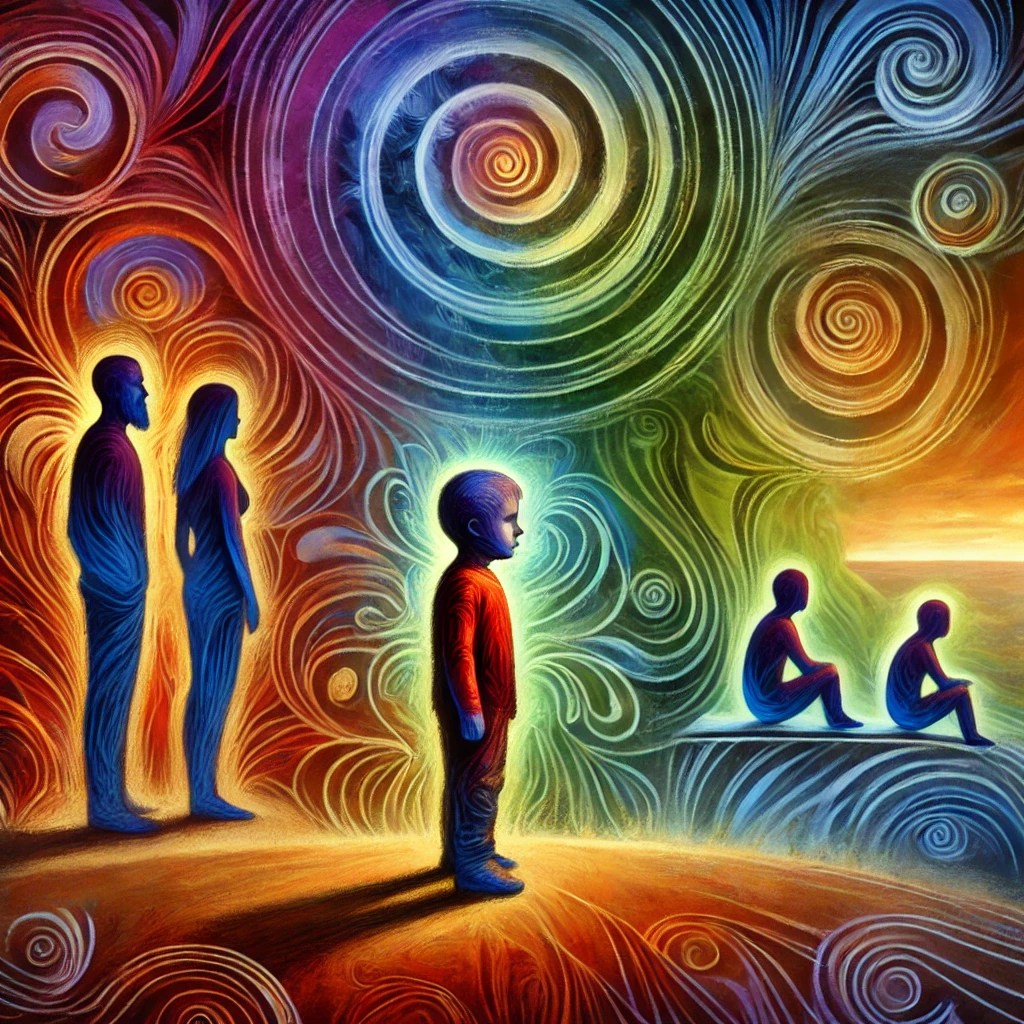
*
Shadows and Light of Defense Layers

Jungian and post-Jungian approaches to understanding defenses, particularly in the context of the psyche’s layered structure, can help us perceive the phenomenon of defense against trauma as a layered process, similar to an onion. This model reveals how a person confronts trauma, but also how these layers of defense are built and transformed in everyday life.
The first thing we encounter is the trauma itself — the central, deep inner core. Trauma, which can be primal and often unconscious, causes pain and destabilization. The psyche then, in an attempt to protect itself, creates a defense around that central layer. These defenses are not static; they evolve throughout life. Initially, they may be necessary and crucial for survival or functioning. However, as a person grows and faces new experiences, each new confrontation with the world leads to the formation of additional layers of defense. Thus, the initial trauma is buried deeper within the psyche, while the layers of defense accumulate.
In Jungian terminology, these defenses may be related to aspects of the Shadow, Animus/Anima, or other archetypes, as they represent unconscious structures that are part of both the personal and collective unconscious. They exist to protect us from further harm, but often, these layers become outdated, maladaptive, and block personal growth. Therefore, we often suffer not only from the trauma itself, but from the defenses we developed to protect ourselves from it. These defenses, once functional, can become obstacles that trap us in a pathological pattern.
As we progress through life and various stages of psychological development, we face new challenges that demand new defenses. These newer defenses often help to integrate the previous ones into our personality, allowing them to become part of who we are as whole beings. However, sometimes the process stalls, and we begin to suffer not from the trauma, but from the „stuck“ defense. This concept is akin to a psychological armor that prevents us from moving forward.
In a post-Jungian context, we can observe different approaches to working with defenses. Some therapists focus on „cosmetic“ solutions — removing the most recent symptom without delving into the deeper layers. Others search for the original trauma, attempting to unearth and integrate it. However, it may be necessary to unify both approaches: the light and dark sides of each defense, and a conscious understanding of the armor we have built around ourselves.
We must also recognize the functionality of these defenses at different stages of life. They had a purpose, and often they protected us. Gratitude toward these old, often inadequate but once life-saving defenses can be crucial. They sustained us, and their function was noble in the context of the time in which they arose. We need to thank them and ask them to protect us no longer. However, when new symptoms arise, we don’t always have to view them as regression or a return to old trauma. Often, they are signs that we are ready to uncover a new, deeper layer in the process of peeling back our defenses.
In the end, all these defenses function as a network. Each new defense has its place in this system, and each is connected to the previous ones. Personal growth requires the gradual uncovering of these layers, understanding the purpose of each, and developing the ability to integrate them into our being, so that they no longer act as barriers but as bridges toward deeper self-awareness.
This approach requires an integrative process, which involves understanding the light and dark sides of every defense, gradually reaching a place where trauma is no longer the center of our experience, but part of an integrated and enlightened self.
*
Insight is the moment when the Unconscious stops exerting pressure on the Conscious, the „equalization of osmotic pressure.“
Insight is a state where balance is achieved between two worlds, and the Unconscious no longer needs to push the Conscious to understand or accept something. At that moment, the Unconscious realizes that the Conscious has become fully aware of everything the Unconscious wanted to convey.
There are several reasons why the activated complex might stop being energized:
- Energy depletion: When there is no more energy to support the activity of the complex, the pressure decreases.
- The Conscious has understood the message: The Unconscious recognizes that the Conscious has understood everything it needed to understand.
- Pressure equalization: The pressure at the boundary between the Conscious and the Unconscious has equalized.
In this state, the Conscious no longer filters the Unconscious but allows it to enter and deliver a clear message that can be decoded. Insight is the moment of balancing at the boundaries, where the Unconscious no longer needs to push the Conscious.
When the Unconscious no longer demands anything from the Conscious, an osmotic state is reached, where the pressure is equalized and everything becomes calm.
*
The Foundation of Everything in the Universe: Relationship
In post-Jungian psychology, relationships are the foundation of our psychological reality. Carl Jung believed that our development and identity are formed through interactions with others and with our unconscious. „The meeting of two personalities is like the contact of two chemical substances: if there is any reaction, both are transformed,“ Jung said.
Our inner world, with its archetypes and unconscious processes, shapes how we relate to the external world. These relationships, in turn, shape our inner world, creating a dynamic interaction between the inner and outer. Recognizing this interdependence, we understand that relationships are essential for our existence and development.
Quantum physics provides scientific confirmation that everything in the universe is interconnected. At the quantum level, particles do not exist in isolation; they are entangled, where their properties depend on one another. Albert Einstein called this phenomenon „spooky action at a distance,“ pointing to the mysterious yet undeniable connection between particles.
This intrinsic interconnectedness supports the idea that the universe is woven with a network of relationships. Even the smallest particles do not exist alone but are defined by their relationships with other particles. This understanding helps us see that everything in the universe is part of a larger web of mutual relationships.
Philosophical traditions around the world affirm this idea of interdependence. In Eastern philosophies such as Buddhism and Taoism, the interconnectedness of all things is a fundamental principle. The Buddhist concept of „dependent origination“ states that all phenomena arise in dependence upon conditions and relationships.
Taoism, through the principle of wu wei (non-action), emphasizes the need to align with the natural flow of life. Laozi said, „When nothing is done, nothing is left undone.“ This teaches us to accept the relationships and interactions that shape our lives instead of resisting them, allowing us to harmonize with the natural rhythms of the world.
When life is difficult and full of challenges, recognizing and accepting relationships can be a path to finding inner peace. Here are some ways to apply this concept:
Acceptance of Interdependence
The first step is to accept that nothing exists on its own. Accepting interdependence can reduce feelings of isolation and loneliness. By recognizing that we are all part of a larger network of relationships, we can find comfort in the community and support of others.
Small Changes through Adaptation
Applying the concept of relationships, small changes in our approach and behavior can have a significant impact. Instead of forcing solutions, we can adapt to situations, allowing natural processes to flow and creating harmony through our interactions.
Meditation and Self-Reflection
Practicing meditation and self-reflection can help in recognizing and accepting our relationships. These practices allow us to connect with our inner world and recognize how our relationships with others shape our experiences.
Seeking and Giving Support
Seeking help and support from others is also part of accepting interdependence. Through the support of friends, family, or therapists, we can find the strength and wisdom to face difficult situations. At the same time, offering support to others strengthens our bonds and reminds us of the importance of relationships.
Focusing on Positive Aspects
Focusing on the positive aspects of our relationships and lives can help balance negative experiences. Recognizing and appreciating the small joys and beauties we encounter daily can help us connect with the world on a deeper level.
*
Symmetry CP in Cosmology and Jungian Psychology: An Integrated Exploration
Symmetry CP (Charge-Parity) in cosmology and the concepts of Jungian psychology seem, at first glance, to belong to entirely different domains. However, a deeper exploration reveals fascinating parallels between these fields. These analogies not only enhance our understanding of physical and psychological phenomena but also enrich our perception of the universe and the human psyche.
CP symmetry is a fundamental concept in particle physics. It combines two distinct symmetries: charge symmetry (C), which exchanges a particle with its antiparticle, and parity symmetry (P), which inverts spatial coordinates as in a mirror. In theory, the laws of physics should be invariant under this combination of symmetries. However, certain weak interactions show a violation of CP symmetry, a discovery that earned James Cronin and Val Fitch the Nobel Prize in Physics in 1980.
This violation of CP symmetry has profound implications, particularly for explaining the matter-antimatter asymmetry in the universe. According to the Big Bang model, matter and antimatter should have been created in equal amounts. Yet, the observable universe is dominated by matter. This asymmetry is essential for understanding why we exist, because if matter and antimatter had annihilated each other in equal quantities, virtually nothing of the current universe would remain.
In Jungian psychology, similar concepts of symmetry and symmetry breaking appear in the dynamics of complexes, the relationship between light and shadow, and the process of individuation. Complexes, for instance, are organized sets of emotions, thoughts, and memories, often unconscious, that influence behavior and can conflict with other complexes or aspects of the psyche. Just as the opposing charges of particles interact dynamically, psychological complexes possess an internal symmetry where positive and negative aspects coexist and interact. The breaking of this internal symmetry can lead to psychological tensions and conflicted behaviors, similar to CP symmetry breaking in physics.
The relationship between light and shadow in Jungian psychology is another example of symmetry and symmetry breaking. Light represents the conscious aspects of the psyche, while the shadow contains unconscious aspects, often repressed or ignored. Exploring and integrating the shadow can be seen as a psychological „symmetry breaking,“ where hidden aspects of the psyche are revealed, leading to profound personal transformations. This dynamic is analogous to how CP symmetry breaking in physics reveals fundamental asymmetries in nature.
The process of individuation, according to Jung, involves the development and integration of various aspects of the psyche over time. This process integrates experiences from different periods of life, creating a coherent understanding of oneself that transcends the linearity of conscious time. In the unconscious, time is often perceived as atemporal, allowing interactions between past, present, and future. This notion is analogous to temporal symmetry in physics, where laws should remain the same if time is reversed. Breaking this symmetry in physics has significant implications for our understanding of the universe, just as the non-linearity of time in the unconscious has implications for the individuation process.
These analogies between CP symmetry in cosmology and Jungian psychological concepts offer enriching perspectives on the internal dynamics of the psyche and cosmological phenomena. By linking charge to complexes, parity to the light-shadow dynamic, and time to the individuation process, we discover parallels that deepen our understanding of both fields. These connections reveal the inherent interconnectedness of all aspects of human knowledge, allowing a more holistic exploration of internal and external dynamics of our existence.
To further this exploration, it is useful to consider how violations of CP symmetry can be compared to psychological imbalances. In physics, CP violation is necessary to explain the matter-antimatter asymmetry, a phenomenon crucial for the existence of the universe as we know it. Similarly, in psychology, imbalances between complexes or between light and shadow can explain disruptive behaviors and experiences. These imbalances often require conscious integration to restore internal balance, akin to how physical theories seek to understand and explain fundamental asymmetries.
The concept of baryogenesis, where processes violating CP symmetry generate an excess of baryons over antibaryons, can be compared to the process of integrating complexes and shadow into the psyche. Baryogenesis requires specific conditions, such as baryon number violation, CP violation, and conditions out of thermal equilibrium. Similarly, integrating complexes and shadow into the psyche requires awareness, exploration of repressed aspects, and conditions conducive to personal transformation. Both processes are crucial for understanding the composition of the universe and the development of the psyche.
Current and future research in cosmology and particle physics continue to explore CP symmetry violation and its implications. Experiments on neutrinos, such as the T2K experiment in Japan, and studies of B meson decays at LHCb at CERN, aim to measure CP violation with greater precision. Similarly, cosmological observations, like those of the Cosmic Microwave Background (CMB) and temperature anisotropies, can provide clues about baryogenesis and CP violation in the early universe.
In Jungian psychology, similar approaches are used to explore and integrate repressed aspects of the psyche. Dream analysis, active imagination, and exploration of archetypes are methods employed to reveal and integrate complexes and shadow. These methods allow access to deeper levels of the psyche, facilitating the individuation process and the integration of diverse temporal experiences.
Analogies between CP symmetry in cosmology and Jungian psychological concepts reveal a profound interconnection between physical and psychological phenomena. These parallels enrich our understanding of internal and external dynamics, emphasizing the importance of integration and transformation in both fields. Exploring these analogies provides new perspectives on the nature of the universe and the human psyche, offering a more holistic and integrated vision of our existence.
Discoveries in cosmology and Jungian psychology continue to develop, offering new opportunities to explore these parallels and deepen our understanding. Future research in both fields promises to reveal even more connections and similarities, enriching our perception of reality and the human psyche. Integrating this knowledge allows us to better understand the complex dynamics that shape our universe and inner experience, paving the way for continued exploration and personal and collective transformation.
References
- Sakharov, A. D. (1967). „Violation of CP Invariance, C Asymmetry, and Baryon Asymmetry of the Universe.“
- Cronin, J., & Fitch, V. (1980). Nobel Prize in Physics.
- T2K Experiment, Japan.
- LHCb Collaboration, CERN.
- Jung, C. G. (1959). „The Archetypes and the Collective Unconscious.“ Princeton University Press.
- Jung, C. G. (1964). „Man and His Symbols.“ Dell Publishing.
- Von Franz, M.-L. (1970). „An Introduction to the Interpretation of Fairy Tales.“ Spring Publications.
- Neumann, E. (1954). „The Origins and History of Consciousness.“ Princeton University Press.
- „The Mandala in Jungian Depth Psychology and Tibetan Buddhist Tantra.“ SpringerLink.
- „Archetypal Cultural Psychology.“ SpringerLink.

*
Psyche Beyond the Speed Limit: Exploring the Conceptual Foundations
The notion that the psyche, or the mind, operates beyond the speed limits imposed by physical reality delves into speculative theories in both physics and metaphysical thought. These ideas propose that consciousness might not be bound by the same constraints as physical matter, allowing it to transcend the conventional limitations of space and time.
One compelling hypothesis is the existence of higher dimensions beyond our familiar three dimensions of space and one dimension of time. Some physicists suggest that consciousness might access or even exist in these higher dimensions, enabling it to operate beyond the speed limits of our universe. This idea resonates with the concept of tachyons, hypothetical particles that are proposed to travel faster than light. If consciousness could interact with or utilize such particles, it might achieve instantaneous information transfer, effectively bypassing the speed of light constraint.
Quantum entanglement offers another intriguing possibility. This phenomenon involves particles that remain interconnected regardless of the distance between them. If consciousness can engage with quantum states, it could potentially achieve non-local connections, allowing instantaneous communication or influence across vast distances. Such a mechanism might explain experiences of sudden insights, intuitions, or „gut feelings“ that seem to arise instantaneously, as the psyche could be accessing information or making connections beyond the constraints of linear time.
The implications of the psyche operating beyond physical speed limits are profound. One significant consequence is the potential for instantaneous thought and intuition. Experiences of sudden insights or intuitive knowledge could be manifestations of the psyche accessing information instantaneously, transcending the conventional constraints of time. This could also imply that consciousness is not confined to the brain or body but extends across space and time, explaining phenomena like telepathy, where thoughts or feelings are shared between individuals instantaneously.
Furthermore, the ability of the psyche to operate beyond speed limits suggests a deeper level of interconnectedness in the universe. It implies that all minds might be part of a greater, unified consciousness that transcends physical boundaries, fostering a profound sense of oneness and interconnectedness among all beings.
Heisenberg Cut and Waking Up: Bridging Consciousness and Quantum Mechanics
The Heisenberg cut, a concept from quantum mechanics, refers to the division between the quantum and classical worlds. It marks the boundary where quantum possibilities, or superpositions, collapse into a single, definite outcome due to observation or measurement. In the quantum realm, particles exist in a superposition of states, representing multiple possibilities simultaneously. However, upon measurement or observation, the wave function collapses, and the particle assumes a definite state.
This concept can be metaphorically extended to the boundary between consciousness and unconsciousness. During sleep, the unconscious mind might operate in a realm akin to quantum superposition, where multiple possibilities and narratives exist simultaneously. Waking up acts as a „measurement“ or observation, collapsing these possibilities into specific memories or experiences that are recalled. Upon awakening, the conscious mind filters and selects which dream content to bring into awareness, a process similar to the wave function collapse, where the vast array of unconscious possibilities is reduced to a coherent narrative that can be remembered and recounted.
The analogy between the Heisenberg cut and the boundary between consciousness and unconsciousness offers a framework for understanding how the psyche might interact with quantum processes. Just as an observer in quantum mechanics causes the wave function to collapse, the conscious mind might play a role in bringing unconscious content into conscious awareness. The unconscious mind could be thought of as existing in a state of superposition, where multiple thoughts, memories, and possibilities coexist. Consciousness then acts as the observer that brings specific elements of this superposition into focus.
This framework also suggests that unconscious processes might operate beyond the conventional constraints of time and space, influencing conscious experiences in ways that defy our usual understanding of causality. Such processes might explain phenomena like precognition, déjà vu, or other anomalous experiences, where events seem to be influenced by information from beyond the conventional flow of time.
Speculative Synthesis: A Unified Framework
Combining these ideas, we can speculate on a unified framework where consciousness, unconscious processes, and quantum mechanics interact in profound ways. The psyche, operating in higher dimensions or through mechanisms like tachyons, could transcend physical speed limits, allowing for instantaneous thought, intuition, and interconnectedness. The boundary between consciousness and unconsciousness, analogous to the Heisenberg cut, represents the transition from the superposition of unconscious possibilities to the definite outcomes of conscious awareness.
If consciousness plays a role in collapsing quantum possibilities, it suggests that our subjective experiences and the physical world are deeply interconnected. This perspective posits that consciousness actively shapes reality at a fundamental level, blurring the distinction between the observer and the observed. Such a view challenges our conventional understanding of reality and opens up new possibilities for exploring the nature of the psyche and its relationship with the physical universe.
This speculative synthesis offers a rich and intriguing framework for understanding the psyche beyond the speed limit. It suggests that consciousness might operate in realms beyond our conventional understanding of space and time, accessing information and making connections instantaneously. The analogy with the Heisenberg cut provides a metaphorical bridge between consciousness and quantum mechanics, offering insights into how the psyche might interact with quantum processes.
Ultimately, these ideas invite us to explore the profound interconnectedness of all things and the role of consciousness in shaping our reality. They challenge us to reconsider the boundaries of the psyche and the nature of our subjective experiences, opening up new avenues for understanding the mysteries of the mind and its place in the cosmos. As we continue to investigate these speculative theories, we may uncover deeper truths about the nature of consciousness and its relationship with the physical world, leading to a more comprehensive understanding of the psyche and its potential to transcend the speed limits of our universe.
*
Granular Consciousness or an Adhesive Vessel Full of Emptiness?
In modern philosophy and psychology, we often encounter the concept of the psyche as a vessel containing experiences, thoughts, and emotions. This concept, when expanded to include theories of quantum physics, the multiverse, and ancient philosophies, can help us better understand consciousness and the universe.
Bachelard, Roupnel, and Bergson provide different insights into the nature of time and consciousness. Gaston Bachelard, a French philosopher known for his works on poetry and science, believed that time is discontinuous, composed of moments or „instants.“ He argued that imagination plays a crucial role in transforming these moments into a meaningful narrative. His work on the poetics of imagination emphasizes how the psyche uses these moments to create a coherent story of itself and the world.
Gaston Roupnel, on the other hand, in his work „Siloe,“ highlights the significance of the moment in understanding time. For him, time is not a continuous flow but a series of discrete moments that shape our experience. This perspective supports the idea of a quantized universe where reality unfolds in discrete steps rather than in a continuous stream. Roupnel’s theory further inspired Bachelard’s views on the discontinuity of time.
Henri Bergson, known for his concept of duration (durée), advocated for a continuous flow of time that is essential for understanding consciousness and free will. However, even within this continuous model, it is possible to explore how discrete moments of experience contribute to the perception of duration. Bergson’s work provides a contrast but also a complement to Bachelard’s and Roupnel’s ideas, allowing us to see how continuous experience can be built from discrete events.
In quantum physics, the universe is understood as being composed of fundamental particles such as quarks and leptons, which interact through fundamental forces. These particles exist and interact in discrete quantities, which aligns with the concept of a quantized universe where time and space are also granular. For example, quantum field theory describes how particles are created and annihilated in quantum fields, leading to discrete events that shape reality.
Quantum mechanics, especially in the context of theories such as quantum holography, suggests that each part of the universe contains information about the whole, similar to a hologram. This idea resonates with Jung’s concept of the collective unconscious, which postulates a shared reservoir of memories and ideas across humanity. David Leong, in his work, compares quantum holography with Jung’s collective unconscious, suggesting that consciousness functions in a granular, interconnected manner.
The concept of emptiness (vide) is significant in various philosophical and spiritual traditions. In Buddhist philosophy, emptiness (Śūnyatā) refers to the idea that all phenomena lack inherent existence. This can be connected to the psyche as a vessel that lacks essence but is shaped by experiences and perceptions. In quantum theory, the vacuum state is not truly empty but filled with fluctuating energy and virtual particles. This aligns with the idea that the psyche, although it appears as an empty vessel, is dynamically filled with thoughts, emotions, and unconscious processes.
Giulio Tononi’s Integrated Information Theory (IIT) attempts to quantify consciousness and connects it with the complex interplay of neural activities, akin to quantum processes. IIT posits that consciousness arises from the integration of information within the brain, which describes the psyche as a vessel that integrates and contains complex informational patterns, giving rise to conscious experience.
Understanding the psyche as a vessel and its connection to emptiness has profound implications. Bachelard’s poetics emphasizes the role of imagination in filling the vessel of the psyche with creative and transformative images. This aligns with the idea that the psyche is not a passive container but an active participant in shaping reality. Existential and phenomenological philosophies explore the nature of existence and consciousness, often using metaphors of emptiness and fullness. The psyche as a vessel resonates with these themes, suggesting that our sense of self is continuously shaped by the interaction between emptiness and experience.
These different perspectives, when integrated, provide a comprehensive framework for understanding the universe as a quantized, interconnected system. Time, space, and consciousness are fundamentally granular and interconnected, with the psyche acting as a vessel navigating this reality. This synthesis enriches our understanding of both the physical universe and psychological experience, bridging ancient philosophical insights with contemporary scientific theories.
The integration of quantum mechanics and Jung’s psychology opens new pathways for understanding consciousness and the universe. For example, the idea that consciousness might be a quantum phenomenon, where the psyche acts as a vessel integrating quantum information, offers deep insights into the nature of consciousness. Quantum mechanics suggests that even fundamental physical processes are granular and discrete, which aligns with the idea that consciousness is also composed of discrete moments of experience.
*
When That Little Candle Goes Out
Sometimes there’s no more flame from within. It just went out. And all that remains is an unforgiving emptiness. It’s not the kind of emptiness where we feel miserable and used up and drained. No, it’s another kind of emptiness – the one where meaninglessness reigns. Simply put, nothing is funny anymore and nothing has any significance. Or, in some other „dimensional“ language, we’ve fallen out of sync with the world… The wave moves on, and we don’t follow.
Perhaps emptiness isn’t empty but rather the „place“ where not everyone is. That abyss you don’t enter. Simply because everyone is going in one direction and everything around is like that whiteness at the end of the movie „Cube“ – white deliverance into – nothingness. Most of us synchronize with the world in the vast majority of things, even if we don’t love the world: we eat, sleep, breathe. Choice of music or favorite pastimes aren’t the most important survival criteria. We oscillate with everyone in the great Superposition of Everything and move on. Left or right and the meaning just gets lost. Going back is impossible from the force of the Great Wave. And that loss of meaning, that’s the melancholic depression, that looking into the background of all existence and life, into the rear end of existence, when so much beauty is seen from the perspective of cosmic gods, and so much transient and worn out from the perspective of humans. To grasp the beauty of the process, rather than the results, the meaning in that very transient and tragic of those eternally boring gods of the universe, we must look at our oscillation. And when it starts spinning again, suddenly we’re back, in the Great Wave. Claustrophobia of belonging, anxiety of rejection – maybe those are exactly the essential archetypes: in and out, expansion and contraction – and the wisdom of meaning in between.
*
Soul Oscillations
No, it’s not anything esoteric or overly spiritual. Okay, maybe spiritual as much as metaphysics and psychotherapy are spiritual, but not more. Let’s look at the soul as the living essence within us, like the spark that is in each of us and connects us to the first spark of life. We cannot create life, we can transfer it, establish it, channel it, but we cannot make it out of nothing. It flows – that connection with that pouring, with that essential part within us, that soul that makes us alive, and that fragment colored precisely by our body. Does it oscillate differently? Is it like the psyche, consciousness, the collective unconscious and individual, without clear boundaries? Do we see it in dreams, does it flicker differently?
And again those boundaries. Where is the boundary between the Conscious and the Unconscious, in waking, in the transition from non-REM to REM sleep? Or in thoughts that gain words, that exist shaped into something?
When is the soul more ours than Anima Mundi, the soul of the world? How does that separate? Or does it not separate, do they exist alongside each other, because they are some other dimensions, incomprehensible to the human mind? We are part of something, and we often are that – and, again, the question, is there a boundary?
*
The birth of the psychopathological personality
„I love you when you’re unhealthy, I don’t love you when you become healthy. Stay unhealthy.“
This would roughly be the recipe for manifesting one’s psychopathic aspect towards others and how that Other, or when that Other grows up, uses the same traditional recipe to maintain psychopathy. Because psychopathy has its steady percentage in humanity, but always strives for more, either to conquer or to transmit.
The fear of a sick person getting well in the psychopathological personality can be associated with several factors and the dynamics of their psychopathology. It is important to note that each person may react differently, but here are several possible reasons that may contribute to this fear.
Firstly, psychopathological personalities often strive for control and power over others. When someone becomes healthy and overcomes their problems, the psychopathological personality may feel a loss of control over that person. This can trigger fear and anxiety in the psychopathological person because they feel insecure in the new dynamic.
Furthermore, psychopathological personalities may tend to exploit the weaknesses of others to satisfy their own needs. When a person recovers, they may become less vulnerable and less susceptible to manipulation, which can lead to fear in the psychopathological person.
Similarly, psychopathological personalities are individuals with social needs. They often struggle to develop healthy and emotionally fulfilling relationships. When someone recovers, they may start to distance themselves from the psychopathological person to avoid further abuse or exploitation. The fear of abandonment and the feeling of being left alone may be present in the psychopathological person.
The golden rule to „smell out“ psychopathy in the air is that psychopathological personalities often show a lack of empathy and understanding for others. When they see someone becoming healthy and happy, they may not be able to connect with those feelings and understand why someone would want to be healthy.
Paradoxically, the psychopathological person may feel inferior to someone who is healthy and successful. The sense of powerlessness and inferiority may trigger fear of recovery in the psychopathological person. Helping others, the so-called savior complex, or protector complex, may have crumbs (or chunks) of psychopathy within it. To act as a protector, we must have someone to protect.
And all of this is very resilient. All these traits help a person to survive, more or less. And it’s hard to fight against someone else’s survival. And that survival is actually the transfer from one generation to another. The only way is to stop, name it, and take the gift of free will to align that personal vibration with the harmonious and constructive instead of being lost in attempts to survive alone, against its organic carrier of that vibration.
*
Hatred consumes too much energy
We have this polarization, on one hand love-hate, on the other indifference. Then there’s a wide spectrum between love and hate. Finding a good balance between indifference towards everything, everyone, death, life, and feelings towards them is already a great achievement. Once we find the balance, there are oscillations, like the x-y axes, and everything is stable at zero. We’ve found a measure, we feel something, we walk along the x-axis. But y is what shows the direction, we move left, right, towards the center. We fluctuate depending on which graph is represented, which complex is activated. And it’s easiest when it’s stable. Love helps, but it brings instability, yet also progress, openness. Its advantage is that it’s often self-sufficient, if it’s genuine and self-recycles. Its downside is that it often neglects the left side, everything that it isn’t and doesn’t want to be. Hatred is more complicated. It’s aware of love and aware that its progress doesn’t go in the same direction. It can progress and move towards something new, but it increasingly distances itself from harmony and love. For love, which escapes and negates hatred, that part isn’t a problem (until all that neglect explodes if it goes too far to the right). For hatred, on the contrary, it’s difficult; it knows it’s further away from what it envies, and it further drains its energy for exploring where it is. Hatred is aware of the pain of wasting its own energy that could be used differently. It has advantages; it purifies what’s not right, it names things, but it must have limits, it must stop and introduce a constructive part in the dispersion of energy. And there’s love again. Love is constructive until it becomes consumption.
*
Gaia has a body
No matter how much we rely on the Anima Mundi, in the end, the body decides… Our body, our bodies, all of us, from tardigrades to sequoias, we all carry this world soul, or collective Conscious and Unconscious. And our mouths are full (especially mine;)) of spiritual entanglements, enigmas, spiritual aspirations; we seek the psyche to save us, and it is indeed active and important, but we forget that there is no world or psyche for us if there is no body. How much we neglect the body. Even orthorexics, whose mouths are full, to use the same illustration, of bodies, actually see that body as a tool of some unresolved and often dark complexes. The body as a subject, the body as something more than what keeps us alive, the body as a partner to the psyche, and not as something to be endured or sacrificed to (e.g., dieting) or to be appeased by giving it fine food just to prolong our psyche’s stay in this world. Perhaps we should see what the body wants, how much, what its limits are, its lifespan. Maybe before extending the Psyche, we should ask the Body what its telos is. Maybe the result will disappoint us because it’s not about our psyche, individually, but collectively. And perhaps the body is part of Gaia-Body, one of many in the system that is above and around us.
*
We are all necessary
Every birth, every death, every existence, even if measured in days. Everyone is a part of life. Life can renew itself only if it’s fragmented. Eternity is not life; it can only be if there’s also non-eternity. Is life then Consciousness? Or is the Unconscious possible even before existence, before the awakening of Consciousness? Panpsychic theories say that Consciousness exists from the first moment, in everything, in the inorganic as well as the organic. Perhaps, but Consciousness that accompanies Life is different. Even if panpsychic theories are correct, Consciousness in the organic that lives, moves, interacts would have different challenges ahead. Something that the Unconscious can observe over eons, nebulae, cosmic oscillations, and gravitational vortices, here, in our small life, happens on a smaller scale but very intensely. Perhaps for the Unconscious, which has no concept of linear time more than any other concept, because the Unconscious is atemporal, all these moments seem similar, but for the Conscious, they have different scales. The Unconscious, the inorganic, the lifeless, all of that is in some dance of its own, which may also have within it some inorganic Consciousness with different temporal coordinates and measurement systems than for living beings. Conscious and Unconscious, like inorganic and organic, nonliving and living, intersect in some liminal spectrum. There is Change. There is the One, the all, and there are the parts that make it up. Perhaps astral bodies, cosmic vibrations, and black holes have their own Consciousness. They are full of changes. There is a world, a universe, and all its hardware. There is this cosmos as a whole, and every part affects every other part. We all exist, all living beings, and there is something that surrounds us, the entire ecosystem, perhaps Gaia?, which is there and which makes up every bit of us. Every ant, every microbe, every cell matters. We all complement each other, with our deaths, our life juices, our ideas, our dreams.
*
Perhaps it’s not eco-anxiety but rather Zeitgeist anxiety?
Maybe we’re calling it all wrong: eco-anxiety, eco-emotions, but, in fact, people are afraid of the current state of the world, the current order. Perhaps it’s the fear of the present, of the world that we are, that we create, that we cannot control. Maybe we’re afraid that we’ve actually done all of this. It’s so much easier to project. It’s easier to say that someone else made the world bad. And we are that world. We vote, we exist, we think, we do things. Can we do differently? Surely, yes. Do we want to? I don’t know. Maybe not. Perhaps this is what we want because we’re bitter. So much has happened that we didn’t want. There are too many of us and the opinions that are being circulated don’t represent us the best. What next? It’s hard to answer. However, bitterness doesn’t help. In the end, hatred consumes too much. Too much energy. Too many activated complexes. Maybe there’s no answer, but there are names for what we feel. And it wouldn’t be bad to name it, feel it, process it, relate to it. Because that’s what makes us human beings, that conscious relationship with the Other and with ourselves, that Consciousness that cannot be taken away from us. Maybe we’re angry, mad, frustrated, many of us, we don’t see a solution, but, again, there’s a name for that anxiety, and where there’s a name, there’s a solution. Because a name is human. And everything human can be explained, metabolized, and prepared for what’s to come.
*
Gravity and Expansion, the Birth of Archetypes
What are the first archetypes? Those archetypes, that great undefined something that we cannot grasp, and the furthest we can reach is an indirect image, the so-called archetypal image? The first, the one that is like DNA or the atom to our psyche, the basis upon which we think, feel, connect, and become conscious? The building material of our immaterial!
What came first? Nothing, and then something. And that nothing became something through expansion. And that something did not scatter but held together, that is, through gravity. Expansion and contraction, moving outward, moving inward, the first two forces, the first two movements. Are these the first two archetypes, the two most basic forces, the foundation of polarization and our destiny? Is it so difficult to find the middle ground because we struggle to find something between those two forces that alternate enantiodromically? Is that the task and purpose of Consciousness, to find the middle ground?
*
And we are quantum to someone, perhaps
In our macro-universe, we behave according to the principles of Newtonian classical physics. Quantum physics is for the micro-universe, the tiny one that cannot be observed with the naked eye. In the quantum realm, we speak of probability, we speak of waves, of clouds of possibilities, we speak of vast emptiness and only occasional existence. And the way that existence moves determines everything. So far from us, yet so significant for everything that we are. But, are we also to some other perspective, a view from some much larger dimension, just as tiny that we are quantum and our existence is merely a part of the void in which we are. Are we a cluster in the emptiness of the universe?
*
With what prescription does our psyche see the world?
Do we see ourselves correctly? Correctly in this case has nothing to do with ethos, but rather with a somewhat accurate picture of ourselves in relation to the world. The world exists as a whole, a combination of many individuals, like a gestalt. In relation to that whole, we are the Other. That world in relation to us is the Other. This is one of the first relationships we discover after birth. We see that Other as a reflection of ourselves. Sometimes we don’t want that reflection; it’s not what we want to project from ourselves. Sometimes there are issues in transmission, sometimes in the reflection itself, sometimes in the template. And sometimes, we don’t see the communication adequately. We have a prescription. Everything is magnified or diminished or loses its three-dimensionality. In other words, we see through our personal filters. And those filters are okay; they are ours, and therefore they make sense and mean something, but at the same time, they reflect our inner processes, our activated Jungian complexes. They are our truth, relative truth, but perhaps not absolute truth (does it even exist? That’s a big question… and we’re not seeking an exact answer but an approximation). Perhaps it’s perfectly okay to realize that we need help, some kind of glasses. Perhaps we can find a way to sharpen our vision, to make the contours of everything clearer, to find a better distance (closeness) from the Other. Sometimes those glasses are antidepressants, sometimes it’s meditation that distances, sometimes it’s grounding that brings closer. What is common to all methods is consenting to an „ophthalmological examination,“ accepting the adjustment of the „prescription.“
*
The First Archetypes – Are They Born with the Big Bang?
Gravity could be seen as the archetype of connectivity, attraction, and integration. In the physical world, gravity is the force that binds the cosmos, pulling scattered elements into coherent structures—galaxies, stars, planets. It represents the merging of different parts into a whole, much like Jung’s process of individuation where fragmented aspects of the self are recognized and integrated.
Psychologically, gravity could symbolize the deeply rooted human need for relationships and belonging. It resonates with the idea of Eros, the principle of connectivity in Jung’s thought—our innate drive for psychological and emotional connectedness and attraction to the collective unconscious.
On the other hand, expansion may represent the archetype of exploration, individuation, and creation. In cosmology, the universe is in constant expansion, pushing boundaries and creating space for new possibilities. This reflects Jung’s concept of the journey of the self toward individuation and the expansive nature of personal growth and exploration.
This archetype could also encompass the idea of the principle of entropy in thermodynamics, where systems tend toward disorder and diversity. Psychologically, this aligns with the need for differentiation, moving beyond collective norms and values toward the development of personal consciousness and a unique identity.
In Jungian thought, the self is realized through the tension and reconciliation of opposites. Thus, gravity and expansion could represent this dynamic play—how we as individuals seek to connect and integrate with a larger whole (gravity) while simultaneously affirming our unique identity and pushing our boundaries (expansion). They could symbolize the balance between collective unconsciousness and personal consciousness, between being drawn by common human experiences and narratives and pushing toward our own unique destiny and creative potential.
These archetypes can be understood not only as psychological but also as cosmological principles governing the narrative of the universe, as well as the narrative of the human psyche. By identifying with these forces, it can be argued that the human spirit plays out the drama of the cosmos on the inner stage.
The moment of the Big Bang can be seen as a metaphor for the birth of consciousness—from singularity comes multiplicity, just as the psyche, from undifferentiated unconsciousness, prompts the diversity of conscious experiences. The interaction of gravity and expansion that follows can be compared to the development of the ego and the unconscious forces that shape it.
There is so much that could lead us to think that panpsychism might be a quite plausible idea, of course, if we do not consider consciousness only from the human perspective.
*
Surrender, as a Path to Liberation: Exploring the Paradox of Disobedience in Distinguishing Positive from Negative Femininity, Inspired by the Work of Marion Woodman
In the complex landscape of human psychology and the dynamics of gender roles, the concept of submission occupies a unique and paradoxical position. Submission, often misunderstood as obedience, is a complex and multidimensional phenomenon that plays a crucial role in understanding femininity. Therefore, it is necessary to explore why submission should not be equated with obedience, emphasizing its significance in distinguishing positive from negative femininity. By dissecting the nuances of submission, the goal is to shed light on its profound implications for personal development, empowerment, and the evolution of gender roles.
Submission, at its core, refers to the act of yielding or surrendering, but it is crucial to distinguish it from obedience. Obedience implies unquestioningly adhering to external authority, often stemming from fear or coercion. Submission, on the other hand, represents a deeply personal and conscious choice that arises from inner wisdom, a willingness to let go, and a sense of trust in the unfolding of life processes. It is not submission to external forces but rather alignment with one’s authentic being. Marion Woodman, drawing upon her rich knowledge of Jungian psychology and her experience as a therapist, provides profound insights into the concept of submission. She argues that submission is an essential part of feminine psychology, offering a path to wholeness and self-realization. Woodman’s perspective highlights the significance of submission as a means of reclaiming and integrating aspects of oneself that have been suppressed or denied. To understand why submission should not be conflated with obedience, it is important to embrace the paradox contained within this distinction. Obedience, as mentioned earlier, often involves relinquishing personal agency and autonomy in favor of external authority. In contrast, disobedience within the framework of submission entails rejecting blind adherence to societal or patriarchal norms that suppress authentic femininity. It is a conscious act of resistance against forces that seek to control and limit the expression of femininity.
Marion Woodman’s work emphasizes the transformative power of disobedience within submission. She argues that true submission requires rejecting patriarchal paradigms that have historically constrained women and stifled their authentic expression. Disobedience, in this context, becomes a radical act of liberation, reclaiming one’s voice, desires, and agency. To understand the significance of submission in distinguishing positive from negative femininity, we must first define these concepts. Positive femininity represents an authentic, empowered, and self-aware expression of femininity. It encompasses qualities such as intuition, empathy, nurturing, and creativity, contributing to personal growth and the well-being of society. Negative femininity, on the other hand, reflects distorted and suppressed aspects of femininity. It is often characterized by submissiveness, self-sacrifice, passivity, and a sense of helplessness. Negative femininity arises when societal pressures and patriarchal expectations compel women to adhere to prescribed roles and suppress their true selves. Submission, as Woodman contends, serves as a transformative bridge from negative to positive femininity. Through a conscious act of submission, women can liberate themselves from the shackles of societal expectations, shed layers of negative femininity, and embrace their authentic beings. In this context, submission becomes a profound form of self-love and self-acceptance.
One of the key reasons why submission should not be equated with obedience lies in its role as a tool for self-discovery and self-dedication. Submission involves a deep introspective journey into one’s inner landscape, a process of discovering and embracing one’s authentic self. It is a courageous act that requires confronting fears, vulnerabilities, and insecurities. Marion Woodman’s work highlights the therapeutic potential of submission as a means of self-discovery. Through submission, women can access their inner wisdom, connect with their intuitive abilities, and develop a deep understanding of their desires and aspirations. This self-discovery is a crucial step in distinguishing positive from negative femininity, as it allows women to reject societal expectations and embrace their unique essence.
The dynamics of submission extend beyond the individual level and enter the realm of relationships. In healthy relationships, submission is a mutual process that involves mutual trust and vulnerability. It is not about domination or subordination but rather two individuals coming together in a harmonious dance of giving and receiving. Woodman’s insights into submission in the context of relationships emphasize the importance of maintaining boundaries while allowing for emotional intimacy. In patriarchal society, women are often conditioned to be overly accommodating and self-sacrificing, leading to the suppression of their own needs and desires. Submission, when understood as a conscious choice, enables women to strike a balance between nurturing their relationships and preserving their autonomy.
Another key aspect of the significance of submission in distinguishing positive from negative femininity is its role in the healing process. Many women carry deep wounds and traumas stemming from societal expectations, experiences of objectification, and the suppression of their true selves. Submission provides a path to healing by allowing these wounds to surface, be acknowledged, and ultimately transformed. Marion Woodman’s work highlights the therapeutic potential of submission as a means of healing these wounds. Through submission, women can access their deep-seated pain, anger, and sorrow that have been deeply suppressed and begin the journey of self-healing and self-dedication. This healing process is crucial for shedding layers of negative femininity and reclaiming one’s authentic power.
The relevance of submission in distinguishing positive from negative femininity extends beyond the individual and interpersonal levels to cultural and societal dimensions. In a world where patriarchal values and structures still exist, submission offers a powerful counterpoint. It challenges the status quo by encouraging women to resist conformity, embrace their authenticity, and redefine their roles in society. Marion Woodman’s work is evidence of the cultural relevance of submission. Her writings and teachings have inspired numerous women to question societal norms, challenge oppressive systems, and reclaim their voices. In this context, submission becomes a form of activism, a way to dismantle patriarchal constructs that perpetuate negative femininity.
Submission is not limited to the realm of psychology and the dynamics of gender roles; it also has profound spiritual significance. Many spiritual traditions emphasize the importance of submission as a means of transcending the ego and connecting with higher, universal consciousness. Marion Woodman’s exploration of submission aligns with this spiritual perspective. She sees submission as a spiritual journey that leads to a deeper connection with the divine and a sense of unity with the universe. In this context, submission is not about obedience to God but rather surrendering the ego and false self to uncover a deeper spiritual truth.
Therefore, the distinction between submission and obedience is crucial in distinguishing positive from negative femininity. Marion Woodman’s work has illuminated the transformative power of submission as a conscious choice that empowers women to reclaim their authentic selves, heal deep wounds, and challenge societal norms. Submission, at its core, represents a path to self-discovery, self-dedication, and liberation from the shackles of negative femininity. Submission is not about blind adherence or obedience; it is a courageous act of disobedience that challenges oppressive systems and societal expectations. It is a journey that leads to the integration of the authentic self, nurturing healthy relationships, and healing deep wounds. Ultimately, submission is a powerful tool for personal growth and the evolution of gender roles, offering a path to positive femininity that celebrates the full expression of the feminine spirit.
*
A bit about Jean Gebser, of course through a Jungian lens
Jean Gebser (1905-1973) was a Swiss philosopher known for his research on structures of consciousness and the evolution of the human mind. His most famous work is the book „The Ever-Present Origin,“ in which he developed a theory of consciousness evolution through different historical epochs or „structures of consciousness.“
Here are some key concepts and conclusions from Gebser’s work:
Structures of consciousness: Gebser developed a theory of five different „structures of consciousness“ that evolved throughout the history of human culture. These structures are archaic, magical, mythical, mental, and integral. Each of these structures has specific characteristics, modes of thinking, and perceptions of the world.
Integral structure: Gebser’s „integral structure“ of consciousness represents the highest level of consciousness development. In this structure, humans become capable of holistic thinking that transcends rationality. It is a state in which the boundaries between individuals, time, and space begin to dissolve, allowing for a deeper understanding of interconnectedness.
The dialectic of aperspectivity: Gebser believes that all structures of consciousness overlap and are present simultaneously. This means that at any moment in historical development, traces of all structures of consciousness can be recognized. This is called the „dialectic of aperspectivity,“ suggesting that there is no linear progress, but rather all structures are present in the present time.
Desacralization and resacralization: Gebser observes that throughout historical development, human consciousness has changed in relation to the experience of holiness. In earlier structures, holiness was deeply rooted in everyday life, while in the modern era, there has been „desacralization“ and a loss of that deep connection. Gebser sees the possibility of „resacralization“ through the integral structure, where the connection between holiness and everyday life is reestablished.
Archetypal code: Gebser explored the presence of the archetypal code in all structures of consciousness. He sees archetypes as fundamental patterns underlying human experience, appearing throughout different epochs of human history.
Jean Gebser and Carl Gustav Jung have similarities in their approaches to understanding human consciousness, but they also differ in their emphases and focuses. Here’s how their concepts overlap and differ:
Similarities:
Archetypes and the deep structure of the mind: Both Gebser and Jung recognize the importance of archetypal patterns and deep structures of the mind. Jung is known for his concepts such as archetypes and the collective unconscious, while Gebser explores the evolution of consciousness through different „structures of consciousness,“ which are essentially deeper archetypal patterns that human consciousness goes through in different epochs.
Evolutionary approach: Both authors deal with the development of consciousness over time. Gebser considers how structures of consciousness evolve throughout history, while Jung reflects on the evolution of consciousness through individuation, the process of finding one’s own unique personality.
The importance of deeper understanding: Both Gebser and Jung recognize the need for a deeper understanding of human nature, reality, and the connections between different aspects of life. Both explore the connections between the material and spiritual worlds.
Differences:
Focus on individuation: Jung specifically focuses on the process of individuation, where the individual strives to integrate their different aspects and archetypal patterns to achieve inner harmony and authenticity. Gebser, on the other hand, focuses on the development of consciousness through epochs and structures of consciousness that have evolved throughout history.
Structures of consciousness vs. psychological concepts: Gebser focuses more on structures of consciousness and the evolution of human thought, while Jung deals more with deep psychological concepts such as the unconscious, complexes, anima, and animus.
Attitude towards spirituality: Gebser explores the relationship between science and spirituality through his concept of transdisciplinarity, while Jung explores the connections between the psyche and spirituality through archetypal symbols and mythology.
Robert Mitchell, an American Jungian, wrote about their connections and similarities, as well as the benefits of Gebser’s (and Jung’s) teachings on education and children’s education. Here is Robert’s lecture on the topic (in English): https://www.youtube.com/watch?v=0cmGZ1iRmwc
*
The Right Moment – Who Decides When Waiting Is Over?
Psychotherapists often face the dilemma of when the right moment is to intervene and say something to their patient. The decision of when and how to react can have a significant impact on the therapy process and the well-being of the patient. And it’s not easy at all. Spontaneity with intuition is always the best approach, but in an intellectual-emotional-physical work with patients like psychotherapy, reason can contaminate that spontaneity.
Key principles that psychotherapists often consider when „they have to think because spontaneity has dissipated for some reason (time, relationship, external circumstances, urgency)“ are:
Empathy and assertiveness: Psychotherapists must be empathetic towards patients, understand their needs and feelings, but at the same time, they must be assertive in their approach. If they sense that the patient is ready for certain realizations or changes, it may, and often must, be ethically correct to address them, even if it might be difficult for the patient.
Following the patient’s pace: Every patient has their rhythm in the therapeutic process. It is ethically important to respect that rhythm and not to force too rapid changes or interventions that the patient is not ready to accept. The therapist’s kairos must synchronize with the chronos of the relationship and the potential kairos of the patient. Patience and careful listening are crucial in deciding when the right moment for action is.
Therapist self-awareness: Psychotherapists should be aware of their motives for intervening. If they feel they want to say something to the patient because of their personal needs or frustrations, it could compromise the ethical aspect of therapy (and it’s also quite narcissistic, which is also human, but it’s up to the therapist to recognize the source, modality, and goal of that awakened narcissism at that moment). Being aware of one’s motives is crucial before making a decision on intervention.
Building a relationship (this may be the first, or even the zero criterion): A thorough and confidential relationship between the therapist and the patient is the foundation of successful therapy. Before deciding on a key intervention, it is important to ensure that the relationship is sufficiently developed and safe for such communication. Are we in a state of con-fiance (with mutual trust, because trust is always mutual, never just one-on-one (then we talk about belief or faith))?
When it comes to the question of whether it is ethical to wait a long time for patient activation, there is no simple answer. The time required for intervention varies from case to case and depends on the complexity of the patient’s problem, their reactions to therapy, and other factors. Psychotherapists need to balance between waiting for the right moment and recognizing opportunities when action is needed. However, the golden rule is: never lie to the patient, as soon as the moment arises, seize it, as soon as the question is asked, answer honestly. Never, absolutely never risk the collapse of trust and alliance.
*
Brain reserve
The concept of brain reserve refers to the brain’s ability to withstand damage or pathology while maintaining normal cognitive functioning. It is believed that individuals with greater brain reserve have a better ability to resist the effects of age-related cognitive decline or neurological diseases, such as Alzheimer’s disease. The concept of brain reserve suggests that certain factors, such as cognitive activities, level of education, complexity of occupation, and social engagement, contribute to the brain’s ability to build a reserve of neuronal connections and cognitive abilities. When the brain encounters damage or diseases, individuals with greater brain reserve can compensate for the damage by using alternative neuronal pathways or cognitive strategies, thus delaying the onset of noticeable cognitive impairment. For example, a person who engages in lifelong learning, regularly challenges their brain through activities such as puzzles or games, and maintains an active social environment may develop a greater brain reserve. This reserve can potentially help them better cope with the effects of aging or neurological disorders.
Although Jung himself did not explicitly address the concept of brain reserve, it is possible to explore the concept through a Jungian lens by considering some of his key concepts:
Individuation:
Jung believed in the process of individuation, which involves the integration and harmonization of different aspects of the psyche. This process leads to a more complete and mature personality. From the perspective of brain reserve, engaging in activities that promote individuation can be seen as contributing to greater cognitive and emotional reserve. These activities may include exploring one’s own unconscious through dreams, creative expression, and self-reflection.
Archetypes and symbolism:
Jung proposed the existence of universal symbols and themes, known as archetypes, which are present in the collective unconscious. These archetypes influence human behavior and experiences. From the perspective of brain reserve, engaging with archetypal themes through art, literature, and cultural practices can stimulate the brain and contribute to cognitive flexibility and adaptability.
Complexes:
Jung introduced the concept of complexes, emotionally charged patterns of thought, memories, and perceptions that can influence behavior. By becoming aware of and integrating these complexes, individuals can develop greater self-regulation and resilience. In the context of brain reserve, managing and understanding one’s complexes can contribute to emotional well-being and cognitive adaptability.
Active imagination:
Jung proposed the technique of active imagination, a process in which individuals communicate with their unconscious through creative visualization and dialogue. Engaging in active imagination exercises can be considered mental training that contributes to brain reserve by stimulating neuronal plasticity and creative thinking.
Shadow work:
In Jungian terms, the shadow refers to the hidden and often less desirable aspects of the personality. Integrating the shadow involves acknowledging and integrating these aspects rather than repressing them. This process can enhance brain reserve by promoting emotional regulation and reducing cognitive rigidity.
In essence, from a Jungian perspective, engaging in activities that facilitate personal growth, self-awareness, and the integration of the psyche can contribute to the development of cognitive and emotional reserve. By nurturing a deep connection with the inner self and exploring the rich landscape of the unconscious mind, individuals can enhance their ability to adapt, learn, and cope with the challenges that come with aging and neurological changes.
*
The Dance of Psychic Energies: Jungian and Post-Jungian Perspective
At the heart of our interpersonal interactions, there is a constant subtle exchange of psychic energy. Like invisible dancers, we engage in a complex emotional choreography, based on the idea that we can draw from the inner riches of others while respecting the boundaries of each individual. This idea, deeply rooted in Jung’s teachings and expanded upon by post-Jungian thinkers such as Hillman, Marion Woodman, and Edinger, offers an exciting perspective on how we can interact in a balanced and enriching manner. Regarding the topic of psychic energies, Edinger emphasized the importance of individuation, which is the process of realizing the potential of personality through understanding and integrating unconscious aspects of the psyche. This is crucial for understanding how interpersonal interactions unfold from the perspective of developed personality. Hillman was known for his work in the field of archetypal psychology. He emphasized that psychic energies manifest through different archetypal patterns and complexes. Hillman promoted a deep understanding of people’s inner worlds, including the „soul“ of things and phenomena. Regarding interpersonal interactions, Hillman stressed the importance of subtle and profound aspects that each person brings to the relationship. In the early post-Jungian period, Marion Woodman emphasized the importance of the feminine aspect of the psyche and feminine archetypal patterns. Her work focused on interpreting psychic energy through the lens of feminine individuation and psychosomatic experiences. Her analyses of deep psychological processes that occur through the body and mind contribute to understanding interpersonal relationships.
In this dance of psychic energies, it is crucial to understand the fundamental concept of emotional reciprocity. Just as we cannot constantly draw water from a well without depleting it, we also cannot continuously take psychic energy from others without the risk of frustration and disappointment. This simple but profound truth stems from Jung’s teachings, who emphasized the importance of self-awareness and mutual understanding in our interactions. If we demand more than others can give, we risk disrupting the subtle harmony of the dance and creating unnecessary tensions.
On the other hand, we also have a responsibility to provide others with what they need and what we can give without exhausting our own resources in the process. This is where post-Jungian wisdom comes into play, personified through Jungian thinkers. They expanded Jung’s vision by emphasizing the need to maintain a balanced relationship with our own inner energies. For example, Hillman explored the multiplicity of archetypes and complexes that exist within us, emphasizing that each aspect of our psyche has its role in the interpersonal dance.
The idea of transcending this dance of psychic energies lies in the ability to develop a sharp awareness of our own needs and the boundaries of others. Emotional reciprocity, illuminated by Jung’s teachings and deepened by post-Jungian thinkers, encourages us to create nurturing and fulfilling relationships. This subtle dance is not only an individual matter but also shapes the texture of our communities and society as a whole.
… or in simpler terms:
Take from people what they can give you, no more, because they will be frustrated that they cannot or hurt that you ask, and you disappointed; also, give people what they can accept and what you have enough of, no more than what you have, because you will (lose) yourself in something that is no longer a gift. Don’t eat what isn’t eatable. Don’t give others to eat if you don’t have enough for your basic needs.
A sincere psychic transaction, without shame in it.
*
How would the world look if it were composed according to Jungian principles of the psyche?
Jungian psychology offers very exciting perspectives on how the world and society might look if guided by its principles. What might the world look like if society were shaped according to the concepts developed by Jung?
Here are a few „amendments“ :):
Versatility and Integration
Jung emphasized the importance of integrating all aspects of the personality, including unconscious parts. Similarly, society would focus on understanding and integrating different cultures, religions, and values. This would lead to the richness of diversity, as well as the creation of a harmonious environment in which differences would be appreciated and mutually supported.
Self-awareness and Personal Growth
The central idea in Jungian psychology is the process of self-awareness and personal growth. In a society based on these principles, education would focus not only on academic skills but also on the development of emotional intelligence, versatility, and a deeper understanding of oneself. This would support individuals in becoming aware of their potentials and realizing them in a positive way.
Archetypal Thinking
Jung spoke of archetypal patterns present in the unconscious mind of all people. Society would rely on these archetypes to shape its culture, art, and institutions. For example, values such as courage, wisdom, and compassion would be promoted through various aspects of society, rather than exclusively patriarchal or yang principles.
Balance of Masculine and Feminine Principle
Jung emphasized the importance of balancing the masculine and feminine aspects in each person. In a society based on these principles, the roles of men and women would not be strictly defined, but rather supported to express their natural qualities without limitations. This would contribute to greater understanding and collaboration between genders.
Individuation and Collective Consciousness
Jung believed in the process of individuation, where a person achieves their unique potential. In a society based on these principles, freedom of expression and the search for one’s personal meaning would be supported. At the same time, collective consciousness would develop through sharing experiences and common values, creating a connected global community.
Although shaping the world according to Jungian principles of the psyche is a complex task, this vision offers an inspiring picture of a society that focuses on inner growth, deep understanding of oneself and others, and harmonious collaboration between different aspects of human nature. Integrating these principles into the real world would require continuous efforts at the individual level, educational systems, and broader society to achieve this vision of a harmonious society.
Perhaps the true title of this blog could be: Enterprise Utopia…
*
Horror vacui
„Horror vacui“ is a Latin expression that refers to the fear of emptiness or lack, often used in the context of art and design to describe the tendency to fill every surface with patterns or details, often at the expense of space and balance. This expression can also be a metaphor for internal consumerism or the constant need to fill life with material things or experiences to avoid emptiness or lack.
Jung’s theory of individuation, the process of personal development that aims to achieve wholeness and integrate different aspects of personality, can be fluidly connected to „horror vacui.“
Jung explored the deeper layers of the unconscious mind and believed that symbols and archetypes were key to understanding that part of psychology. „Horror vacui“ can be analogous to the fear of internal emptiness or lack, which can also translate into inner emptiness or conflict in the unconscious mind. This fear of emptiness can manifest through deeper psychological patterns and symbols indicating a lack of wholeness.
The process of individuation in Jungian psychology aims to integrate opposing aspects of personality, both light and dark. This can be connected to the fear of emptiness or „horror vacui“ through the integration of these inner conflicts. Instead of avoiding emptiness or conflict, the Jungian approach encourages individuals to explore deeper aspects of their personality, including those that may have been suppressed or ignored.
Jung emphasized the importance of archetypal symbols, which represent universal ideas and motifs. The fear of emptiness or „horror vacui“ can be expressed through archetypal symbols such as the „Shadow“ (hidden and denied aspects of personality) or the „Anima/Animus“ (inner male or female principle, yin and yang, give and receive). Working on integrating these symbols can help individuals overcome fear and find deeper meaning in their lives.
Jung supported deep introspective exploration and active confrontation with unconscious content to achieve personal transformation. Instead of avoiding internal fear or emptiness, the Jungian approach encourages individuals to engage in a deeper process of self-exploration to understand inner conflicts and find deeper meaning.
Care is always there, provided we are whole with all our parts and aware of our connection to the nature (world) around us…
*
About Jungian Psychology and Taoism, and a bit about Gnosticism
The connection between Jungian psychology and Taoism arises from similarities in certain concepts and ideas concerning individuation, deeper spiritual connection, and balance. Analytical psychology, developed by Carl Gustav Jung, explores the deeper layers of the human psyche, and its ideas can be linked to Taoist concepts in several ways:
Individuation and Taoist self-realization: Jung developed the concept of individuation, the process through which an individual achieves wholeness and develops their unique personality. Taoism also promotes the idea of self-realization, where the individual seeks to find their inner path and achieve balance between opposites. This similarity indicates a deeper connection between Jungian psychology and Taoism when it comes to achieving inner balance and authenticity. Archetypal similarities: Jung explored archetypes, universal symbols and patterns present in the collective unconscious. Taoism also contains a rich symbolic world and archetypal representations, such as the symbols of Yin and Yang or the five elements. These similarities point to parallels between deep universal symbols present in both traditions. Balance and transformation: Jung emphasized the importance of balance between opposites as crucial to personal development. Taoism also emphasizes the importance of balance between opposites, such as Yin and Yang, to achieve harmony and transformation. Both approaches highlight the process of transformation as a path to inner development. Light and shadow: Jung spoke of the concept of the „shadow,“ hidden and unrecognized aspects of personality. Taoism also includes the idea that opposites such as light and shadow exist within each individual and that it is important to accept both sides to achieve wholeness. Spiritual connection and transcendent aspects: Taoism emphasizes spiritual connection with the universe and seeks to achieve transcendent states of consciousness. These aspects are related to Jung’s exploration of the spiritual dimensions of the human psyche and the search for deeper meaning. Sometimes there is an incredible similarity in concepts, especially when reading the „Tao Te Ching“ translated by Stephen Mitchell.
Similarly, we can see similarities when we add Gnosticism to this „game“ of comparisons:
Gnosticism, Jungian psychology, and Taoism are three different spiritual and philosophical traditions that can be connected through some common themes and concepts, although they have their specificities. Here’s how these three traditions can be connected:
Deep spiritual insights: Gnosticism, Jungian psychology, and Taoism all promote a deeper understanding of the inner world and spiritual dimensions. Gnostics sought knowledge of higher truths beyond the material world, while Jungian psychology explored the depths of the unconscious to achieve individuation. Taoism also encourages deep introspective insight to achieve harmony with the Tao, the universal principle. Duality and integration: Gnosticism often emphasizes the duality between the material world and the spiritual reality, focusing on liberating the soul from material bondage. Jungian psychology explores the duality between light and shadow in the human psyche, striving for integration of these aspects to achieve inner balance. Taoism also uses dual concepts such as Yin and Yang to illustrate the balance between opposites. Transcendence and inner transformation: All three teachings explore the path to inner transformation and transcendence of the limitations of the material world. Gnostics seek to liberate the soul from the cycle of reincarnation, Jungian psychology seeks to achieve inner balance and integration, while Taoism seeks to achieve unity with the Tao through spontaneous action and conscious observation of natural cycles. Mystical aspects: All three traditions contain mystical elements, with an emphasis on direct experience of spiritual truths. Gnostics sought knowledge of higher levels of reality, Jungian psychology explores deep internal archetypes and symbols, while Taoism teaches about deep mystical insights through inner meditation and introspection. Unity and connectedness: Gnosticism, Jungian psychology, and Taoism, each in their own way, promote the idea of the interconnectedness of all things and seek a deeper understanding of universal laws. Gnostics emphasize the connection between the soul and the Divine, Jungian psychology seeks to understand the collective unconscious present in all people, while Taoism teaches about the interconnectedness of all things through the Tao. In essence, these three traditions intertwine in their concepts and goals, offering different perspectives on deeper aspects of human nature, spiritual insights, and achieving inner harmony.
*
Struggling with the Fear of Effort and the Desire for Genius
Internal conflicts are often deeply rooted and complex, influencing our attitude towards effort, genius, and our own worth. Deep subconscious dynamics reflect on our actions and feelings. Jungian theory emphasizes these deeply connected layers of the unconscious mind and how they shape our consciousness and behavior. The fear of effort and the aspiration for genius can stem from internal conflicts between the „light“ and „dark“ sides of our personality, as Jung calls it, the „personal unconscious.“ These conflicts may arise from unrealistic expectations we have internalized or negative beliefs about ourselves.
The conflict between the fear of seemingly futile effort and the desire for genius, which fears inadequacy, reflects deeper unconscious struggles. The feeling that effort is not worthwhile may indicate inner resistance to facing potential failure. This aspect can be observed through the Jungian idea of „resistance,“ which signifies conflicts between the conscious and unconscious parts of our personality. We may fear not meeting expectations or that failure will embarrass us.
On the other hand, the desire for genius can be a source of unrealistic expectations stemming from the „archetypal model“ in the collective unconscious. Archetypal models are universal patterns and symbols present in all cultures. This aspiration may be associated with the „hero archetype“ or the „perfect being archetype,“ which influence our longing to achieve something exceptional. However, such desire can become excessive and lead to suppressed fears and feelings of inadequacy.
Laziness, as a cover-up, can be a symptom of this internal conflict. By staying on the surface, it allows us to avoid facing deep fears and insecurities we carry. Through Jungian analysis, we can understand that laziness can be a way to avoid confronting these conflicts and evade internal challenges.
Dealing with our shadow, which manifests through laziness, can be complex yet deeply fulfilling. The Jungian concept of the shadow refers to aspects of our personality that we suppress, deny, or do not accept as part of ourselves. Laziness, as a manifestation of the shadow, carries deeper fears, insecurities, and shortcomings that we do not want to directly acknowledge.
Here are a few steps on how to deal with the shadow of laziness from a Jungian perspective:
The first step is to become aware that there is a feeling of laziness and that it may be connected to deeper aspects of your personality. Asking questions like „Why do I feel lazy?“ or „What can my laziness tell me about myself?“ can help initiate the process of understanding.
Then, it’s important to approach yourself with compassion and understanding, rather than condemnation. Instead of blaming ourselves for feeling lazy, we try to explore what that laziness can tell us about our needs, fears, or hidden desires.
Next, we reflect on situations in which we feel lazy. Are there deeper reasons for this? Is there a fear of failure, perfectionism, or something else hidden behind that feeling?
We try to recognize which emotions lie beneath the feeling of laziness. You may discover fears, insecurities, or negative beliefs about yourself that contribute to this feeling.
After understanding the deeper aspects hidden behind laziness, we work on accepting those parts of ourselves. Nobody is perfect, and the shadow is part of our entire personality, a part from which we can also learn a lot if we see it as a helper, not as a leader (the Shadow likes to seduce and take on the role of the leader… so… be careful with it, politely and slowly). Shadow integration involves accepting and working on these aspects to achieve inner harmony.
After getting acquainted with our shadow of laziness, we can, calmly and without haste, take steps towards changing our behavior. This does not mean that we should completely eliminate laziness, but rather learn how to manage it and direct it in constructive ways.
*
Integrated Self and Relationship with Parents: Balancing Between Past and Present
The relationship with parents represents a complex field of emotions, experiences, and dynamics that evolves throughout life. Some perceive their relationship with parents as a source of support and understanding, while others may feel tension and conflict, even stronger and more destructive feelings and a need for explanation, apology, or revenge. Our personal version of „Self“ integrates with the relationship with parents, especially focusing on balancing between past experiences and the present.
Each of us carries a unique Self shaped through experiences, values, and teachings. This individuality can often clash with the roles we have as children in relation to our parents. The feeling of belonging to oneself, yet also being part of a family, can lead to internal conflict. It is important to recognize that our Self is not just a product of the current time, but the result of a continuum of time.
The relationship with parents often stems from childhood. Our reactions and feelings towards them often rely on past ups and downs in the relationship. However, as we grow and develop, we become more aware of our needs, goals, and desires. This means that our present Self is not the same as the Self from the past. The question arises of how to reconcile these two versions of ourselves and how to integrate the past and present in the relationship with parents.
The concept of an integrated or integrative Self indicates the need to merge our past and present versions to form a complete picture of ourselves. This involves accepting our past vulnerabilities but also recognizing the strength we have gained over time. Through introspection and self-work, we can develop an integrated Self that supports us in various aspects of life, including the relationship with parents. Additionally, it is necessary not to insist on the parental Self; it is up to them to integrate when they are ready for it, no matter how slow or unattainable it may seem at times. An authentic relationship is not achieved if Kairos is absent.
*
Utilizing Other Complexes for Transformation
Jung believed that people have different archetypal structures that shape our personality and behavior. Complexes are deeply rooted patterns of behavior, thoughts, and emotions that arise from the conflict between consciousness and the unconscious. Each complex contains specific emotional charges and is associated with certain experiences, often suppressed or unrecognized.
The idea that one complex can be used to transform another comes from a deep understanding of complexes and their interrelationships. If a certain ego complex is overly dominant and creates dysfunctional patterns of behavior and emotional reactions, we can explore how other complexes interact to achieve balance.
For example, if a person has a pronounced inferiority complex deeply rooted in their ego, the superiority complex can be utilized as a contrasting aspect. The Self, the concept representing consciousness and wholeness, can act as a mediator between these two complexes. The person can learn to recognize when their inferiority complex is activated and consciously redirect attention to aspects of superiority. Through introspection, reflection, and self-awareness work, the individual can achieve greater balance between these opposing complexes.
The Self is a central concept in Jungian psychology, representing a state of consciousness that includes all aspects of the personality. It represents the goal of psychotherapy – achieving harmony between the conscious and unconscious, the personal and the archetypal. The Self has the ability to recognize and understand different complexes, and can guide them towards healthy relationships.
The key, therefore, lies in harmonizing and balancing these complexes under the guidance of the Self, thereby achieving deeper personality integration and greater emotional stability.
However, to engage in this „dangerous“ game, one must ensure that the Self is sufficiently integrated and that the encounter, recognition, and polite conversation with the Shadow have already occurred.
*
Acceleration and Projection into the Future
In order to recognize and address global challenges such as climate change, economic inequality, pandemics, etc., we must focus on the future through projection and planning. This requires long-term thinking and decision-making that will have a positive impact on future generations.
People’s unwillingness to focus on the future through projection can be due to several factors. People often focus on solving immediate problems and neglect the long-term consequences of their decisions (short-term orientation, today’s Ego is not in contact with or is unprepared for projection and contact with tomorrow’s Ego), lack of education (ignorance of global challenges can lead to disinterest in future planning, Ego and the Other don’t communicate enough or there is not enough trust), or a sense of helplessness (some people may believe that individual efforts will not have a significant impact on global problems, trust in the Other is compromised).
Simultaneously, in the modern world, technological advancement, globalization, and societal changes contribute to the acceleration of life. The speed of information, communication, and change often creates a sense that we cannot keep up with everything that is happening and that synchronization with others is becoming increasingly difficult.
These challenges can result in several problems:
Information overload:
An excessive flow of information can cause a feeling of overwhelm and reduce the ability to make informed decisions (the Ego becomes overwhelmed and fails to organize the activation/suppression of complexes).
Decreased attention and presence:
The acceleration of life can lead to less dedication to the present moment and getting lost in worrying about the future (Ego-Kairos and Ego-Chronos are not aligned).
Inconsistency and desynchronization with others: Rapid changes can lead to discrepancies between individuals, organizations, and societies (the Ego is not synchronized nor prepared to synchronize with the Other, and vice versa).
To overcome these challenges, several approaches can be helpful:
Practicing mindfulness and presence to better focus on the present moment (autosynchronization, grounding). Developing adaptability and fast learning abilities to cope with changes more easily (collaboration with future Egos). Maintaining healthy relationships and communication with others to better understand their perspectives and goals (optimal distance-closeness with the Others). And to achieve all this, a little self-critique and an optimal relationship between the Ego and the Shadow are necessary.
*
The Right Measure of Empathy
In interpersonal relationships, empathy is a crucial skill that enables understanding and compassion toward other people. It’s the ability to put ourselves in someone else’s shoes, understand situations from their perspective, comprehend their feelings and viewpoints, and express understanding towards their needs. However, like with all things, empathy needs to be balanced and dosed properly.
The right measure of empathy involves being compassionate and empathetic towards others while simultaneously not losing our identity and boundaries. Here are a few key aspects of the right measure of empathy:
Understanding boundaries: It’s important to recognize the boundaries between ourselves and other people. We should be careful not to overly absorb other people’s emotions and take them on as our own. Being empathetic doesn’t mean being an „emotional sponge“ and allowing others’ emotions to overwhelm our own emotional space.
Authentic compassion: Empathy doesn’t just mean sympathizing with someone; it also involves recognizing their emotions and genuinely caring for them. Being present for another person and showing that we truly listen and understand their feelings can be of great importance in building trust and support in interpersonal relationships.
Self-awareness: Developing self-awareness is crucial for properly dosing empathy. We need to be aware of our own emotions so that we can recognize when we’re becoming too emotionally involved and potentially negatively affecting ourselves and others.
Now, regarding „emotional contagion,“ it’s a phenomenon in which emotions are transmitted from one person to another through nonverbal and verbal cues. When we’re in close contact with others, we can unconsciously adopt and „catch“ their emotions, which can affect our mood and feelings. For example, if someone around us is anxious or sad, we may unconsciously start feeling the same emotions.
To protect ourselves from the negative effects of emotional contagion, we can apply the following strategies:
Self-awareness: Again, self-awareness is crucial. Being aware that we’re exposed to emotional contagion can help us understand our reactions and actions.
Emotion differentiation: Learning to distinguish our own emotions from others’ emotions can be helpful. If we notice that we’re adopting others’ emotions, we can use relaxation techniques or meditation to return to our center.
Setting boundaries: Setting emotional boundaries can help prevent others’ emotions from excessively affecting us. We can distance ourselves from the source of emotional contagion if we recognize that it’s harming us.
It’s important to properly dose empathy to preserve our mental and emotional health, as well as to develop an awareness of the phenomenon of emotional contagion to protect ourselves from the negative effects that can arise from close interpersonal relationships.
*
Memory of A Dream
From a neurological perspective, the process of dream memory and deciding what we will remember may be associated with various neurological mechanisms. Although dreams still represent a complex area for research, here are several key elements to consider:
Activation of brain regions: During the REM (rapid eye movement) phase of sleep (the phase during which dreaming is most intense), brain regions associated with emotions, visual processing, information processing, and memory consolidation are activated. These activations may be linked to the formation and processing of dreams. Neurotransmitters: Various neurotransmitters, such as acetylcholine, serotonin, and norepinephrine, play a significant role in controlling the REM phase and shaping dreams. Changes in the levels of these neurotransmitters can affect dreaming and dream memory. Role of the hippocampus: The hippocampus is a part of the brain that plays a crucial role in forming new memories and transferring information from short-term to long-term memory. During the REM phase, the consolidation and processing of information from dreams may occur, which can influence which dreams we will remember. Function of the frontal lobes: The frontal lobes of the brain are associated with cognitive functions, including attention, awareness, and decision-making. It is believed that these regions may play a role in deciding what will be retained in memory upon awakening. From a Jungian perspective, dream memory may be linked to the process of integrating unconscious materials into consciousness. Jung believed that dreams represent an important source of information about the unconscious and that through dreams, the unconscious mind communicates with the conscious mind. Dreams typically contain symbols, archetypal motifs, and personal material reflecting deeper emotional, spiritual, and psychological processes.
Jung always emphasized that dreams have deeper meanings than surface interpretation and should not be taken literally. He developed the concept of „amplification,“ meaning that dream symbols should be explored in a broader context and their archetypal and cultural associations recognized.
Dream memory can be challenging from a Jungian perspective because unconscious materials can be elusive and variable. Dreams often contain symbolic and mythological elements that connect to deeper levels of the collective unconscious and can be interpreted differently depending on the context and personal experience of the individual.
Jung recommended that individuals keep a dream journal to record their dreams immediately upon waking up, as time passes quickly, and dream memory can be unstable. Recording dreams allows for better memory and enables individuals to explore their dreams later, identify recurring motifs and symbols, and gain deeper insights into their psyche.
However, sometimes there is something that prevents us from penetrating the world of the Unconscious.
Consciousness plays a role in filtering dreams after waking up. When we wake up, we transition from a state of sleep to wakefulness, and our consciousness becomes active. In this process, many dreams and experiences from sleep can quickly fade or be forgotten, while some may remain more vividly in memory.
There is a phenomenon called „sleep inertia“ that occurs after waking up from deep sleep. At this moment, consciousness is still somewhat sleepy and partially connected to the dream, which can cause dreams to remain present in our minds but quickly dissipate as consciousness becomes more active. This is why details of dreams are often quickly forgotten after waking up.
Additionally, our consciousness may partially filter dreams and extract those parts that we experience as significant, emotionally charged, or that relate to our current state of consciousness. This filtering may result in some dreams being retained in memory while others remain forgotten.
Moreover, sometimes the timing may not be right. The unconscious attempts and tests, but the conscious mind (Ego) does not find it ready. Dreams repeat with variations until the dreamer becomes adequately prepared to receive them.
*
Promises that arise from complexes are not sustainable if I, as a whole, do not support them – but it seems like betrayal to others
According to Jung, complexes are deep emotional patterns and sets of thoughts that form in our psychology based on life experiences, especially those that are emotionally charged. They can manifest as unconscious contents and can influence our actions and decisions without us being aware of it.
When promises come from a complex (deep emotional patterns), and „I as a whole“ (conscious and unconscious parts of us) do not support those promises, it can lead to inner conflict. Our conscious part, which represents our awareness and understanding, may be aware that those promises are not sustainable and may not be in line with our values and goals. However, the complex can trigger an emotional reaction and a desire to fulfill those promises.
When we fail to keep those promises, it can create a sense of betrayal towards others because we may have made them out of an emotional reaction rather than authentic values and intentions. This can cause internal conflict between our conscious understanding and the emotional impulses imposed by the complex.
One of the goals of Jungian psychology is the integration of different aspects of our personality to become a whole person. This includes recognizing and confronting complexes, understanding their influence on our actions, and making decisions based on authentic values. To prevent a sense of betrayal towards others, it is important to work on understanding our own deep emotions, values, and goals, as well as achieving harmony between our conscious and unconscious parts.
Therefore, integration and wholeness are key elements of Jungian psychology and enable us to make sustainable decisions and relate to others with authenticity and empathy.
In conclusion:
I exist as a whole and as a center; one does not exclude the other.
*
Acceptance: We Can Only Receive What Is Given
In the race of our lives, we often strive to control everything, to obtain everything, to possess everything. But sometimes, despite all our efforts, some things slip away from us because what others give us depends on their capabilities, their time, their filters, and their needs for protection and for themselves. We can only accept what is given, but seeking more than that satisfies not only others but also ourselves. Satisfaction lies in receiving what is given or offered, recognizing that it can be a precious and unique gift.
Acceptance is a powerful act that frees us from the burden of absolute control. It does not mean that we should give up on our dreams and aspirations but rather recognize that some things are beyond our control. By accepting this reality, we develop the ability to let go and open ourselves to new possibilities. It also does not mean that we should be passive but rather that we should give our best effort while being aware that the final outcome may be beyond our grasp.
Gratitude plays a crucial role in our ability to accept what is given. By recognizing and appreciating what we already have, we develop a positive and open attitude toward life. This makes us more receptive to new experiences and opportunities that arise. When we are grateful, we stop focusing solely on what is lacking and realize that what others offer us can be valuable and unique.
Difficult moments and trials can be particularly challenging to accept. However, often those moments are the ones that provide us with the greatest life lessons. By accepting those challenges, we can learn more about ourselves, develop resilience, and grow as human beings. Such moments can reveal our inner strength and ability to cope with difficulties.
Finding a balance between effort and letting go is crucial in our pursuit of happiness and success. Effort is necessary to achieve our goals, but at the same time, we must be willing to adapt to the changing circumstances of life. Sometimes, it is harder to let go than to hold on to our desires, but it allows us to believe in the process of life and to open ourselves to new opportunities.
What others give us depends on their capabilities, their time, their filters, and their needs for protection and for themselves. We can only accept what is given, but seeking more than that satisfies not only others but also ourselves. Satisfaction lies in receiving what is given or offered, recognizing that it can be a precious and unique gift. Accepting this does not mean giving up on our ambitions but rather accepting reality with gratitude and serenity. When we understand this, we become more resilient, more open to new opportunities, and more in tune with ourselves and the world around us.
*
Psyche and Cell – Analogies
Jungian psychology provides a deeper understanding of the human psyche through concepts such as the collective unconscious, archetypes, Anima and Animus, Shadow, and individuation. At the center of Jung’s theory is the idea of wholeness and the harmonious integration of all aspects of personality.
If we take the cell as a metaphor for the human psyche, a complete cell has several structures that can be connected to specific aspects of the psyche:
Cell Membrane: The cell membrane is like a boundary that separates the inner from the outer space. In analogy, this could represent the ego, the conscious part of the mind that separates from the unconscious and the external world. The ego is a filtering instance that determines what will enter consciousness. Nuclear Membrane and Nucleus: The cell nucleus contains genetic material and controls vital functions. In psychological terms, this is the area of consciousness that contains the identity and fundamental beliefs of the individual. It could be the place where fundamental values and beliefs that make up the individual reside. Its membranes are the boundaries of the Ego. Cytoplasm: Cytoplasm is the space within the membrane that contains organelles and molecules. This can be compared to the unconscious mind, where many archetypes, experiences, and memories that are not currently conscious reside but influence behavior and emotions. Mitochondria: Mitochondria produce energy for the cell. In analogy, this could represent the vitality and life energy that drives a person towards fulfilling their purpose and goals. Vacuoles: Vacuoles store nutrients and organize the disposal of waste materials. Psychologically, this could reflect our emotional experience, where we store memories, traumas, or emotions that we have not fully processed, and some we suppress and send to the Unconscious. Reflection on the Cell Membrane: When it comes to the cell membrane, it plays an important role in regulating communication between the inner and outer space. Similarly, in the psyche, this concept can be connected to defense mechanisms that the Ego uses to protect the individual from consciously confronting traumas and unpleasant experiences from the unconscious, signifying with the Persona and its defense mechanisms.
*
Personal Pockets of Time
Can I hide in time? So that no one can find me? Or hide something in the pocket of time, so it belongs only to me?
Time is inevitable and constantly flowing, not leaving us the possibility to stop or hide in it. However, metaphorically speaking, we can understand „personal pockets of time“ as special moments and memories that we keep in our hearts and minds. These are precious memories, emotions, and experiences that belong only to us and make up our unique life story. In this sense, we can create our own personal „pockets of time“ through memories and thoughts that shape and define us.
On the other hand, when it comes to hiding from others or concealing something, time is not our ally. Our actions and decisions will always have echoes in time, because even though we may be able to hide something from other people at a certain moment, time will still pass, and the truth may eventually come to light.
However, despite this, there are some true little pockets of time, neither hiding nor memories. We can remember our past selves, from that moment, and enter that moment. Not just remembering it, but with the help of memory, immerse ourselves in it. Who was I, how did I feel, what was important to me then? And then, in that moment, we open the door to Now. And we keep those doors open: so that we can rejoice in things, be afraid, feel, understand, on two or more tracks, all as part of ourselves. In that pocket of time, we keep one of our many selves and pull it out like Sport Billy from a magic bag, by intuition…
*
The Multiverse of Relationships
Understanding the complexity of interpersonal relationships can indeed be challenging because each of us carries our own unique inner reality and experiences.
When considering relationships such as mother-child, two women, two animus (inner male archetype according to Jungian theory), or similar combinations, we are faced with a wealth of different personality aspects and emotions that interact in various ways.
The positive aspect is that stable universes, those parts of us that are stable and balanced, can form the basis for functional relationships. When the majority of universes within us function stably, it allows us to build healthy relationships with others and cope better with challenges.
However, there are also parts of us that may not be as stable, perhaps due to traumatic experiences, unresolved conflicts, or other reasons. These less stable universes may react to similarities or differences in other people and relationships.
Actively stabilizing can be crucial in achieving balance and harmony in relationships. Passive compliance or too quick resistance can lead to further dysfunctionality in relationships. Finding balance and flexibility is not straightforward.
It is important to recognize that no relationship is perfect and singular (it is a product of transgenerational patterns, forgotten or suppressed personal history, or reactions to others’ unconscious). We all go through challenges in interpersonal interactions, and we all contribute to the multiverse, no matter how claustrophobic that may sound, because even a vast space can suffocate if it’s not ours. Finding our own space in a large space is the path to individuation.
*
Still, I’m cold.
„Maternal fusion“ represents a situation in which a mother and child have a very close, almost overly attached relationship, where the child becomes the center of the mother’s world, and the mother expects the child to fulfill all her emotional needs and provide her with the only love and support in life. This bond can be so strong that the child struggles to establish their own identity and healthy boundaries, as they are overwhelmed by the mother’s needs.
This form of love can be very problematic and unhappy, both for the mother and the child. The mother may become emotionally dependent on the child, making it difficult for her to establish healthy relationships with others and lead her own independent life. On the other hand, the child may feel the burden of responsibility for the mother’s happiness and be frustrated because they cannot meet all of her needs, which can lead to feelings of helplessness and inadequacy.
This type of transactional love, where the mother uses the child to satisfy her emotional needs, can be extremely unhappy and unhealthy because there is no real balance and reciprocity. Instead of the relationship being based on love, understanding, and support, it becomes a one-way street in which the child feels used and neglected.
It is important for the mother and child to gradually develop healthy boundaries and independence to be able to establish fulfilling and functional relationships with others outside of this emotional dependence. Additionally, therapy or professional support may be useful in recognizing and addressing problems in such a relationship.
Ideally, maternal love should be full of love, attention, and support, but it should also allow the child to grow and develop as an independent person with their own identity. A harmonious relationship between mother and child should be the foundation for further formation of healthy and fulfilling relationships throughout life.
Therefore, we often find ourselves in a paradox: it’s always cold outside when maternal fusion still provides warmth. The contrast between the outside and the inside is too great. Warming up the entire environment is impossible. The only recipe is to dress warmly with „your own love“ when venturing out into the cold world. Maybe it’s not so cold after all.
*
Complex of pleasing others’ needs (so-called people pleaser)
Writing about the complex of pleasing others’ needs (people pleaser) can be an interesting exploration of human behavior and the consequences of suppressing our own needs and desires to satisfy others. The term „people pleaser“ refers to individuals who prioritize meeting the needs of others, often at the expense of their own well-being and boundaries.
When we constantly try to avoid conflicts by fulfilling the needs of others, an interesting phenomenon occurs: the shadow aspect of our personality is pushed aside. This shadow represents parts of ourselves that we are ashamed of, do not want to acknowledge, or neglect. Similar to forgetting to invite the 13th fairy to Sleeping Beauty’s birthday party, we may forget to invite and include the shadow aspect, which can evoke feelings of resignation, pain, and eventually, the shadow becomes hypertrophied and intensified.
As the shadow aspect becomes stronger, it becomes a burden waiting to be unleashed. It accumulates beneath the surface and eventually, when it can no longer be suppressed, it explodes. This explosion can manifest in various ways, such as outbursts of anger, feelings of despair, or even physical symptoms caused by repressed emotions.
The metaphor of the 13th fairy at Sleeping Beauty’s birthday party illustrates how neglecting or rejecting parts of ourselves, like the shadow, can have significant consequences. Just as it is important to invite and acknowledge all aspects of ourselves, including the shadow, it is also important to set healthy boundaries and prioritize our own needs while simultaneously showing empathy and understanding for others.
Understanding and facing the complex of pleasing others’ needs involves learning to affirm ourselves, communicate our needs, and find a balance between caring for others and caring for ourselves. It is important to recognize that self-care is not selfishness and that it can lead to healthier and more authentic relationships with others.
By acknowledging the presence of our shadow and integrating its aspects into our consciousness, we can lead a more fulfilling life and develop deeper connections with others based on sincere understanding and mutual respect.
*
The age of my inner child and the age of your inner child must be balanced
The topic of the inner child in romantic relationships can be very intriguing and useful for understanding the dynamics of interpersonal relationships. The inner child represents the emotional part of ourselves, which develops during childhood and often retains influence on our adult lives and romantic relationships.
When we talk about balancing the age of the inner child in a romantic relationship, we are actually referring to levels of emotional maturity and past experiences that have shaped that inner child. Ideally, partners should be in a similar „generation“ of inner child, as this can facilitate understanding and mutual support. When partners are in similar emotional stages, it’s easier to share similar perspectives and behavioral patterns, making the relationship more harmonious.
When partners are from different „generations“ of inner child, such as in a „parent-child“ dynamic, there can be challenges in communication and understanding. The older partner may take on the role of the „parent“ in the relationship towards the younger partner, which can lead to power imbalances and feelings of inadequacy in the younger partner. However, even these kinds of relationships can be functional if partners consciously and actively work on identifying and resolving these dynamics.
The greatest challenge may arise when there is about half a generation difference in the inner child ages between partners (e.g., 16 years and 9 years). In this case, partners may have different life priorities, needs, and levels of emotional maturity. This can create conflicts and a sense of discord. However, this doesn’t mean that such a relationship cannot work. It’s important for partners to openly discuss their needs and feelings, be willing to understand each other, and work together to find compromises and solutions that satisfy both.
The key in any romantic relationship is communication and understanding. If partners actively work on understanding and supporting each other, most challenges can be overcome, regardless of differences in inner child generations. Open and empathetic dialogue can help build a strong and healthy romantic relationship, despite the weight that generational differences in inner child may carry.
*
Creativity is Born from Relationships
This concept has foundations in many artistic and scientific practices and can be further understood through various perspectives:
Interaction with other people and the environment can be inspiring and stimulating for the creative process. Sharing ideas, conversation, challenging, but also listening to others can bring new perspectives and foster the creation of new concepts or solutions.
When multiple creative minds work together, synergy can be created that elevates ideas and energy to a higher level. This synergistic effect can lead to the creation of something that would not be possible individually. The exchange of energy and ideas in a group can create a „shared energy field“ that nurtures the creative process.
Nature has a deep connection with creativity and is often a source of inspiration for artists and scientists. Observing nature can awaken the imagination, and natural patterns and phenomena can serve as models for new ideas and innovations.
The relationship with one’s own inner self, introspection, and understanding of one’s own emotions and thoughts can also be a creative stimulus. Instead of looking outward, sometimes it is necessary to turn inward to discover new dimensions of creativity.
Through connection and relationship with the environment, other people, nature, and one’s own inner self, the basic conditions for creativity are created. However, it is important to note that creativity can also arise from solitude, introspection, and deep personal experiences (thus, also from relationships, but from the relationship of the ego complex with its other complexes with the „little“ help of the Self and the axis Ego-Self).
*
Persona in Artists and Scientists
My hypothesis is that science starts from the standpoint of „it is what it is, it is as it is,“ while art is interpretative: „I see, I observe, and then I bring my being into the final judgment of what has been observed.“ This leads to the use of different parts of the persona in scientists and artists. The former aims to reduce the influence of their ego-complex, while the latter takes care of a balanced proximity between the external and internal. Let me explain further:
If we analyze their different approaches and ways of thinking, we can better understand how the forms of expression and creativity differ in these spheres.
Firstly, with scientists:
Scientists focus on objectivity and observing the world through the lens of facts and evidence. Their persona is often directed towards developing a methodical approach to research and attempting to minimize the influence of their own emotions and subjective interpretations. The goal of scientists is to discover an objective truth that is the same for everyone and independent of individual experience.
In this sense, scientists strive to rid themselves of the influence of their ego-complex and personal biases that may compromise neutrality in research. Instead of bringing in their personal judgments, they try to base their results on empirical data and objective measurements.
Then, with artists:
Artists deal with interpretation and subjective experiences of the world around us. Their creativity stems from internal experiences and individual expression. Art is often a channel for expressing emotions, personal experiences, and imagination. Instead of blindly following facts, artists pay attention to their internal experiences and then transform them into their creativity.
Artists use different parts of their personality to create works that express their uniqueness. This may include intuition, emotions, and even unconscious elements. Art is often an interpretation of the world from the artist’s perspective, which can create a wide range of expressions and styles.
Artists often carefully balance the boundary between the external world and internal experiences. Their Persona allows them to shape reality in a unique way, incorporating their subjectivity into their work. This balance between the external (real) and internal (subjective) allows the artist to create works that are rich in deeper meanings and emotions.
On the other hand, scientists strive to maintain a distance and observe the world from the outside, relying on facts and evidence. This enables the creation of objective knowledge that is not burdened by individual interpretation.
This hypothesis about different parts of the persona in scientists and artists can help us better understand the different ways of expression and thinking in these areas. These differences contribute to the richness of human experience, as they allow us to see the world from different perspectives and understand that creativity and exploration are possible in multiple ways.
*
There is no destruction.
I often contemplate, while discussing with different individuals, how there is no loss in the psyche; everything is constantly adding, transforming, and transitioning from one „aggregate state“ to another. Considering the psyche as cumulative, where there is no destruction and everything that has ever existed, even as a thought or feeling, remains preserved somewhere in the collective unconscious, can open up many deep and interesting perspectives.
Firstly, can we say that the psyche is of cumulative nature? The assumption that the psyche functions as cumulative has deep connections with Jung’s concept of the collective unconscious. According to Jung, the collective unconscious is a layer of unconscious experiences and archetypes that are common to all people, transcending individual boundaries. This collective heritage shapes our behavior, dreams, and symbols.
In the cumulative model of the psyche, all our individual and collective thoughts, feelings, and experiences are recorded and contribute to our overall psyche. Nothing is lost; rather, it builds upon what previously existed, shaping us as unique individuals in the context of universal consciousness.
Within the cumulative model of the psyche, it is important to understand the dual nature of consciousness and unconsciousness. Consciousness represents what we are currently aware of, while the unconscious encompasses the hidden part of our mind, including what we have forgotten or suppressed. This unconscious can contain experiences and memories that we are not aware of but still influence our behavior and emotions.
The cumulative nature of the psyche opens doors to understanding the deep connection between people and the universe. The idea that everything that exists remains present in the collective unconscious suggests that we are all connected through an invisible network of shared consciousness. Additionally, symbols and myths, which have universal meanings and are present in different cultures, also support this idea of interconnectedness and the cumulative nature of the psyche.
Of course, this can have interesting implications for personal development. Understanding the psyche as cumulative can have significant implications for personal growth and self-acceptance. When we realize that nothing we have ever experienced is lost but rather builds upon our inner architecture, we can better cope with the traumas and challenges of life. Working on becoming aware of unconscious contents and understanding their symbolism can contribute to wholeness and self-awareness.
*
Jungian complexes as hooks of our recognition
Jung developed the concept of complexes. Complexes are emotional patterns and tendencies through which we shape our identity. They are clusters of interconnected thoughts, emotions, and experiences that often arise from the unconscious depths of our psyche. By understanding and becoming aware of these complexes, we can better understand ourselves and our behavior.
The hook of our recognition represents how these complexes can hook into and shape our perception of reality. When we are unaware of our complexes, they can influence how we perceive the world around us. This phenomenon is particularly interesting because it can be difficult to distinguish reality from our projections.
Robots, as artificial entities, do not have an unconscious psyche and emotional patterns like humans do. They function based on programming and the skills of artificial intelligence. Therefore, robots do not develop complexes, which means that their reactions and behaviors do not stem from deeply ingrained emotional patterns.
Humans, on the other hand, are endowed with a rich emotional sphere and unconscious processes that influence their behavior and feelings. These complexes can be responsible for various aspects of personality, such as feelings of inferiority, superiority, guilt, and the like. Understanding these complexes can help us develop awareness of our internal processes and become different versions of ourselves.
Understanding and becoming aware of our complexes enables us to grow and develop as individuals. Working on resolving conflicts arising from these complexes can contribute to personal growth and self-confidence. When we become aware of our unconscious tendencies, we become capable of making more conscious decisions and acting in a manner that better reflects our authentic selves.
In this sense, each experience of recognition and working on our complexes can transform us and lead to new versions of ourselves. A conscious approach to these emotional patterns can free us from their limitations and enable us to live more authentic and fulfilling lives.
*
Stages of the aggressor-victim-savior triangle:
First – Eden:
In the Garden of Eden, there are no conflicts. It seems that there are no victims, no aggressors, and no need for salvation. The triangle is ignored. It may exist, but it’s invisible. It’s innocent and gentle, but actually, only the beautiful aspects are visible. Suffering may occur from those outside the Garden of Eden, even from the inhabitants of the Garden of Eden, but it doesn’t reach the Conscious.
Second – Snakebite:
A trigger occurs. The world interferes. Or we interfere with the world. Injustice happens. Harmony slips, and the triangle activates. Someone gets hurt, someone hurts, and someone sees it and wants to do something about it. If all this repeats and happens relatively early, sometimes it cements into roles – sometimes the victim identifies with being a perpetual victim, the same goes for the others. The victim doesn’t like being a victim, but feels the injustice of that position and doesn’t change it, waiting for recognition from others of what seems to be happening to them. The aggressor isn’t always aware that they are the aggressor. The victim-aggressor is part of the same continuum. If the aggressor knowingly falls into the trap and being the aggressor is the only way to survive, they won’t be motivated to slide into the victim role. The savior is the most complicated, as they are the least motivated to change their role. It’s altruistic, beneficial, and well-regarded by others. Also, the savior doesn’t see that they are part of the triangle that, by its existence, pulls the creation of the other two. In other words, the savior, to be a savior, even when there are no problems, finds the victim and the aggressor. The same goes for the other two entities.
Third – Therapeutic:
Here someone attends therapy, or doesn’t, but life circumstances force them to reconsider the validity and duration of their role and their team’s color. This can be a significant leap in the individuation process, but it can also be an option to continue climbing the ladder of individuation or staying, and even sinking into regression or status quo. For many, the third stage never happens.
In the third stage, the triangle begins to internalize. Parts of the savior, victim, and aggressor are found within oneself. The self is seen not as an integrated entity that entirely fell into a role, but as different parts with different goals, strategies, and ways of adapting to the world. In therapy, slowly (and holding the therapist’s hand, but without pulling them into the triangle – if that is felt, it is openly discussed), one walks between the whole self and all these little triangles and parts of the self. The intention of this process is to untangle, empower, weave, and intertwine again (but with awareness) the self with all its parts.
Fourth – A Different Garden:
We’re back to the beginning, but we’re not. When therapy settles, and the self is consolidated, it returns to a world that is no longer ignored. There are snakes, bites, and disharmonies. Triangles are noticed, possible reactions are anticipated if one slips a little, but overall, it’s seen what’s happening and what is no longer necessary for the continuation of a conscious and harmonious life. Triangles exist, they are not ignored, but one doesn’t fall into them. One doesn’t take the colors of their team, remaining colorless from the triangle’s perspective but delightfully colorful from the perspective of an empowered self.
*
Review of: Why Existence? An Explanation with No Remainder
taken from: https://doi.org/10.32388/2UZGCY
Review of Sanford Drob’s article: “Why Existence? An Explanation with No Remainder1” (original: https://www.qeios.com/read/CX22GR)
Dragana Favre
MD, PhD, Psychiatrist and Analytical Psychotherapist
Geneva, Switzerland
In the first lines, I would like to share my enthusiasm and gratitude. Being able to read and, even, add my professional (in Jungian terms, Persona-filtered) and intimate (Ego-complex driven) opinion on one publication that tackles the major metaphysical and cosmological question. I dare to add that Leibniz’s famous quote2 is also psychological dilemma, in ontological way, as human-individual and human-species.
This review will follow the narrative Drob’s article.
1.1
Drob gives an overview of philosophical attempts to answer why there is something instead of nothing. However, although mentioned, the teaching of the Neoplatonists stay unexplored which is, in my opinion, a great pity. Their extensive work and their semantics could be an interesting addition to the next chapters of this publication. Staying with “The Good” of Plato, there is a bias. Moral quality of the word “good” is probably a way to connect with Leslie’s axiarchism. Pleroma3 (πλήρωμα, old Greek word meaning „fullness„) is less human, social and ethical context- related term. It is fulness3, so the chapter on evil (ch. 4.1) becomes superfluous.
Drob says early in his text: “For example, if the origins of existence are to be found in its actualization (i.e. its “beginning” is to be found in its “end”) does this count as a complete explanation or does it simply leave us with a “circle” that itself needs to be explained?
Here, my comment goes on the amplification of the term “actualization”. “Its “beginning” is to be found in its “end”” sounds as simplification and I am not sure if the author was searching for this impact of that word. Presuming that the end defines the origin of existence demands the realization of the end, the possibility of the end or finality of the end. Nevertheless, the actualization is ever-going process (for example, our world exists until it is not ruined (yet, but it is another story)). Being complete or a circle, as Drob wonders, are the questions which comes after we test the actualization as process and not as the finite action in time.
1.2
Since I am not native English speaker, I got “stuck” immediately with the “why” chapter. My first thoughts went to ancient languages. Old Greek has four words for why: λαμά (what – why), τά (why), τίη (why-wherefore) and τίπτε (why pray)4.
In my mother tongue, serbo-croat, radi cega (what for) and zbog cega (because of what) are detailed versions of why (zasto) question. Leibniz asked the famous question in German: Warum ist überhaupt etwas2? Heidegger’s amplification sounded like this: Warum ist überhaupt Seiendes und nicht vielmehr Nichts2? Warum comes from old German wär umbe (wo (where) and um (in order to, around) (https://en.wiktionary.org/wiki/warum). French translation is „Pourquoi il y a plutôt quelque chose que rien?“5 where «pourquoi” means literrally «what for». This long digression comes to accentuate different etymology and different meaning in different languages, different contexts and different syntaxes. Claiming that warum (why) is more important than überhaupt (at all, in general, overall) sounds as another rational choice of the author. Differentiating causation from purpose is important but the accent could have been given on overall (in general) which does not necessary includes the outliers. Similarly, for Heidegger’s modification: why beings at all and not only more of nothing, could be analyzed from the angle of more of nothing versus one (nothing, as opposite to one being or more beings).
However, the adverb why includes the temporal dimension. Drob does not devote enough of his writings to this aspect which could be expected since he writes in the following pages about the privileges of temporal order. Why implies that two events do not share same temporal coordinates, one thing precedes another. Even in mathematical terms: 11 + 11 = 22, the operation comes before the result (from the human brain angle, in atemporal and a-moral sense they are Abelian groups).
One remark: the example with the bus to Florida – it seems that the “how” and “why” got mixed unless there would be an answer: “Because buses to Florida exist” which would imply that being possible is reason per se without saying why exactly to Florida and not somewhere on the way to it. In parallel, the answer is product of concrete thinking, the answerer either is not able to use the abstract thinking or consciously manipulates the answer. In any case it is not the appropriate example of adult abstract thinking. Only a being with abstract thinking capacities (thinking about linear time included) can answer to this “why”.
Another note: There is interesting fans’ theory on Adams’42. In program language ASCII, the asterix is represented as 101010, or 42 and the asterix means different things for different people, like joker in cards or like “whatever you want it to be”. Adams never confirmed this but I feel there is a tiny place for this story in this review.
I will add a few lines to the interesting Drob’s discussion on the God hypothesis. God needs sentient beings in order to incarnate itself. What does it mean? Can we see God as an object of its own evolution, God as dynamic process, God who survive through changes (inner or outer), God as vulnerable in linear time? In Jungian analytical language this could be translated: is there an individuation of Self? Or is linear (Chronos) time-bound Self only a facet of The Self?
1.3
I like the start of thought experiment by postulating that “nonexistent x can be a condition or foundation for existence”. This is quite analogous to the transformation of inorganic material into organic life. I wonder if we tackle here alchemist transformation. Nonexistent/not alive needs “electric charge” or “conjugation/coagulation” to become existent/alive. In modern cosmology, we can associate to the entropy jump. This jump, does it happen spontaneously/progressively? Is catalyzed by some additional agent?
If we follow the same analogy, does linear time starts existing from the moment we measure it or it has its objective existence? Or is linear time the effect of (one or many, primordial or later) entropy jump or time is related to the catalyzer of the entropy jump? Drob’s thoughts on this are welcome.
2.1
In the cartographic analogy, I would disagree with Drob. Indeed, his conclusions are valid when he writes “these gaps represent “nothing whatsoeves” as they have no interpretation within the map”. What he does not accentuate is the necessity of these gaps. Their exact distribution, abundance and form are not important (they do not exist as such), but their approximative existence is necessary to make the globe round. This reflects the Heisenberg’s uncertainty principle: exact places are not defined but there is a cloud of their possibilities.
2.2
In this section before we can claim anything, we need to define our own existence or at least the limits of our knowledge about our existence. It seems that Drob chooses some of our reality manifestations as hypotheses and some other as facts/axioms. Although he does fine job with discussing the most of them it is not always clear why some terms are worth of explaining and the other are taken per se.
Drob cites Leslie who argues about the potential in the emptiness as pre-existence. I cannot omit the comparison with Jungian theory of archetypes6. In addition, I wonder why there are no citations or remarks of Jung’s heritage on this topic. His extensive and systematic studies on Plato, Neoplatonism, Gnosticism, European mysticism and alchemists (and from 1929 on the oriental culture and religion) are profound well of knowledge about the preexisting ideas, the concept of eidos Platonian and its application in the study of human psyche7. Even more, in his seminal publications, Jung insists on the difference between archetypes and archetypal representations/images. “Leslie calls such pre-existent facts, i.e., facts that hold regardless of whether anything has existed, does exist, or will ever exist, “synthetic necessities.” They are not “logical” or “mathematical truths” as they require some form of at least hypothetical experience to secure their validity—but they are necessities, nonetheless.” – these lines fit well with numerous definitions of archetypes by Jung8.
The following sentence “Even in a blank, it would still be true that if there were a world it would be good for it to manifest love, beauty, wisdom, etc.” is subjective opinion. Surely, as human beings, we tend to support this line of thinking but the declarations on what is good and what is not, are dependent on the claimer’s position, context, history, aims. History thought us cruelly that good intentions are far from good realizations.
2.3
Similarly, Drob argues that “we cannot conceive of a universe where the values of truth, compassion, beauty, freedom, and wisdom are vitiated “. I do not understand what are the bases for this statement. Does Drob talk about social values or natural values? I wish to ask, making me imagine the second slide of the psychopharmacological power-point presentations, what are his conflicts of interest. Here, it is irrelevant to what religious, spiritual or philosophical tendencies he adheres, but it is essential to accentuate that our ethics is based on our ecosystem and our linear time. It would pretentious to be sure what are good (or any) intentions of Others if there is no empathy (in the sense of seeing the world from entirety of other’s being) for different Other.
For example, if we had lived on the planet that has very limited resources maybe religion would have been replaced by the scientific explanations, and what is wrong or what is good would be expressed in the statistics relevant to the survival of the species?
2.4
The author’s illustration of his claims reminds me on James Hillman’s “Soul’s Code”9 hypotheses. However, it is not taking in account the psychological marshmallow test10. I have always wondered if this test would be replicable in different cultures, especially in societies with ongoing wars, poverty or environmental crises (or where these factors changed significantly during the longitudinal study). Playing safe versus risking is dependent on many factors. Therefore, the potential is differently actualized depending on time (Chronos and Käiros time; linear and opportune now time). If we put this into to cosmological perspective, Now is not equal to Atemporality and is function on linear time (dependent in the sense that Kaïros is the crossover of Atemporality and Chronos). The value of Now is that it is actualized. The attention of atemporality is focused on it. But does this Now has potential of End, or just “pre-beginning” had it? Or in Hillmanian terms, does archetype contain and/or overwhelm all possible outcomes of its actualization?
Teilhard’s Omega11 principle “privileges” Omega in front of Alpha. Indeed, paying the same respect to all “letters from alpha to omega” sounds more in concordance with the red thread of this paper.
2.5
Here, I would be grateful for the author’s differentiation between the values and archetypes. I believe that he refers to archetypes while anthropomorphizing them and focusing only on human moral aspects.
Drob’s accentuates linear time (one I call in this review Chronos, in concordance with Ancient Greek perspective on different times) – however I am wondering if Kaïros (or Kaïros x Chronos) would be more appropriate.
I am not sure if this hierarchy or dualism (mathematical/scientific facts versus moral/aesthetics values) is necessary. Why (again one why, here clearly in the sense where from) the writer of these lines separates fundamentally these representations? And speaking of representations vs. potentials, does Drob think that the idea (potential, eidos) of time exists in the Atemporal?
In Taoism, there is a verse: “We shape clay into a pot, but it is the emptiness inside that holds whatever we want”12. Emptiness gives the purpose. Maybe archetypes are axes (just like geometry coordinate systems axes, no matter here how many axes there are) used to be “filled” with values. Nothing does exist in this situation so Leibniz’s question loses meaning because Nothing is something. However, for the sake of not “playing smart” in front of great minds of Heidegger and Leibniz, let us stay with nothingness. Can we differentiate static nothingness and dynamic nothingness? Static would be absolute absence of entropy, of movement, of time, ultimate individuality. Dynamic would be nothingness that it (overall – überhaupt) nothing in its totality, but is composed of dynamic game of appearing and disappearing. Appearances and anti-appearances (sounding as antimatter? or as spectrum of archetype differing in frequency, amplitudes, parity) make duality, duality makes movement and tim. Time could exist only collectively, in duality. If we look through Drob’s paper’s prism: the origin of universe is value with potential of incarnation.
3.1
After all being written, Drob comes back to reason (spirit, mind) and I wonder why is necessary to promote one above another. Rather, I would suggest based on very nice paragraph on Hegel, that macroworld is not the consequence of the microworld (quantum reality) but they are intertwined through their parallel existence, duality and time dimensions. The author hypothesizes that mind without values is unreachable, but he doesn’t explore the opposite. Values without mind are not actualized. They are part of the same but not being equal to same gives them possibility of movement.
Since we tackle panpsychism, it is worth of accentuating that it does not mean equal distribution of (un)consciousness but its equal total sum.
When talking about values, Drob insists only on moral categories. In my opinion, it is more various than this, and, probably, it is connected to the interaction of two individual entities plus time. If two, let us imagine, elementary primordial virtual particles (annihilating in any moment when they are in contact with their counter-particle) “meet”, they can have interactions that we can symbolically name or associates to human languages terms such as: mother, separation, division, comparison, bigger, provenance, solidarity etc. (in fact all that those elementary particles can do one to another).
I would be happy to hear how Drob differentiates value from information. New information which comes as surprise is known as entropy13 – can we claim the same for values. What is relationship between values and entropy? Is entropy related to the amplitudes or other parameters of values?
Following the McGilchrist’s studies on attention, Drob concludes that “attention directed by “value” causes the cosmos to appear as cosmos”, adding the causation to purpose of values in the existence of Uni/Multiverse. However, attention happens when Chronos gets its opportunity (its opportune moment Kaïros). Maybe universe exists because 0 (nothingness) is individuality and individuality gives rise to duality (0 is 1, 1 is 2, cf. Maria’s axiom14).
3.2
I am not enough familial to Leslie’s work, so why “shouldness” and not “couldness”? It seems that we leave the potentiality and we orientate toward predestination; in other words, free will is not dual with destiny.
3.3
It is not clear if many (or all) values are engaged at the same time, and if that impacts the outcome, as well what is the relationship of different values. Drob comes back in this short paragraph which could (not to say should) be more elaborated to the “freedom” of potential (again could/should). If something is potentially possible, is it “obligatory” to act on it and if so, are we again in the cartographic metaphor (or taoistic bowl) where the form is various but purpose is stable?
In my view, combinations of values make time and incarnate those values, thus values are on and off and only their relationship/communication/contact/awareness make them exist. In other words, Existence is (an)Other with me. Previously mentioned Shouldness allows the movement and what is hortatory is the keeping the sum neutral (therefore Evil and Good, as Drob simplifies, are both in the spectrum of Same).
The last sentence of this paragraph: “… the universe, indeed the entirety of existence, is conditioned by the general principle that provides the reason for its existence, the potential maximal realization and development of value in each of its multifarious forms” comes after the analogy with human life making me perplexed about the author’s view on the end of Uni/Multiverse. Does he suggest end of values or their Completeness?
4.1
As much I have enjoyed with Drob’s concept of open teleology, the section on Evil brings one too anthropomorphizing view on the universe, which is not necessary in this paper, except if for spiritual/religious reasons. The gnostic concept of Pleroma gives quite satisfying response to this query. Mixing the Good of Plato with moral good seems too weak analogy, as ethics and axiology are not the same disciplines.
It is difficult not to make references to the excellent book of Jung “Response to Job”15 which is dedicated to these questions, especially to limits et risks du principle privatio boni.
The author writes: “This claim does not require our world to be perfectly or even largely good, only that it be, as we have seen, an arena within which value and meaning can be realized and maximized.” Again, the word maximized seem to be correlated with his intrinsic (and definitely highly recommendable in our world) system of values. However, the universe, even if considers panpsychic, is not necessarily habited by only sentient beings in the form of human (and even if this would be true, the place on the top of the ethical pyramid does not seem to belong to homo sapiens). Why not instead of maximize aim to right measure and right tensions?
Similar goes for the elaboration on death. Why not aiming to harmony, compensation and alliance with Chronos? Too much of anything (even with + as is prefix) is not the same as good. Right measure has some breaks buttons.
4.2
Here again there is a rigid binarity: good versus evil (it would be interesting TV debate between one mother lion and one old antelope). I am surprised that questions of justice (fairness) and justice (accuracy) (in French justice and justesse) are not having some space that would be appropriate in this paragraph.
In. the same direction, I am wondering if there is a bias that something means better than nothing. Something is maybe only a visible part of All? Maybe the fluctuations and danse of nothing constitutes the dark matter? Maybe the fact that in this universe it seems that we are matter and not the antimatter does not give a bad name to the antimatter.
Again, I am not sure from what position Drob claims that death is disvalue. This looks as bias of individual versus collective. Death is part of collective process which we do not like on an individual level, but again we cannot privilege one without giving space to not one.
4.3
There is one very nice and highly complicated paper by Lahav and Neemeh16, in which they mathematically defend the hypothesis that the designer/higher consciousness is not viable idea since it makes fail the zombie paradox.
In this paragraph I miss a bit of discussion on relationship between entropy and enthalpy in big (open or not?) systems. I value (pun intended) panpsychism hypothesis and for that reason (as here I am biased) it could give it a favor to observe it through the lenses of the economics of entire system (uni/multiverse).
4.4
Drob let us think that sentient beings (and we take ourselves as their representatives) are holders of values. Here I do not find very strong arguments in favor of anthropomorphism. I do not think that it puts in the peril the Drob’s major take home message. The answer and the question are related but why discarding different ecosystems or different forms of (un)consciousness (sky objects, fluctuations of particles, different life forms)?
5.1
Answer is the fact that we (whoever we is) are capable of asking the Question.
Nevertheless, can we allow different means of asking (without words)? And is it possible that only more than one is needed to “ask”? One and only cannot reach this dilemma? (And again, one is two, as in the Axiom of Marie14). When (while accepting all time dimensions spectrum of this word) is enough of asking-answering?
5.2
Drob finishes with Wittgenstein’s advice on human remaining silent in the great mystical arena – can we add: with capacity of naming (asking)?
In conclusion, this paper stimulates. Drob’s thoughts and dilemmas are contagious. They contribute to this exciting domain. Capacity to ask, capacity to value, or if I can paraphrase, capacity to react to beauty maybe created uni/multiverse but certainly can save the world.
References:
1 Drob S., Why Existence? An Explanation with No Remainder, Qeios, CC-BY 4.0 · Article, May 22, 2023
2 Muck, Warum ist überhaupt etwas?, in: Der Glaube der Christen. Ein ökumenisches Handbuch Bd.I, Hg. von Biser, Hahn, Langer. München Stuttgart – Pattloch/Calwer 1999, 217-237. https://www.uibk.ac.at/philtheol/muck/publ/warum_ist.pdf, consultes on June 11th 2023
3. Jung, C.-G., Psychological Types, CW6, pp. 429
4 https://www.perseus.tufts.edu/hopper/definitionlookup?type=begin&q=why&target=greek, consulted on June 11th 2023
5 Prinzipien der Natur und der Gnade n.7, Gerhardt VI, 602
6 Jung, C.-G., Dialectique du Moi et de l’inconscient, Gallimard, Paris, 1964, coll. Folio essais, 1986, trad. de Die Beziehungen zwischen dem Ich und dem Unbewussten , Rascher, Zurich, 1933, par le Docteur Roland Cahen – G.W. VII, 287 p.
7 Delaigue C., Jung et la métaphysique : entre être et non-être, Revue de Psychologie Analytique 2014/1 (n° 3), pages 135 à 149
8 https://www.cgjung.net/espace/cg-jung/archetypes/, consulted on June 12th 2023
9 Hillman, J., The Soul’s Code: In Search of Character and Calling, Paperback – August 1, 2017
10 https://en.wikipedia.org/wiki/Stanford_marshmallow_experiment, consulted on June the 10th 2023
11 Castillo, M., The Omega Point and Beyond: The Singularity Event, American Journal of Neuroradiology March 2012, 33 (3) 393-395
12 Lao Tseu, Tao Te King, Synchronique, Sagesse poche, 2022, ch. 11
13 Gray, R.M., Entropy and Information Theory, First Edition, Corrected, Stanford University
Springer-Verlag, New York, 2000
14 Jung, C.-G., CW 16, p.207, par. 404
15 Jung, C.-G., Réponse à Job, Buchet-Chastel, 2009
16 Lahav N., Neemeh, Z.A:, A Relativistic Theory of Consciousness, Frontiers in Psychology 12 (2022)
Review
Jun 12, 2023
Qeios ID: 2UZGCY
Open Access
CC BY
https://doi.org/10.32388/2UZGCY
*
In order to protect something, we usually need to feel connected to what we are protecting
It’s easier to protect what is ours. Of course, I don’t mean possessiveness and objective ownership, but „ours“ in the sense of something we recognize, with which we can connect. We anthropomorphize the planet, animals, clouds, historical periods, groups – we give our shape to something that is not „I“ so that it becomes something like „I“.
And if that’s the case, why not use it for something useful? If we need to identify in order to love (projection on which falling in love and affiliation rests), why not identify more with the Earth, for example? If we truly perceive it as a part of Us, maybe we’ll love it and, therefore, protect it more? It sounds simple, but it’s not because human beings are not simple. Not even when we love ourselves are we truly loving (see under love is also liking and disliking, the free choice of disliking so we can indulge in liking). And we have complex feelings towards ourselves. And that’s complex in the true sense of the word – our Psyche is composed of complexes, some small universal cores (which exist from the beginning of life, if not before) surrounded and strengthened by psychic energy. So, if we start from self-love, which is not always clear in its polarity, and add to it the ambivalence of self-protection, it’s quite clear that we are not always in the act of self-saving with ourselves.
How can we protect the human race on Earth, or the biosphere, or anything else that is less „I“ when we are not always tolerant towards all parts of ourselves?
*
Between two extremes lies an entire dimension
We live one way of life. And then something happens: puberty, crisis, a great discovery, illness. And there arises the possibility of another kind of life. Sometimes we just switch over, and sometimes we resist change. But most of the time, we oscillate for a long time. We move from the past and the safe (even if unfavorable) towards the risky new that pulls and seduces us. And, like binary code, it’s either one or zero. The middle ground is hard to achieve. However, sometimes we work on ourselves or have already had experiences and insights, and we reasonably move towards the middle, even if it hurts. Still, the middle is not enough. Between A and C, there’s B if we’re in a one-dimensional world. But we’re not. The middle is more than just one point. It’s a space, an axis, and a new dimension. In the middle, there are more options. That’s why compromises are not enough, nor are pragmatic solutions. They may bring some kind of socially understood justice or, at least, ego satisfaction. However, what we are looking for is something much more personal. And for that, it is necessary to remember that black and white are not colors. The colors are what’s between them and are not the same as they are.
*
Emotional junk and aging
What if we age not only because our genetic material is worn out or our cells are reproducing less effectively, but also because our emotions are being recklessly spent? What if we age faster because we are more against ourselves, incoherent with ourselves? If we pretend to be good, but the Shadow is unruly? Or if we project onto others what we feel is ours? Sometimes defense mechanisms are deeply unconscious. And then we are incoherent (if we observe all parts of ourselves and their connection), but consciousness keeps the doors closed enough to prevent too much „interworld,“ too much „grey area.“ But when consciousness awakens, takes a bite of the apple, or at least smells it, when the process of entropy begins and nothing is the same as before – consciousness starts to work hard (and it costs us a lot) to cover up the change and maintain closed doors that are less and less willing to remain closed. Then incoherence begins. And it wears us down.
A lot accumulates in our intersynaptic communications. And it goes everywhere. And it’s not complex. And sometimes it can’t be, but we try to make it complex. We go against entropy. And that battle is impossible in this universe.
*
The possibility of choosing absolute destruction of the parental representation in order to save the parental representation within Oneself
Or, in other words: being able to kill the internal parent to live and to have a choice, and then, when that possibility is no longer taboo, still not kill him(them).
What does that actually mean? We all have parents, and even if we don’t know them, and if they are donors and if they are total strangers who provided biological material, and someone else provided parental love – still, we all come from somewhere. And that origin is archetypal. The idea of origin, that something existed before me and from that building material I am constructed, and I, that is the archetypal thread that connects us to the ancestor-parent-creator. We have some representation of that. We are made of something. That something is inorganic („star dust“), organic (cells, chromosomes, DNA); further (centuries and millennia further) or closer (our specific parent). That representation is either based on the real parent, or on the ideal-fantasy, on various models we encountered in childhood. There is something linear about it: we go from before towards later. Science fiction likes to play with the collapse of linearity – our descendant returns to the past and becomes our ancestor – DNA of the future and the past mix. Those loops usually end badly in sci-fi (a very successful example in the German series „Dark“).
So, something from before has made us from now. That something that made us is linear-hierarchical superior – of course, not in the sense that it is superior (children, and their parents should strive for their children to be superior to them, to have learned more, to be better adapted and to strive for something new and more complete…) ethically or cognitively, but it has some power of longer existence. And that core, composed of archetypal interconnected threads of the idea of parents, is strengthened, colored, and even contaminated with energy. It is about psychic energy, and an adequate analogy would be light, that is, its spectrum from darkness to brightness. All together makes up the complex of the internal parent (generally, father and mother). And when that complex is activated (traumas, memories, prolonged stress), it can push the Ego – suppress it, terrorize it (with the help of the Shadow), suffocate it, cover it. It can also be useful, constructive, the voice of reason or a more systematic view of the situation. Complexes are useful when they serve the Ego, not when they sabotage it.
When the internal parent starts to intrigue, we can easily feel guilty, unworthy, inferior, ashamed, stupid, lost, or angry. It’s hard to call him by the right name, but we fight against it and often wish it didn’t exist – so much so that we would kill it. And the idea of „killing“ creates a loop: by killing him, we kill ourselves, our existence, and, plus, we feel even guiltier. Even when we feel like getting rid of that part of ourselves, we will hardly call the parent-mother-father-murderous impulses within us by their real name (of course, it’s about the internal mother and internal father, even when we have very much alive parents who really annoy us). We don’t feel like really confronting what is in us – and that’s the only thing that can help us. Yes, maybe sometimes we do want to destroy everything and that’s okay and there’s no taboo and we’re not bad people if we think about it. Only then it is possible to ask the question – but would we really be able to do such a thing, even if we could. And there’s the catch. Being able without guilt and spontaneously renouncing that realization, not because we can’t, but because we choose not to do it, because we are more complete-mature than what makes us suffer. The aggressor within us is not disarmed by sacrificing and putting into the role of a victim, nor by aggressing the aggressor, but – by getting out of that triangle, by stopping that dangerous „game“.
*
Nine Planetary Boundaries, or, how much longer can Earth tolerate us and are we the tenth – self-destructive?
Even in superficial readings of ecological literature, one quickly arrives at the concepts (and realities) of the nine planetary boundaries. These are the ultimate limits that cannot be exceeded – otherwise, there is no salvation for the human species.
These are the planetary boundaries and their current status:
Ocean acidification Stratospheric ozone depletion (currently healthy, but was a huge risk in the 1990s) Climate change (exceeded since the 1990s) Atmospheric pollution (aerosol particles) (difficult to determine, still no clear measurement techniques) Biodiversity loss (exceeded since 2009) Freshwater consumption (not yet exceeded) Biogeochemical losses (applications in the phosphorus and nitrogen cycles) (exceeded since 2009) Deforestation and reduction of natural resources (exceeded around 2005) Chemical pollution (switched to the dark side in 2022) It is obvious that the problems are significant and that we ourselves are our own destroyers. Just our existence accelerates our disappearance.
We rush too much and are too little in solidarity. We are always in a state of defense. Every Other is a potential aggressor. Can we get out of this hellish triangle? To be neither victims nor aggressors and saviors? To eliminate crime, or rather to say that if crime happens, it is punished, but not given attention. Currently, we are awaiting stress, collapse, problems, and all of this gives us a sense of power. Paradoxical power. We are all victims who know they are victims, and this knowledge is turned into some form of control. The punishment itself, the crime itself is repeated, analyzed, processed, given the status of something important, and it becomes that. When there is no aggressor, the victim invents one; when there is no victim, the savior imposes one; the actions of the aggressor are clear in themselves. Crime is what gives them roles, meaning, and significance. And the crime is big: we kill each other (and kill others by that act). We constantly play the same roles. Some of us fight against it, some pretend to be powerful, others get lost. And if instead of a triangle a nice circle was made – solidarity. It sounds utopian, of course. Nobody wants to lose their role, because without it, it either doesn’t exist or doesn’t know what to do next. Solidarity is also boring – you need to fill your free time with something other than just existing. Everyone needs an apocalypse for different reasons. And there, at least, we could find ourselves – in that triangle that could finally be called by its real name, transform and flatten out the boundaries between us. Without them, it’s difficult, but at least we’re alive. And those after us. Maybe that’s not motivation enough? Maybe it would be better if that solidarity led to a slowing down of time – of course not Chronos time, but the pace of experience, this awful running after something. Maybe a world without the triangle of roles would have a somewhat gentler attitude towards subjective time? It might be worth fighting for time – there is something humanly selfish in that fight.
*
Egoism in defense and egoism in peace
Egoism in defense and egoism in peace are not the same. The first serves to conquer before we are conquered. The second doesn’t have much to do with others. Others are simply non-priorities.
The problem, a big problem, is that we often perceive others as a threat. And then, all the dreadful thoughts arise: what if I get lost, what if someone gets hurt, what if I die, what if I never recover, what if someone laughs at me… And we attack. We don’t wait. We attack. The other feels attacked and, obviously, responds symmetrically. And everyone attacks more and more, regardless of who started first (even if it does matter).
The question is why do we perceive others as dangerous. Maybe some are, but not all. Are we risking too much by assuming the worst? It makes sense to save ourselves when we are attacked, but what are we saving when we only anticipate an attack without clear arguments?
In battle, survival is key, but it seems like even in peace, we don’t live, we just survive. Is it because our minds don’t recognize the current society as peaceful? Are we really at peace? In everyday peace? It seems like we’re not. We exhaust ourselves, and egoism costs, especially if somewhere deep down we know we’re overreacting, anticipating, and the timing of our reactions isn’t appropriate. In clearer terms: when we defend ourselves without any danger, and thus hurt others, the unconscious knowledge of this inadequacy stores our Shadow. And when the Shadow is activated, it seeks scapegoats.
In true peace, or at least relatively acceptable peace, it’s okay to love ourselves the most in the world as long as others don’t suffer, don’t lose themselves because of it (if that other doesn’t have the capacity or ability to decide for themselves), and as long as there’s a healthy relationship with solidarity or social consciousness. This is the egoism that comes because I want to please myself, because I know I need to survive if something happens. And I admit that I want that. And I’m not ashamed of that desire. And if something happens, I’ll fight for myself, but since others aren’t inherently dangerous, just in a complicated situation, solidarity and social empathy might prevail. I won’t be a roof if something happens, but I won’t insist and push myself to betray myself. I have a choice.
In wartime egoism, there’s no choice – the other is bad, and I save myself, so everything is permissible, which is a pretty lie that eats me from the inside. If the other is bad, I’m good, but I’m not really (the unconscious won’t allow it), and that’s where I get stuck.
The only way is not to default to hating the other.
*
People are not sick, but there are complexes that we associate with illness that obscure the sun of the Ego.
We stigmatize people. People carry labels. Crazy, beautiful, cynical, bipolar, melancholic, and so on. But people are not that. People are neither good nor bad. People are neutral. Just like complexes – they have something that, akin to cosmic variants – I would call parity, but maybe it would be more appropriate to say valence. Something like from -1 to 1 over zero. Like a spectrum of a certain trait. For example, the spectrum of sarcasm or the spectrum of inferiority (-1 would be when it draws out the worst in us in the sense that the Shadow prevails and destruction is the only reaction, while 1 would be an extremely constructive reaction to the feeling of inferiority, as soon as I feel it, I become determined and succeed at everything – of course – extremes are rare).
So, there are certain states of complexes that don’t really help us in social adaptation or individuation. They certainly have some meaning for the Ego that allows them to take a central place, but the question is whether that central place is voluntarily given and whether the Self (or Ego) is consulted. So, does our entire personality know about hiding the Ego-sun with complexes-clouds? Is the Ego-sun moved or fragmented (as in psychotic reactions), or does it have weak boundaries, so complexes color it, mix with it, or simply push it to the center (as in various neurotic states)?
Of course, it’s possible to say that the ignorance of the Self (which is not exactly true, it is in every nanosecond and shorter in contact with all its parts, but it has its temporality and its relationship with the Ego (as much as the Ego can bear and endure)) or those porous boundaries of the Ego are in themselves a kind of illness-defect-disorder, but in that case, it would be simpler to just call it that, considering that it is a very transitional state – that is – in a given moment (Kairos), it is the most suitable constellation.
Can anything be changed then? If everything depends on the temporality of our psyche which is not entirely comprehensible to us, should we resort to the principle of wu wei, to wait for it to come? Maybe that’s a reasonable strategy. And maybe it’s possible to ease that Ego. We are that Ego, we are now, we were, we will be. What if we gather them all together and find a common mission, direction, desire, state?
For that, it is necessary not to stick to labels, not to stop in a certain combination of our internal executive board and to approach our relationship with the world from a slightly more timeless perspective.
*
Love = to love and not to love, not just to love
It is necessary to have the option not to love when we love someone. There are too many prohibitions in love. First, we must not not love the other person. But sometimes there are things we don’t love about that other person. And then, problems arise because something stands out, it’s not as it should be – the ideal is tarnished because we are obliged to love the whole Other. That’s not true. Everything has boundaries – and that’s not necessarily a bad thing. These are boundaries of self-respect, similarities and differences, and also where I end and where You begin. In between is the necessary space for breathing and growth.
Giving the choice of not loving while we love someone is quite healthy, of course, if we are aware of it and if we can accept that we are not so wonderful towards the Other and that the Other is not always so wonderful towards us.
The only true relationship is one that is free in its essence, where everything is possible, and then we choose what is harmonious, fulfilling, nourishing. Love in which not loving is taboo is often fear. Not loving that is called love is (although sometimes white) a lie. Loving that could not love but chose to love is stronger than loving that has closed its eyes and turned away from that option.
*
Empathy isn’t when we think that the Other is like us, but when we genuinely consider how something appears to the Other.
We love to throw around words. Empathy is a convenient term that is often used without understanding, without even wanting to understand. „It’s when I imagine how it is for you“ – sounds empathetic and mature, but most often it means: „When I imagine my and only my reaction to the given situation, the only thing I’m in your shoes, and it doesn’t even occur to me that it might be completely different for you.“
In clinical settings, I often encounter the following situation: one partner (often the woman, but without the need for generalization) wants a child – the other partner is unsure. The first partner then doesn’t want to proceed until the decision comes from the other partner, saying: „I don’t want you to do this for me, but for yourself.“ There is usually an unconscious trap in this sentence: „If you say yes, maybe it’s just a gesture of goodwill or love towards me, but not towards that child, and if you say no, you don’t really feel my sadness and other feelings.“
Another common example is the relationship with a child who is becoming independent – here, usually, genuine care, personal fears, and insufficient communication are mixed – it starts from the point of view that it’s known that children need freedom and friendships, but everything is guided by personal memories and examples.
Can we truly be empathetic: to really put ourselves in the shoes of the Other, and then do something we reluctantly do for ourselves – to step out a bit – to distance ourselves from ourselves, to enter the so-called meta-position and see ourselves (and the Other) as a complete being. What does that complete being need? That being which exists here and now, but is connected to my past self and all possible future selves? Can we give that gift to the Other (and thereby to ourselves) – to journey through that virtual space-time of the complete Self now – the entirety of myself? Perhaps through this, we could arrive at the real Other and experience that Other without contamination by Me, but from my benevolent existence?

*
The Intolerability of the Word „In-between“
When we scratch the surface of various societies and communities, we often see that those who are most stigmatized are those who are somewhere „in-between“: stateless individuals, mixed-race individuals, mulattos, zambos, bisexuals, transsexuals, second-generation immigrants, new rich, overweight beauties, androgynous beauties, and so on. Regardless of the state’s organization, dominant religion, or traditional customs, most societies prefer to give a place, even if that place is full of clear hatred towards some imagined enemy, rather than someone „in-between“. This „in-between“ is elusive, „neither here nor there“, unclear and undefined. The human mind loves binary distinctions: either I love you or I hate you, either you’re with me or you’re against me. Of course, much could be criticized about such thinking, but now it’s more significant to see why there is such discomfort with the undefined. This seems even more interesting because we often hide in undefined relationships. We carry our ambivalence, but it’s burdensome, so we project it. And it’s easiest to project onto those who are already „by definition without a clear definition“. Therefore, it is necessary to delve deeper into our personal relationship with the vague, foggy, undefined, with that discomfort, to encounter it and see where it draws its energy from. Can we survive in the spectrum and in the nuances? Can we accept that we tend to round off everything we perceive to avoid ambiguity?
And that’s okay. It’s okay to round off, and sometimes it’s easier or more economical not to deal with all the nuances but to choose what is more accessible and manageable for us, and sometimes we want to really understand everything we see. We just need to know that we’re doing it and that „in-between“ our understanding that something around us is only partially clear to us, and pretending or wanting it to be clear, and that absolute knowledge, which is often unavailable to us, is our „in-between“ and there is no need or sense to project it onto other „in-betweens“.
*
When debt protects
Sometimes it’s easier to remain stuck in a situation. However, when we know we’re stuck, it’s not so easy to convince ourselves that we can’t get out. And we don’t get out because, yes, it’s uncomfortable, but it’s also familiar, and we don’t know what awaits us after being freed. How do we justify it to ourselves? One „good“ way is to get into debt. We do it because we owe it to him/her, or because I’m doing this as it was done to me before, or again, because if I don’t do it, I won’t be at peace, because I’m indebted. Especially „nice“ debts are to parents, the largest being the debt of life itself. We exist, already something we can’t pay off. We can save lives, fix things, pull out of fires or venous thrombosis, but can we make the lives of those who gave us life? And here begins the imbalance. Sometimes parents collaborate in this debt, sometimes they don’t even think about it, sometimes they don’t even know they support the maintenance of the debt. Either way, are we really indebted or would we like to be? Are we really responsible for others’ choices or for our past choices, earlier versions of ourselves? It sounds fine as an excuse, „It’s not Me, it’s my past Me.“ Even if this may be true, what to do – should we still owe, repay the debt, or not even embark on changing ourselves until all debts (all sounds very utopian) are paid off?
I think the most urgent thing when acknowledging-recognizing-confronting some debt is to do the following: see if our current position suits us and why we keep it. If yes, why and what next? If there’s never anyone to reproach us (neither for paying nor for not paying the debt), what would we do? If there’s not a single witness, what’s our choice? And if it’s the other way around, if everyone will know we’re in debt, how would that affect us? Do we want that label of „non-payer“? Maybe the debt keeps us in a relationship from which we don’t know how to get out or dare to get out?
Debt can serve as an object of our projections, our mediator of relationships with someone. But maybe it’s more convenient, quicker, and more efficient to just talk – communicate – have a dialogue with that someone?
*
Borderline society: How to handle saying no
We live in an extremely complex time. Of course, this could be said for any epoch of human existence, but this time we are more numerous than ever before, which, just statistically, increases the number and visibility of all previously marginalized groups, as well as the nuances of human behavior and actions. Of course, this is neither good nor bad – it has its advantages in noticing these nuances and responding to them more easily, understanding them more precisely, but at the same time, some types of reactions, which were rare before, are now gaining power and prevalence, which can have devastating consequences. In other words, there is more of everything and disputes are more visible. Sometimes this visibility of others can help us not feel lonely even if we feel a certain difference from the usual human functioning. Also, those who feel lonely in our giant world can feel even lonelier.
Our global society is quite fast-paced and hyperactive, it has high potential (and not always high realizations), many traumas behind it, a need for binary views of the world (good-bad, us-them, black-white), chaotic relationships, impatience, instability, and impulsiveness, in short, various borderline characteristics and more. Now, in this society, how do we find an adequate relationship without falling into the trap of blaming society (which we also constitute) for everything? Whether it’s to blame or not is not the question; the question is what is my attitude, how much am I Me, how aware am I of my Persona (social mask), how much of that does society draw from my complex or am I feeding my complexes with society?
How to handle saying no to such a society? Assertiveness sounds wonderful in theory, but its application requires a meta (outside) position, when we observe ourselves or our relationships from the outside. Can we really do that? Hence, all that talk about the observer affecting the observation, about changing everything if we’re part of everything. Saying yes or no or maybe is a great endeavor. Finding our measure and our relationship, without self-punishment (I am humble, weak) or self-inflation (I know better than others, I will defy), or guilt for not taking a stand (everything is always indifferent to me, I can’t decide). So, it’s a great endeavor, but contrary to that great endeavor, it’s not a shame and weakness, but a current achievement and compromise and moment. We cannot judge ourselves while we are in the process because it is dynamic. But we can know that we are in the process and adapt the process to our Self.
*
A peaceful conscience
If Others are evil, and I am good (what splitting!), what if I become evil too, so I can survive? The question of revenge, seeking justice, settling debts to family, the past, or some ideal – it always leads to a reaction, whether it’s discomfort, recognition, approval, fear of karma, and the like. Do we have the right to let our Shadow roam because Others do? Do we have free will in that case or not? Because if Others do it, I’m just reacting, and can my „just reacting“ diminish my responsibility? Not really. These are different dimensions, and mixing spectrums with different dimensions is often the „mother of all problems“. We’re comparing what shouldn’t be compared. Specifically, if someone is cruel to me, the entire spectrum of that Other’s reactions to me is in the same dimension, and my feeling toward that evil adds to it. My reaction to evil is in the dimension of my defense mechanisms in general. When my reaction, context, Other’s action intersect, a new spectrum is created, and in that spectrum, I have all the freedom to choose my next steps. Of course, it is connected to what happened, but there’s a part that belongs to me, my future predictions, my risk-reward ratio, my hormonal and metabolic status, time, and so on. Then I choose. Sometimes the reaction time is too short, we’re talking about impulsive decisions. And that impulsivity is ours. We can do something with it, see what it protects us from, and what its goal and guiding principle are. Others don’t force us, Others inspire, influence, provoke, but Others aren’t impulsivity.
Therefore, I can be evil if it seems like a better choice to me. We have the right to everything. Without moralizing, because moralizing is a useful, burdensome, complex social construct with all its shortcomings and advantages. If we set it aside and look only at our choice, regardless of moral judgments of ourselves and the world, do I want to be like Others, do I want to admit that I am already like Others, do I want to consider whether I actually know Others, whether I reduce Others to only some manifestations in specific situations? However, I don’t have the right to attribute my choice and decision to Others. And vice versa. I bear my choice.
*
I-the silenced, I-the zombie, I-the vaccinated zombie
Patients often refuse psychotropic medications to avoid becoming „someone else“ or some kind of zombie. The question of zombies in psychiatry and psychology has always interested me on multiple levels. Specifically here, I would like to explore some variations of psycho-zombies, or different parts of the spectrum in the dimension of zombie-human conscious being.
Firstly, psychotropics shouldn’t be generalized. Medications given to facilitate emerging from the unfathomable Unconscious in which one may be stuck are not the same as those that will simply numb and ignite a fire while we are snowed in on a mountain. The former will thrust us into this world with all its might, but it will take time to establish a relationship with this world. The latter won’t help in descending from the mountain, but we’ll have more energy to start descending on our own.
However, sometimes the world is so overwhelming that we seek any means to anesthetize ourselves. Sometimes we do this with substances, and sometimes we simply – numb ourselves. We’re just not there. There are many shades of this numbing: from selective, for those who are difficult for us, then mild, but for everyone, when we’re silenced, surviving with distance, then very palpable, zombified when we’re inaccessible to ourselves and others. These are all various protections from the past, present, and future. There is another variation: we were zombies, and then we recovered and we’re not anymore, but we remember. We know we tasted that numbness, that we were distant. Now we’re better, but still fragile. We keep to ourselves, knowing that the zombie technique doesn’t help, yet nostalgically remembering it. Because it was easier to believe it was okay to be silenced, isolated, distant. Understanding the Other means being in contact with the world and understanding that this contact is eternal, I as well as the Other cannot exist without each other. That „vaccinated zombie“ is the period after sobering up, surviving, naming-intellectualizing the problem. Now it needs to be lived. Then those medications from the beginning can even help because they’re no longer there to work „instead of,“ but to work „with.“
*
The observer changes the observation – but which observer?
Quantum mechanics has long established the conclusion – what we will observe/measure/register depends on our presence, or that old philosophical question: if a tree falls in an empty forest without animals/humans – does the falling tree produce sound? Now, that is complicated enough on its own. Our senses which limit us, but also connect us to the external, without which we cannot and with which we have only a subjective depiction of reality (if reality exists) inundate us with consciousness and, slightly, the Unconscious with vast amounts of information. We respond with our actions and our thoughts, our consciousness that we are here and that we perceive something. However, do we alter the result of that observation with our Unconscious? In other words, if we usurp-modify-distort what we observe merely by our presence, which „part of us“ does that, especially considering the frequent incoherence of our Conscious and Unconscious (all those questions of free will…).
One of the most common illustrations of the observer effect is Young’s double-slit experiment (in English: https://en.wikipedia.org/wiki/Double-slit_experiment and https://en.wikipedia.org/wiki/Observer_effect_(physics)). Although there is no evidence that the consciousness of the observer (especially since the observer is often a robot-device-machine) alters the effect, if we do not discard that hypothesis, it would be correct to ask – Conscious or Unconscious, who actually alters the effect?
Can my Unconscious influence the Other? Am I responsible for it, because my Consciousness was bypassed? Can the Unconscious then „take over“ Consciousness and do everything on its own – where am I in all of this? Or is focusing attention – giving priority to what changes everything? Only when I „synchronize“ – stand-connect with the event, does my presence change and adjust it? Does that mean contact of Consciousness, which is a kind of incarnation of the vast and collective Unconscious, alters the outcome? Does the Unconscious use or benefit from the Conscious, because the Conscious is a named, specific (although dynamic and changing) part of the Unconscious and only as such can it change results and processes? We, human beings, lose ourselves in the Unconscious – the Conscious Me is the one that reminds us that we exist and react and change. What a wonderful balance between the Conscious, concentrated, small yet powerful in its own way, and the vast Unconscious, immense, all-powerful, yet dispersed! Nurturing the Self is nurturing this balance.
*
There’s Room for Everyone
Rivalry kills. It stimulates at the beginning, like any drug, and then drains vitality and earnestness. There’s room for each of us on this planet, at least in the psychological sense. The boundaries we feel are more often our own self-punishments, self-sacrifices, and self-love. If boundaries are there because they need to be, because they are useful and facilitate many things, and not because they suffocate, everything changes. It’s easier with boundaries that come from the outside – they offer us anger and hatred towards those who set them. What if we are the ones setting them?
It’s easy to fall into the trap of comparing ourselves with others. What we always forget is that there’s room for everyone. There’s room for our thoughts, our creations, and our feelings. However, we can’t control how Others will react to that. So, the space exists, but what happens with that space, how visible it will be, loved, visited, all depends on our relationship with Others, with Ourselves, and with the content itself. Sometimes we are true to ourselves, even if we’re not accepted. Sometimes we make compromises at the expense of our beliefs. Sometimes it’s the content itself that we have a strong impulse to express, and we can’t do anything but follow it without automatic understanding. Likewise, sometimes Others accept us without understanding us or don’t accept us even if they do understand. There are no rules. Manifesting oneself and one’s creations comes at a cost – the cost of the possibility of being truly seen by someone. And it’s our choice whether we will trust that we can survive being visible to Others. But the space exists. There’s always room for everything.
*
The Journey, That’s Me. The End of the Road, That’s Part of Me
We wait, thus, for something to happen. We know very well that what makes us who we are is the process of becoming, not the result. And yet, we constantly focus on the goal. The goal is an orientation and motivation, the energy with which we choose that orientation, but the journey is what happens and what we truly are. Because when we reach the goal, are we still ourselves? Or are we just at the beginning of a new cycle? Of course, we are all that, the unifying Self, but this great Self contains all those phases with which we identify and towards which it’s not naive to find total synchronization with the rhythm of change. And those smaller Selves, they change.
Many people cannot endure success. Success is static. Even love, relationships, intellectual, material, spiritual wealth cannot bear the burden of static. Inertia kills everything. We get stuck in Kairos. Chronos is needed. Time is needed. Not only is it necessary, but we instinctively feel it. The more we are stuck in some extreme, even if it’s in success, we have the sensation that everything will turn around. We begin to feel anxiety, even fear of the inevitable change that awaits us, and by these fears, we accelerate it. As if we’re going to lose something… As if we’re going to move away from the goal, not realizing that life is a process, not a result. The process, that’s the Self that is being upgraded and getting closer to the unifying, great Self, the one that contains all parts of us, all potentials, and all manifestations and choices of the Self. The future happens afterwards, and the future exists mentally and emotionally. And we have a relationship with it. But it’s not more of the Self, and it won’t be more of the Self. Maybe it will be a self with which I can identify more easily, or I’ll be prouder, or it will make my life easier, but that Self will be just a part of me, just like now. I choose that Self, give priority to some expression of myself, time metabolizes, but all together, all that is me.
*
Being in this here, Kairos, moment means to privilege. It’s easy to write and intellectualize, but privileging is a painful and very costly process. It means choosing something at the expense of something else. Detaching from memories, surrendering to mourning the past, confronting the thought that we cannot control the future. Being here and now means, at least for a nanosecond, not being there.
Likewise, for those who would rather choose here and now, sometimes a significant step is essential. Kairos is highly valued in our time, and rightfully so, as it’s necessary for centering oneself, for contact with oneself, for short-term but nourishing separation from the flow of time. However, existing in it can impact the environment. Sometimes it can lead to an extreme, and in that extreme, there’s no place for Others. A step towards associations, towards Chronos, might be a necessary balancing act. Meaning, the priority will shift from the Kairos moment, sacrifice it momentarily, and move towards a pocket of the past or confront the uncertainty of the future.
And again, we return to the same, to balance and moderation. Let’s not be confused, though. This doesn’t mean boredom or static. The ultimate sum is in the moderate zone, but everything that constitutes the sum of that total is free. This means that every pocket of time, every moment of Chronos and Kairos, along with the atemporal, eternal Aion that envelops everything and is there as needed (whether we’re aware of it or not) has all the freedom of expression. But, not all at the same time (again time!). The priority is given and chosen by the Conscious, and this priority is dynamic and flexible. We value what is more important not from moral and other social constructs, what is better or worse, but from the utility of surviving the Self and Others together, sometimes on different sides of the seesaw, sometimes together on the same swing. Like in a mandala, the center unifies, but there isn’t just the center – the mandala is also everything around the center. And priority is our right and freedom and responsibility.
*
PTSD – Two Sides – Who Am I?
It’s clear, I am everything. And then, there are some incarnations we adopt, identify with, and they seem to us more or less the correct description of Ourselves. And yet, if trauma occurs, it’s possible to slip out of this description.
PTSD is yet another psychotemporal disorder. Here we are physically, but the mind is still in that moment, the moment of trauma. The unifying Self, full of potential for everything, doesn’t break through the boundary between these two expressions of Self, because they are too discordant. This is especially evident in war situations – I particularly noticed this in my work with humanitarians. They most often enter wars with great illusions and goals, with the idea of saving the Other, the world, establishing harmony. And then, a big bang happens, a terrible confrontation with the most banal and powerful of all impulses – survival. The drive to continue living, choice, reevaluation of personal values, all this makes this job on many levels, conscious and unconscious, difficult. In principle, all jobs directly related to death must have within them some system of balance, a drawing of life energy that will balance the daily observation of its loss. The one who exists long enough in this double world, the one at work and the personal one, must use various Personas to separate these two worlds on a practical level, yet remain whole mentally. Any disturbance from the outside threatens to disturb this fragile balance. A good example is a new, inexperienced colleague arriving in a war zone. He experiences trauma and needs the empathy of more experienced colleagues, but they dare not give it, because any presence of empathy would worsen their vulnerable balance between the part that is fearless and practical and the fragile, inner one that is afraid. He slowly becomes like them, which eases the acceptance of the collective defense mechanism, but it’s not always easy to achieve.
In situations of war and other traumas that do not lead to this parallel dwelling of these two parts, that temporal parasite, PTSD, remains. The only way is to work gradually on reminding oneself of the large, unifying Self to slowly find a place for everything. Likewise, those who don’t have PTSD and who have quite separated these two parts to function, once leave chronic trauma or war. How to adapt to a world without trauma? How to accept a world without huge dangers? Again, the answer is the same, seeking the Whole Self, but the task here is very complex because it’s necessary to accept, forgive the defense mechanism that helped survival but now seems like a parasite in a non-traumatic, non-war world.
From all this, the advice would be to work on the great Self before going on humanitarian missions and into war zones, which sounds good when there’s time for changes and preparations. When there isn’t, when we’re drawn into trauma, when it falls from the sky into our life, just follow the intuition that will first help survival, and then accept that we wanted to survive, that it’s a deep instinct. And only after we’ve survived, can we authorize ourselves to accept that we are a little of everything, as needed, and the choice of satisfying those needs is ours. But, it can’t be out of order. First, life – the choice of life, then feelings and thoughts about life, and then again and finally – the choice of life. There’s no need to apologize for surviving, but it’s necessary to recognize the moment when the survival instinct ends and something else begins. And the psyche accepts much better what is named. After all, that’s therapy: naming.
*
Spectrum and Identity – Who Am I?
Does identity exist? I’m not sure it’s correct to say it absolutely exists. I think identity is an ephemeral category, adaptable and dependent on the given moment and context. All of us can be everything, and yet in one moment we choose only one or a few things to make our life journey lighter. Often, we choose relatively early, then become akin to that idea of ourselves, making it painful and lengthy, often unnecessarily, to change anything. Simply „this is me.“ But in reality, there is no permanent Self. There’s the Self here and now, Kairos-Self. All that Self stems from the great Aïon-Self in the context of Chronos-Self. However, we, human beings, need to define ourselves. We need to name things, shapes, phenomena, ourselves, and others. Naming is stopping at one value or a group of values. Privilege and hierarchy. Therein lies all injustice and all disorders of balance. Simply, at a given moment, something is more important than everything else, even if it may be trivial in another moment. I choose a Self when I’m young and it chooses me, then I bargain with the world for my Self, then in youth I choose myself or in conjunction with the call from the Unconscious a more mature Self which still changes. It’s not always necessary or possible to discard everything. Much is cemented by complexes. These complexes „love“ to take responsibility for a person’s character and identity. „That’s just how I am“ is privileging some defense mechanisms that cost less in the past. Then, if a bigger existential crisis comes, that Self is reevaluated to see if it will adjust further. Sometimes huge changes occur, sometimes very superficial ones. Many adjustments are made throughout life. After all, the process of individuation itself is becoming more of that Self that is part of the world, chosen to be as close to the balance of Self – Other as possible. Sometimes the Self draws from potentials very different embodiments from the earlier ones. Sometimes it returns to some earlier versions of the Self, with new adjustments. Then it’s necessary to have a bit of insight that it’s not easy for Others around to adjust, they may even feel betrayed because something that was usual and stable turned out to be unusual and dynamic. And that scares. And fear is there to curb big changes and, likewise, to be curbed when big changes are necessary.
*
Who Am I? The Self in Time?
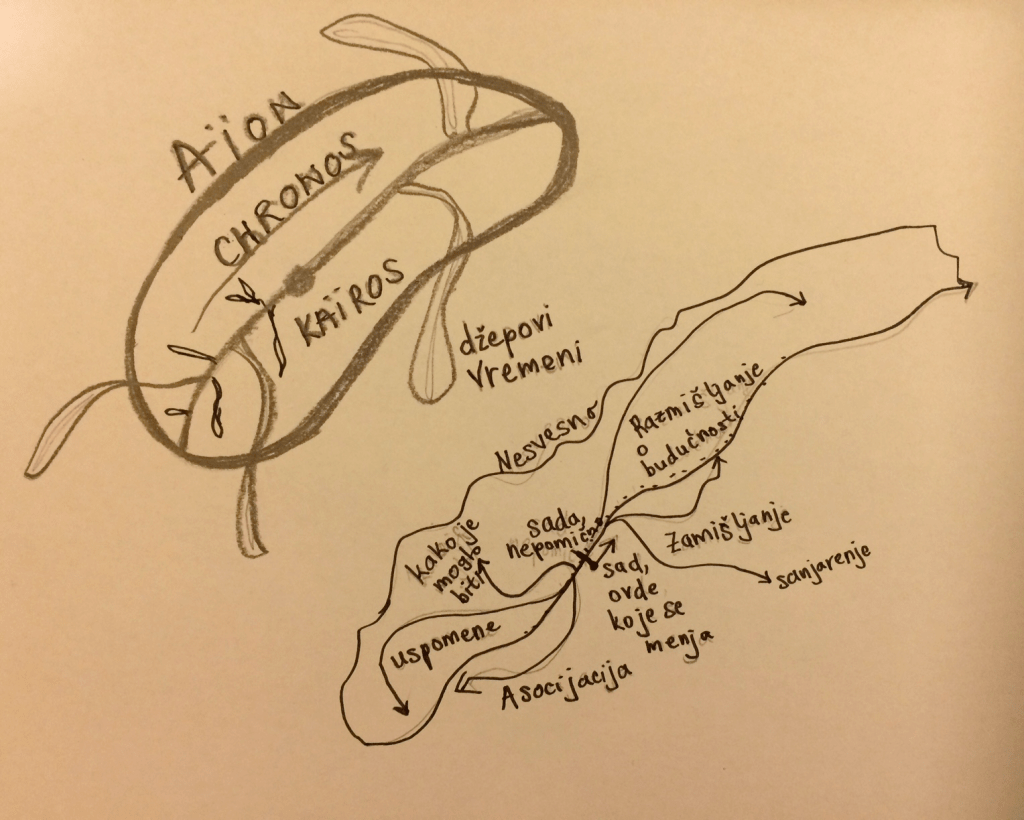
When we observe the spectrum of any trait, potential, thought, which as a whole is unsustainable and necessitates a choice between what is more useful, significant, and necessary at a given moment and situation, the question arises whether the same should be done with time. Time, as a whole, is not sustainable in the mind. Sailing across all aspects of the ocean of time sounds enticing but is dangerous – one could get lost in the open sea and never find the way back. Thus, we must concentrate, define ourselves in only some times. First, from time to time, we are in contact with a reflection or a gap through which the vast Aïon, the enormous Unconscious, can be hinted at. Then, there is this time here, this marker of linear time where we find ourselves in relation to others – our Chronos and the Chronos of the entire world. Finally, there is Kairos, my time, my here and now which is right here now, unconnected to movement, yet it is, because it moves without being in contact with that movement. It’s always a Now.. And our mind can combine all these times through fantasies, memories, predictions, and other pockets of time. It can return to the past and be the mini-Chronos of that past, knowing that it’s not this here, the conventional and all-around-us Chronos. It can imagine the future or a parallel, alternative reality. The mind can go everywhere, but for it to function, it needs to keep at least some connection to the conventional Chronos. The connection to the mother time is crucial to embark on other adventures. Without it, the Self disperses and dissolves. Without Aïon, it’s thought to be possible, but it’s around, more or less filtered by the Conscious. Its „lack“ diminishes our completeness. Theoretically, one can do without Kairos, but that’s hiding from life. It’s possible to exist only in pockets, but again, that’s another form of „cheating“ the Self. It’s possible without pockets, they are like diverticula, which can become dangerous if blocked. However, they also change, expand, „cheat“ time, and hide the Self as needed. I often notice that mental illnesses are disorders of time, our relationship with time, our choice of time, just as with all other spectra. We can exist in all times, but it would be overwhelming and static if we surrendered to it. We must privilege some time, some relationship, to define our Self in some areas of the spectrum, all spectra. And then, when we get stuck, change, adapt, take something else, more useful from the spectrum, we adjust what we think we are the Self and another version of that Self. Every Self is a subset of enormous potentials the same for everyone. And we take a piece and make it our own. But it’s borrowed, and there’s nothing wrong with changing it, in that same Chronos, with the help of different dimensions of time.
*
Following the Call
The Unconscious sometimes screams. Then, it should not be ignored. It sends signals, rages, breaks through the controls of the Conscious. Most often, it sends dreams, nightmares, or those unpleasant recurring dreams. And then these dreams give no peace. And then they should be listened to. To what chases us, do not turn our back but ask it what it seeks and what it expects from us. To who breaks through our walls, open the door and ask: „What now?“ When we fall, look down to see into what we are falling. It’s hard, often painful. What we most commonly do is to flee, ignore, or our Conscious filters everything with the help of convenient forgetfulness. The Unconscious does not have the same relationship with Chronos as the Conscious does. It loses its linearity in it. It observes it from the outside. The Unconscious is driven by the force of individuation, to the extent the Conscious allows, and the Unconscious insists. It’s important to listen then. The call of the Unconscious can be bypassed, but the cost of these new adjustments (just like when GPS encounters a street under construction) increases, and often gets stuck. We try hard to become deaf. The branch of the comfort zone has its mufflers. But, then, once, we listen to the call. And it’s hard to forget it once it tickles the Conscious. Change arises from the Unconscious. It doesn’t mean we should submit to it or let it lead us. The only thing to do is to listen to it, and then engage something even more important than calling the call fate, utilize our wonderful gift: free will – and choose. The call is a tickle, not a command.
*
Dream and Fear
Dreams lead us. We know so much about dreams: the reconsolidation of learned and memorized material, the organization of new experiences and their connection to old, already stored information, placing new data into the correct file with access to all other files. Additionally, sometimes the Unconscious uses them to remind us of the origin of our impulse for a particular new experience. Sometimes the Unconscious, from its atemporality, sends signals to the Conscious. Sometimes the Unconscious provokes the Conscious – creating a simulation of a possible future if we continue with what we’ve started with a new action, decision, and the refusal of new actions and decisions.
An intense dream, even a nightmare, is significant information: it’s a pleonasm – something is brought to its extreme in several dimensions. What would have happened if, or, more often, what will happen if this continues. The dream often caricatures, using a language of symbols that only we can decode. This „only we“ isn’t entirely accurate – a therapist can be a handy translator if they manage to connect with the patient on various levels, if the patient allows them to „read“ their psychosymbolic language.
Does the dream discourage? Does the dream clearly state something? A dream has no morality, as the Unconscious doesn’t either. It is „merely“ a tool for finding the right measure, the right measure of decision, action, reaction, change, non-change. A dream calibrates.
*
The Comfort Zone, That Branch We Hang From Above the Abyss

Photo by Ricardo Esquivel on Pexels.com
When we advise someone to consider why they remain barricaded in their comfort zone, we often hear a remark like: „But I’m not comfortable here, where do you get that it’s comfortable where I am?!“ We have an idea of comfort as El Dorado. Comfort is not that – it’s just the place where it’s safe, we can’t fall, we have somewhere to sleep, something to eat and drink. Of course, this comfort does not mean happiness and well-being; they wait somewhere else. Still, moving towards that something else implies movement. And movement means using stored energy. Will there be enough?
To me, this very much resembles sitting on a branch over a cliff. The branch is large and won’t fall. Below is terrifying, and above is the sky. The exit is relatively close. Yet, it’s not so simple, naively, to climb up. One could slip and fall. Where we are is at least safe. Is it worth sacrificing this safety, especially since from the hole one cannot see what’s outside. One can see the sky and light, but not the landscape. Maybe there are holes and cliffs all around? Maybe it’s wonderful? Maybe there are only larger branches? Why move? Yes, the view of the sky is „balanced“ by the view of the abyss, but sometimes one can only look horizontally. To decide to climb, one must have: enough energy, enough motivation, enough curiosity. There are no rules about when to climb or even if one should climb. There is no morality here. There is only the call of the unknown. Or the thought that the branch might wear out. Or the roar from below. Or the right moment. Or never. The only thing one must not do is push.
*
Everything Exists in Sport Billy’s Bag

When I was little, I loved the cartoon about Sport Billy, Sport Lilly, and their dog. Everything existed in his bag; he would reach in, pull out a miniaturized version, and in an instant, the necessary tool or item would materialize. Working with patients, I often think of that bag, especially when discussing a different way of reacting or a new view of reality. We often come to: „But where do I find that, I don’t have it within me.“ But, actually, we do. We have all within us: all shades of anger, the entire spectrum of sadness and joy, the ability to hate, to sulk, to be measured, to be extravagant, to be sociable and generous, closed off and cautious. However, if we were in touch with all these spectra and potentials, we would lose ourselves in the multitude, in the choice, in the possibilities. At what point would we identify our identity if everything was possible? We have some values around which we orbit, sometimes with large amplitudes, and sometimes we’re stuck in place. All this makes us rigid in some situations and quite flexible in others, in those for which this rigidity was not a survival mechanism, and vice versa. Then we fully identify with the identity, as the word itself says, and gradually forget the potentials. And they are still there. If we’ve learned that caution is more acceptable than innocence, we’ll have to reach deeper into Sport Billy’s bag to find innocence, because it’s a less used approach to the world. But that approach exists too, and maybe we need to remember it in some new situations, somewhere where caution would only distance us from our path of individuation. Everything exists in the bag; we just need to constantly remind ourselves that we have the right to reach into that bag. And that the bag fully belongs to us.
*
Anesthesia Instead of Risk – When the Conscious Delegates Suffering to the Unconscious
Sometimes it’s so hard that it must be forgotten, everything must be forgotten. Sometimes it’s even worse because there’s a feeling that something needs to be forgotten, without knowing what it is that torments us. Simply, there’s some unrest. Like in melancholy, where we grieve for something we cannot define, but we know we miss it indescribably, here we fight against a pressure that’s invisible. We doubt it’s all true, because how to convince others there’s something if we don’t even know what it is. Sometimes we can slip too far into it and curl up in another reality, in psychosis, or if that too is inaccessible, in dependency (most often on alcohol, substances, but also much else that sufficiently stupefies the Conscious).
What’s actually happening here? The Conscious is overwhelmed. The Unconscious sends it distress and unbearable feelings, but it doesn’t give all the information. The Conscious is stuck, because to progress on the level of individuation, there must be a dialogue between the Conscious and the Unconscious, the Self and the Other. The Unconscious doesn’t release information to the Conscious because the risk of its collapse is too great. The Conscious is ambivalent, the Unconscious doesn’t allow it to be ignorant and to simply forget everything, because the Unconscious can’t miss the opportunity for the Conscious to still go through individuation in the face of challenges. That’s why the Unconscious illuminates traces in dreams, in activating complexes, and sensitizes the Conscious to the risk that is known to the Unconscious (transgenerational, dating from childhood, related to personal and family traumas, everything that can harm). The Conscious is too tired and goes through a kind of burn-out – the Conscious is anesthetized. And waits. Sometimes it never wakes up. Sometimes the right Time comes and it awakens. The Conscious and the Unconscious talk. Too much has already been given, sacrificed, lost for that risk to be so insurmountable. Then, it’s possible to talk. The anesthesia that the Conscious resorts to is also a type of defense mechanism, only it’s temporally expensive. The Conscious delegates to the Unconscious to keep it safe until an opportune moment. Then individuation continues.
*
The Shadow Cannot Harm If the Complex Does Not Feed on It
We are quite unfair to the Shadow. We use it as a trash can, then never see it because it’s behind us, in dreams it’s the one chasing us with a knife in hand, and even when we do engage with it, we’re likely to accuse it of being the source of our lowest selves. Far from it that the Shadow isn’t a bit of all that. But, likewise, the Shadow is not just that. It depends on the relationship we have with ourselves. If we have the capacity to accept our dark sides without judgment and without euphoria, as one piece of information towards which we will consciously position ourselves – then maybe those ominous killers from dreams have disappeared, but that doesn’t mean there’s no more Shadow. Because now there are other Shadows, other aspects of ourselves we haven’t seen. The Shadow of a belligerent, bold, and brusque person can be rigid, fearful, and yielding – what we don’t want to face isn’t always sociopathic. No matter how much we engage with ourselves, other dusty corners where light does not reach will form. The Shadow is not destructible nor is it fragmented into pieces. Like T-1000 from „Terminator 2,“ it can regenerate and grow from just one remaining drop. We shouldn’t fight against the Shadow; it’s like the dark matter (or, perhaps without the „like“?) of our universe. The Shadow can do nothing to us if we do not connect it with those who feed on it. And it is fed by our complexes. What pinches us from the inside, what we haven’t reconciled with, what we doubt, what hasn’t been said but we feel… all that takes the magical potion of the Shadow and turns into a tyrant. Therefore, it’s essential to work on diminishing the hunger of complexes and reducing the unnecessary „blackening“ of the Shadow.
*
Always the Same Story, At Least on This Planet

Once upon a time, various inorganic elements, over time, began to merge, react, change, and connect. Then came organic compounds, and they began to react with themselves and with inorganic elements and compounds. This story, of course, ends as another begins, with the first living organism. Now, this primordial cell started to devise survival techniques. It couldn’t just dissolve into its surroundings; that simply wasn’t economically viable. It could cease to exist to avoid all these questions, and maybe that happened until a cell decided to see what it could do if it remained armed against the world, both part of it and apart from it. It couldn’t allow another cell to absorb it, though maybe it could have allowed it, but the one that phagocytized it couldn’t. In essence, the cell could pretend it didn’t need other cells and that it was alone in the world. This probably worked as long as there were energy sources around to sustain life. However, it couldn’t influence its environment: whether it would be attacked, whether resources would be available, whether something would change (though the relationship with time probably came later, and even if not, if the cell is in Kairos, when Kairos is a negative context, it would need to figure out how to respond)—and there are many responses: fleeing, defending, joining forces, or ignoring. And here we arrive at: boundaries!
We haven’t changed much from that cell. We still respond similarly to stimuli from the environment. Much still boils down to the boundary. There’s the objective, material, visible boundary: skin. Skin separates us from the other (and psychosomatic dermatology is quite interesting, though care must be taken not to neglect either the somatic or psychological aspect). We have senses through which we feel the environment, receive information. We have locomotor organs with which we respond to these stimuli and a central organizer – the brain. All this isn’t much different from a cell (membrane, cilia or similar organelles, nucleus). The analogies with energy intake, conversion, and releasing unspent or unnecessary material are similar. So, where does the psyche fit in?
Just as there exists this objective earthly cell-like system of organization, there is also a psychic one that follows the same cellular principle.
We have the essence of ourselves, what governs, or at least should govern the entire unit (cell, psyche, individual), we have what we don’t want and what we expel outside (projections of our own complexes onto others), we have the energy we take from the world (stimuli) and that we produce ourselves (here we come to something interesting, psychic energy is, like other energies, transforming and eternal, but also self-renewing, requiring a harmony between self-sufficiency and sociability!), we have all the content-cytoplasm, or all intrapsychic content: intertwinings of shadow and light, all yin and yang, masculine-feminine and other aspects. And we have complexes, like proteins in the middle of the double cell membrane. The membrane is double because it has a layer that just repels or allows entry based on a rough assessment, in relation to general knowledge (hot – bad for me, too strong – bad for me). Then there are the complexes that link all this with personal context. And then there’s the inner membrane, which connects what has entered with its further processing. Proteins exist inside the cell, analogous to complexes. And archetypes – they date back to the first sentence of this text, as old as the universe.
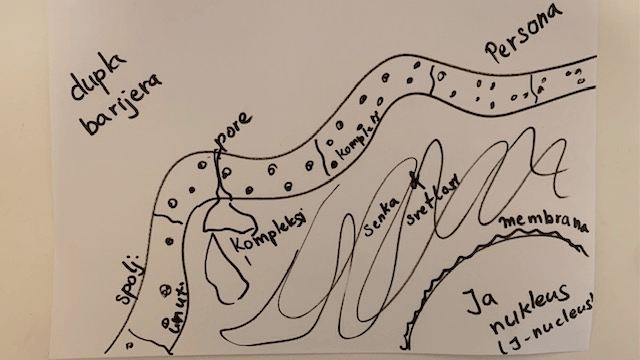
That’s our psychological boundary. To maintain it, we must know its composition and its extent. Also, we must know what is connected to what (complexes located near the cell membrane, those connected (cascade transmission) with internal structures, those whose expression obstructs the functions of the nucleus…). Our relationship with the environment is Persona, wrapping, elastic, constantly adapting membrane. The nucleus (Ego) is protected by another membrane of its own. The nucleus is the I, but the cell is also me. All this is my Self. And it can’t exist without other cells, but it can’t incorporate them within because then it becomes something else. It can join forces, it can destroy, it can flee, it can not react, and maybe it can become something else. And even then, it carries a little of all this within itself.
*
Psyche as a Reflection of Time
The longer I work in the clinic, the more I notice the significance of time in psychological imbalances. Getting stuck in one time, in one moment, almost static, which moves just as we move with the planet, thus not noticing the movement, will be a cure for some and the worst fate for others. Kairos, that moment here, right here, now, which moves with us and always corresponds to the word „now“ with the fact that this „now“ is completely elusive, is a wonderful break from the flow of Chronos’s time, which says that life goes from the cradle to the grave and always reminds or defends against the reminder that the grave is on the side we are heading to. Memories are eternal, in that boundless time, Aion, we will be able to hide in dreams, in daydreaming, in thoughts, everything is accessible, only if we reconcile with the fact that it’s not tangible. And each of us sometimes gets stuck in one of them, and resynchronizing with the already fragile and dynamic balance of these three times is not a trivial process.
Observing patients from the angle of their desynchronization with their personal temporal balance, in relation to others’ temporal balances and in relation to the universe we are in, gives orientation where we are, where we are going, in which direction we are looking, and at what rhythm our flow through all these times occurs. Any kind of getting stuck should be identified, viewed from all angles, and then „decapitated“. Here are a few general imbalances:

A person who fears the flow of time, because that flow means an uncertain future and certain death will try to avoid the linearity of time, or simply, dependency on time, the invincibility of the Time Lord, and confrontation with limited „temporal“ freedom. They will be here in this moment. These could be people who unconsciously flee from the future, burying themselves in tasks and immediate problems, but also people who deceive themselves that they are at peace immediately and now through calling techniques, forgetting that there is no peace that does not take into account all the dimensions of time that we, humans, can perceive. Slow and cautious facing of Chronos is necessary, but only when the patient is motivated and expresses readiness themselves.
Contrary to this example, linearity, death, dependent relationship with time, our present time (whether it’s an illusion or not) is unavoidable and unhidden for many, even if they don’t particularly like it. They form a different reaction to the incontrovertibility of our relationship with time. They accept that it is there. It’s harder for them to emotionally accept that besides it, there is also this here now. Simply, the present moment is invisible to them, completely elusive. The perception of time jumps between the past (which sometimes merges into a „chimera“ with Aion and squeezes out Kairos, as in depression) and the future (which can also have different relations with Aion). Adding Kairos is a great feat and can, in that „running forward or backward,“ seem like a slowdown, even stagnation. Therefore, careful introduction of this concept to the patient is necessary.
Finally, those who can be here now and who realistically understand our transient and conditioned existence in the universe may seem entirely adapted. That is the case if there is also (time-) space for liberation from the importance of time, when things exist if they are in our mind, if we attach importance and attention to them, and if we can tempo-port into any fragment of abstract existence. If this is missing, if imagination, willingness to add to „reality“ eternally and independently and freely is inaccessible, we might question the relation to freedom, free will, but also fear of the human-curious-different, fear of changes. Here, dreams are a good ally, as the Unconscious starts to peek through despite all filters. Resistances are common, and arguments from all sides are subjective, even metaphysical. If the urge for change arises, it needs to be followed and maintained slowly, with a lot of trust.
Also, it’s not all so clear-cut – the human psyche swims in the spectrum of all these temporal instances, dynamic, and in contact with the environment. Sometimes we are in a temporal balance that suits us at the moment, but everything around us is „sometime“ elsewhere, like a few minutes delay in Stephen King’s „Langoliers.“
Time may not exist, but our relationship to time is very real. Maybe calibrating „when“ can help for „where,“ „from where,“ and „where to.“
*
If I Have a Gift, Am I Obligated to Use It?
If I genuinely know something, must I use it? Can I set aside my talent? Do I have the right to be „chosen“ and then just leave it aside? How restrictive is the chance/non-chance of us being the bearer of something extraordinary towards our freedom?
Of course, we can choose whatever we want, and of course, we bear the responsibilities of such a decision and the obligations that subsequently impose themselves. Yet, it’s also clear that there are many possibilities for flexibility, for later changing the decision. All this is fine in theory (though even here, everything can be sabotaged and criticized), but can we truly bear the burden of something we didn’t choose (life, talent, ability, beauty)?
Is it something that came from somewhere else, that we borrow for a while and that might become something else over time? Let’s say I know how to sing (which is totally untrue). Do I have to perfect my voice and become a lyrical performer? And what if I don’t know how to do anything else? Or don’t like to do anything? And what if I don’t even like that? Does my talent condition my source? Does disliking my talent make me ungrateful? Will my talent disappear with me? What will become of it? If, for instance, I become an opera singer, someone will hear me, and my gift will resonate with someone’s ear, thoughts, or memories. If I do nothing, what will it turn into? Will my unexpressed talent pressure me? Will I silence it consciously or unconsciously?
If something is „borrowed“ from the great mine of treasures and everything else in this universe, what is my share in it? I have minimal power from the position of Aion, but Chronos gives me priority. While the talent is leased to me, my free will has the right of expression. The talent is with me, but it is not entirely mine. And it will leave, as will I. It’s my free will whether I will give it a direct transmission to the next generations or condition it to seek various gaps in time-space-order-objects to continue its existence.
Like that idea from the previous post – it’s bigger than me, Aion is bigger than Chronos, but Kairos is now.
*
When I Give You a Gift, the Gift Is No Longer Mine
We love to help and often get angry when that help is not seen or applied. Help is a gift that we give to Others selflessly (often). What we forget is that once given as a gift, it becomes the property of the other. That property is not ours, and the Other has the right to put it in a drawer, give it to someone else, or throw it away.
What about when we give of Ourselves? Of course, not the whole Self, but what is precious to us – are we truly giving a gift, or are we giving a loan or an investment in the future? There’s a lot about this in manuals on mature and some, not so mature, defense mechanisms.
But what about gifts that are premature or well-intentioned, yet we would prefer to make them ourselves rather than have a bought, someone else’s, or industrial version? What about the gift of life? When I begin to exist, that existence is mine even though my parents and all other ancestors were necessary to provide the organic basis of Me. When I express my idea, it begins its journey through someone else’s mind, triggers something, even if it’s rejection; the time after the idea becomes different from the time before encountering the idea. If I paint a picture and write a poem – they become part of this reality and thus separate from me.
When I give my opinion, it ceases to be mine; it emerges from me, but later it creates a personal reaction in the Other. I remain connected to the comment until the moment of utterance, the Other from the moment of encountering it, and the comment is always just that, a comment, belonging to it, more than to me and to the person I give it to.
What does this specifically mean? That life belongs to life itself, and we borrow it, that while it is with us, it has a component of our parents, but it is not theirs. That our relationship belongs to the relationship, not to one or the other (third, fourth…) person. That I cannot demand that the one to whom I give something (feeling, advice, medicine, idea, angry reaction) remains indebted to me, usurps my power/belonging of what I give, or becomes a servant to me who was earlier in that chronological sequence. I can request respect for the temporal order, but I cannot demand 100% of what I give. 100% is only in what has been created, exists, and has its consequences in the future.
*
Society as a Scapegoat
„Hell is other people,“ Sartre said, significantly shaking our inherent ambivalence towards the world. Can the whole society be our scapegoat, the one on which battles are fought and who is the designated culprit? Society is quite suitable for this role. There are so many injustices, sorrows, disappointments, and insecurities in the world that it is easy to vilify it. There is also much that is beautiful, but the beautiful does not restrain the less beautiful. The less beautiful, and even the horrible, by their mere existence, contaminate the more beautiful. Neutrality is not a single point; it varies – our position will easily be shaken by our dreams, previous history, hormonal status, amount of sleep, unconscious associations, etc., etc., etc. As such, it is often important for us to ventilate somewhere all that we can no longer carry, and often we have no one to transfer it to. Projections onto Others are common, but they are generally „betrayed“; we recognize them, the Others, objects of projection, descendants at family celebrations, grandchildren in psychotherapy, and so on… Projections onto the world, if they are not very intense and repetitive, go unnoticed, blending with others’ projections. The world is a much more neutral place than we ourselves are. Neither good nor bad, the world is every event to which we afterward assign a moral-emotional-rational value. Acknowledging this neutrality of the world questions our perception of our non-neutrality. There are no perfect answers, and erasing projections even less so – all that remains for us is the risk, the risk, that the world is as it is, with us in it.
*
Can We Teach the Other Maturity?
Not really. The simplest line of thought goes like this: to know that one is immature, one would need to have insight. Insight would trigger something: anger, stubbornness, a decision to change, acceptance. That very act would be a path to maturity, even if it ends in a dead-end. Still, what to do with those who think they have insight? Healers of all kinds are good examples – the call itself gives a certain credibility – yet, knowing how to initiate someone’s liberation from something on some occasion does not always mean everyone and from everything, and most importantly, does not mean oneself from oneself and now. It’s an incredible gift to know how to accept criticism-remark-advice-comment, to take what’s useful without falling into the traps of complexes that hold one back. Likewise, it’s a powerful talent to accept the probability of one’s own incomplete insight. Therefore, maturity itself is a process of questioning. Immaturity is paddling in the shallow end of the ocean of the unconscious. Swimming and diving into the ocean is not easily conceivable. And how, then, to expedite the maturing process of the Other? Well, not concretely, not by force, not by begging, not by passive aggression. The only way is to take one’s own, never quite ripe, maturity, forgive its relativity and handling of percentages, not absolute numbers, observe from it the other’s insufficient maturity, and not let it feed off us, to set a gentle, transparent, but firm boundary, and endure its approaches and rejections until it begins to find its measure. We don’t change the Other in their space – we facilitate the change of the Other by knowing how much we are ourselves.
*
Left or Right
When an egg cell is fertilized by a sperm and creates a zygote, it starts to multiply, first turning into a blastula, a ball, and then one half begins to tuck inside becoming a gastrula, which is the first in which different layers are shaped – it’s easier to orient by looking at a picture 😦https://nanopdf.com/download/cleavage-blastula-gastrula-neurula_pdf)
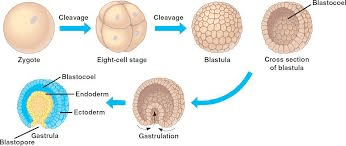
What has always fascinated me is that the outer layer, the ectoderm, which separates us from the Others, will become, through various morphogens and their gradients (this review has enough references and explanations: https://www.ncbi.nlm.nih.gov/pmc/articles/PMC6215528/), either part of the neural plate and gradually a piece of the powerful nervous system or a component of the largest human organ – the skin:
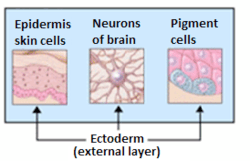
Skin or neuron, if I were to drastically reduce and caricature: what physically separates us, materializes our boundary towards the Other, and what helps us to be in contact with those boundaries and to control the other, virtual-psychological boundaries of the Self. Twins, one reacted to the right, the other found left more appealing (of course, about 10 to 100 times more complicated than this simplification, but, again, in the end, binary code, either one or the other). Splitting par excellence of nature, because there’s no ambivalence here. But the absence of ambivalence and a clear cellular identity doesn’t mean they’ve lost all connection.
The free choice of the cell? Or programming? Or randomness? Or a consequence of some earlier choice? A protein was methylated and inhibited the expression of the gene that would say: neuron? How did that particular cell have its protein methylated? Histone code – okay, even if that was proven, it still stops short. Is there a clause de besoin (like some maximum-minimum number of necessary cells that will inhibit or promote a gene)? Is the individual cell random, but the overall product of the process defined? Should the whole advance, with more or less a few exceptions (in a normal distribution)? Or to the cell, is everything the same – whether a skin cell or a neuron, the outcome is invisible. The cell’s Kairos is its every-nanosecond survival, its Chronos is its duration, Aeon is that drive to endure. However, the cell might not care about what impresses us – the choice of where it will be. The cell exists.
*
Timeless Non-Time
This video is the only thing that overshadowed all the other confusions of 2020 for me. My naive thoughts about the future of the universe and some of our science fiction descendants, organic or energetic, always included – the universe, as it is, infinite, strange, and eternal. And boom – another mourning is necessary. The current universe is a child, its adolescent crisis will get rid of all the toys from its childhood, and its adulthood will be peace, darkness, and full of emptiness.
In this video, as well as in the contemporary sequel to Sagan’s „Cosmos“ with Neil deGrasse Tyson, there is a possibility of some new and different universes, but in each of them, we do not exist. In the most ideal and optimistic case, we will create a new universe, but we will not enter it. It will be just our invisible pledge for a new world. It’s complicated in 2020 to imagine our altruistic descendants, but as long as we last, there is an end to individuality. And then everything is mixed, peaceful, static, and – waiting.
*
Time Neuroses
Do we understand our own temporality? Can we apply it when we are outside of it? And when it, or we, are outside the system that surrounds us? We often say that we are not in phase with someone or something. It seems to me that this is an exceptionally precise analysis of the problem.
I wonder if a child already begins to establish their own rhythm in the mother’s womb? The child is certainly in Kairos, in that present moment, in a present that flows and changes, yet is always now. Then the child begins to grow and starts to accept, or to encounter, or to be imposed upon by Chronos, the linear time in which we are and cannot, at least on this planet far from massive black holes, confuse and manipulate. Subjective time is personal, objective time is unavoidable, and how personal it is a question with several conditional answers. And then, in childhood, the concept of Aion, eternity, time independent of linearity, the „forever,“ is introduced.
Do the disorders of our conscious contact with our psyche (often through various problems in our relationships with the world) base, among other things, on our uncalibrated temporality?
Can someone struggling with their identity more clearly define it in some other temporality, for example: my fears are in a future I fear, my safe place is in early childhood and in some specific moments, eternity seems to me a vague concept, and from time to time I am in the present, but I tend to get stuck in thoughts about the future. Let’s continue with this example: the mother complex got stuck, for example, during adolescence, the father complex is unstable, intensifying and diminishing in loops, my Shadow grows over time (e.g., I become more cynical with the need to convince everyone around me that they should see the world that way), Personas (social masks) are sometimes in Kairos, but most often connected to those fears or those safe places, and I determine them accordingly. What could be concluded from this: Aion low, Kairos unstable, without support, Chronos positive in the distant past with some exceptions, Chronos negative in the immediate future (and the closer I get to it, the stronger the Shadow and Persona begin their defense) – so when am I? I am not here and now, I lean towards a future that occupies my mental energy, without support from now and before to withstand that effort that does not pay off (because that future is always behind Kairos, which is not stable enough for me). If we add to this the World (the Other, father, mother, projections of father and mother), we get an even stronger interaction of subjective and objective time. This objective time can help, can even calm, Chronos does not betray on our earth, it flows, but it also hides the future. What to do? How to restore her identity?
There’s nothing new in the process: find, outline, define, write down all those times, then think about whether this is our rhythm always or something happened, and it sped up or started to revolve around itself. Then look at those safe and dangerous places and their temporalities. All this slowly and without haste, but adjusted as much as possible to the interlocutor. And then start shaping the chimera of lost time and desired time. Find your time. Find out how much this time stands out from objective time and how much that is acceptable. Find where the identity is safest. Ask the identity if it would be willing to come to Kairos and if not, what it needs. That is, defining, communicating, openness to change.
And this last point is what most often sabotages. Maybe the real question is not why but since when and until when?
*
Is Our Common Language in an Accessible Dimension?
A common piece of advice in couples therapy is „communication.“ Ultimately, and in the middle, it mostly comes down to understanding that there’s no adequate communication, defining that communication, and then trying to establish or improve it. However, couples usually start from the last step, go back to the first, and then try to correct it. The intermediary level of defining is often skipped in most cases because it’s reduced to: we get angry, provoke, misunderstand each other, project, interpret, repeat parental patterns in the couple, etc. Then, something that is problematically and scantily defined is repaired without knowing how and what to repair. Of course, it’s necessary to understand the problem, but it’s essential to penetrate it from all angles. Often, the problem lies in different perspectives, and even entirely different dimensions, although we speak the same language, but overlook the diversity of subjective meanings of words.
For example: both are angry; she is angry that he idealizes romantic love as something so strong that it has yet to happen, thereby devaluing the feelings between them. Then she reminds him that what he imagines is impossible and unrealistic, a bedtime fairy tale. Later, she admits she is full of jealousy towards the imagined ideal woman who will one day appear and steal him away. On the other hand, he is extremely angry with her because she belittles his personal mythology, his belief system. He needs that idealization because it’s where he places his faith in the relationship. He knows it’s a utopia, but he needs to position himself, at his own pace and temporality, in relation to this utopia to bring it into the real world. From his perspective, she betrays him by patronizing his childlike part, which he is gradually parting with. For her, he betrays her by not classifying their love as significant or “real” love. She protects her Self in the relationship to maintain her boundaries; he protects his spiritual Self to protect his identity. For her, he is a child yet to learn. For him, she is an aggressor invading his inner world. He withdraws more, she interprets this as proof of the validity of her jealousy. She is not in touch with empathy towards him, as she can’t see how it’s possible to be empathetic towards someone who openly tells her that she might not be “The One.” He is not in touch with empathy towards her because he doesn’t understand that her belief system involves being with something that’s whole, which undermines his respect for her value system. He is prejudiced. She doesn’t trust him.
If we ask them what it’s about, each gives their perspective. If we ask what they think the other thinks and why they are angry, they interpret from their position/dimension. Where, then, is the meeting place? Or when is the meeting place?
Empathy is complicated to perceive if our senses are bound and we are also overwhelmed with our own images. Can we judge someone as unempathetic just because they can’t penetrate all levels of their possibilities?
Is communication possible if it’s hard to understand what the other is talking about? Of course, with a therapist as a translator, this can be accelerated, but what about without? Can we always understand each other? How often are we convinced we understand, but each in their own “understanding”? Is a couple less compatible-successful-harmonious (etc.) if effort is necessary? Or do we just need to give a little time before some artificial exchange of suitable phrases and one simple question: “What exactly do you think I’m talking about here?“
*
Conditional Love in Parenting
It’s commonly said that true love is unconditional. „I love you as you are.“ „Even if you change, or something happens to you, I will love you the same.“ That sounds quite nice, but it’s not always feasible. If a couple of two adults aims for unconditional love, they will encounter numerous obstacles. But what about parental love? Must it also strive for this goal, or is this goal imposed, and any doubt in it impossible? To what extent do parents even desire unconditional love towards their child? How unimaginable is it for a child that a parent might not want this? After all, to what extent do parent and child strive for the same, and exist in the same emotional dimension, especially since it’s a relationship between an adult and another person who is not necessarily (and often at least a third of their relationship) an adult?
Love with conditions like „I love you only if you are like me, I don’t love you if you are someone else“ – how prevalent is this in the parent-child relationship? How much can a parent support difference, realizing that some of their projections and fantasies are unfulfilled? Letting a child walk the path of individuation without too much burden is, undoubtedly, essential. But, how much can a grown child endure the impossibility of a complete relationship with a parent? Disappointment, frustration, bitterness, anger, the need for conflict – all these are expected emotional reactions of an adult child realizing the gap between their intrapsychic world and value system versus the parental worldview. If a negative parental complex has trapped, sabotaged, and contaminated us during a relatively unconscious life, why do we need to confront it once it has slipped into the Conscious? Why the grudge and revenge? Generally not for that, even such views of these strong feelings are rejected. More often, these feelings and impulses are named as urges for justice and mutual forgiveness, or, at least, for verbalization („to have a word“). And there’s nothing contentious here. Except that the grown child thinks they know what justice is. And no one does, as it doesn’t exist as an absolute concept. Verbalization that is not a means to gain encouragement is useful. Naming a problem that desires a result is less liberating. And, again, we return to conditions, „I forgive you if you understand me, I forgive you if you are willing to see my perspective, because I tried to see yours.“ And this is not an unconditional relationship. And it’s not necessarily an unconditional relationship, because it, like all utopias, is that unreachable 100%. What heals is the gradual grieving for that utopia. And if it’s not unconditional, the relationship is important. Labeling relationships can tear them down. Therefore, first understanding, then verbalization, then grieving, and then (conditionally?) enjoying (accepting, living, „relationship with“) in an imperfect world.
*
3D – 2D – 3D… and 4D?
The Other is a three (or more) dimensional being. I can’t fully comprehend him/her. I can perceive (both through rational senses and irrational abilities like intuition) only one projection of this large 3(+)D-Other onto my world. So, I see the Other, diminished by at least one, if not more dimensions, not quite spherical, let’s say transitioning from 3D to a 2D projection onto my world. But the story doesn’t end there. From this 2D projection, I often generalize everything I see and call it the Other. In fact, everything I see when I feel/conceptualize/mentally project the Other is how much they project onto me. These projections depend on numerous factors: from me and my abilities, me and my filters (complexes, etc.), the context of the situation (emotional valence, interferences, and the like), and from the Other themselves and their boundaries. And all this would be fine if we were always conscious of this educated image of the Other. But we are not. We think 2D is the same as 3D. We have no idea whether it’s similar, different, identical in some parts, or completely opposite in other contexts. We must function with imperfections and adapt to take what is given (without regretting that 2D isn’t 3D and without analogies to ourselves and our 3D/countless 2D relationships (our Personas)), but we mustn’t think that we truly know someone… When obscure dimensions from the dark part and time are added, relationships become more complicated. Just lamenting that this is so (despite all reasonable and less reasonable explanations why this is good (filtering, conserving energy and memory, focusing on the concrete, caution, and quick response to the unexpected/dangerous…)) brings nothing more than the flaring of the narcissistic, powerless child within us. Here we are, with what we have been given, what will we now do with it, knowing that the possibilities are endless…
*
Can We Be Alone on Another Planet?
Here below, on the link, is an interesting article that invites some deeper thoughts:
How Two Became One: Origins of a Mysterious Symbiosis Found
Despite all the exciting conclusions from the field of biology, I am interested in a slightly more science-fictional challenge: can we really move to an exoplanet? Let’s say we can physically do it (hibernation, new technologies, babies raised in the style of „Raised by Wolves“ (an HBO series), etc.), and we land on a hospitable or terraformed planet. We have water, no cosmic radiation, we have air and we have land that can be prepared for cultivation – everything is wonderful. And we arrive, mostly with some plants for cultivation and to support the (newly formed) atmosphere. However, can we all completely relocate? By everyone, I mean all kinds of insects, microorganisms, plants, tiny mammalian predators, and so on. The example of symbiosis described in the article about the alliance of bacteria and ants is one of many and not fully researched natural couplings of two or more different organisms. Can we take everything and what happens when someone is missing? Can we do without viruses and microbiotic bacteria? Probably yes, to survive „yes“. However, life between the first generations that are just surviving and getting used to, and those far-future ones who have found new factors in countless chains of biochemical functioning, is another question. We are intertwined with all other inhabitants of the earth and all together we make up its ecosystem. A new ecosystem will need quite some time to calibrate, especially if many factors are unavailable. Therefore, when we start conquering the new, will we take all parts of us?
*
No Identical Filters
We all filter the world around us. Our filters are dynamic results of the interaction between our senses, our personal history (learned), transgenerational influences, instinctual-archaic components, and the Conscious/Unconscious relationship. Each person filters their environment at any given moment, in any given context, based on internal complexes and the internal organization of personality, to the extent that the individual has access to it. Just one differing parameter (and usually, there are more) is enough to confirm the uniqueness of a certain reaction or perception in a situation. Hence, we are never the same, as Heraclitus already knew – so how can someone else be the same as us? Others may see the world similarly to us at some moment, but there’s no guarantee the next moment will be predictable.
Everyone is alone. This solitude is unacceptable to many. They wish to forget it in various ways, some illegal, some legal, some socially acceptable or valued. Yet, no tactic changes the essence: the Other is not Me, and I am the Other to someone else (‘Je suis un Autre’, as Rimbaud wrote long ago).
How to navigate this connection and alienation from the world? On an unconscious level, we are connected, less so on a Personal Unconscious level, and almost disconnected on a Conscious level. Then, when we manage to reconcile with this thought, we begin to reconnect with Others, taking control of our filtering, more or less, into our own hands. If I know that the Other in their otherness is unattainable and accept that longing for it is a waste of energy, what can I realistically do?
Well, I can, for instance, decide to relativize the Other. The Absolute Other is not the same as the relative Other (as in mathematics). I follow my own path. So, I’m not able to be alone, but even I am not always the Absolute Self. Ironically, I too vary according to my own filters that show me a part of the world. Therefore, before lamenting my loneliness within myself, it would be handy to remember that even my reference axis is variable.
Then, I can orient myself towards specific situations and give some of my energy to them (without too dogmatically sticking to the outcome), e.g., someone else has similar thoughts to mine about spirituality. I know we probably don’t have all the same beliefs, thereby giving a chance to diversity. The need to be one, to not be alone, often carries the fear of being different and therefore inadequate, unsuitable, and easily distanced from society (or life). Giving a chance to diversity comes from understanding that being alone is not a fate but the natural state of the cosmos, at least the non-quantum part where we can’t be in two different places at the same time. The Other cannot be in me, not for a moment and not forever. And thus, my connection with the Other is possible, I see him/her from outside where he/she can’t see themselves, and vice versa. My filters are not his/hers (even if the Other is my child, my twin sister, or my soulmate), and my unique time/space in the universe provides a unique puzzle piece in a vast jigsaw. What kind of puzzle would it be if all pieces were cloned? What kind of world would it be if we didn’t see it from our own position?
*
Pyramidal Neurons and Consciousness – Is the Unconscious Free from a Unifying Self?
The work ‘Cellular Mechanisms of Conscious Processing’ by J. Aru, M. Suzuki, and ME. Larkum, published in Trends in Cognitive Sciences in 2020, prompted me to revisit the ‘hardware’ that often eludes me. And this hardware exists; everything in this conscious world has (at least until theories of the world as a hologram are proven) its material base. The abstract cannot exist without the concrete; the body intertwines with the mind, thoughts change the brain’s energy patterns. What separates them is often clear and belongs to different sciences and worldviews. What unites them is problematic. At what point does a particle become a wave, can we even ask that question? Are these different dimensions and projections? Do we live in one of the resultant worlds with a certain number of dimensions (11? or 4?) and if we were to break them down into 1-D worlds, maybe we’d see their building blocks. But perhaps then they wouldn’t carry complete information? Maybe there are worlds with more dimensions than ours, and maybe there the relationship between thought-synapse-oscillation is visible?
This study addresses the hypothesis that there are cellular mechanisms, specifically of pyramidal cells from layer V of the cortex, which enable the functioning of the thalamocortical system, resulting in a conscious state. In deep anesthesia, there is no transmission of signals through this system. The two main conclusions of this study are: 1) the existence of consciousness is connected to the integration of signals from the apical to the basal part of the dendrites of pyramidal cells through the central part where this signal transmission is executed, and 2) there are specific cellular mechanisms that occur only in a conscious mind. The most exciting part of the study is the questions the authors raise: what happens if this integration of signals is disrupted, is something similar happening during deep sleep (and what exactly happens at the dendritic level during sleep and dreaming), can we artificially establish a connection (and new or different consciousness) if we change the dynamics of this signal transmission, does the same happen in the entire brain, does signal transduction propagate beyond the thalamus and how, does transmission occur in both directions, can we study these phenomena non-invasively?
What surprised me, despite the clear excitement about such works, is the hypothesis about integration happening in a specific compartment of the dendrites. The number of dendrites in the human cortex is impressive (the number of pyramidal cells alone is enormous: 70-85% of all nerve cells, and one cell can have up to 15,000 dendritic spines). How much integration occurs in one nanosecond, differing spatially-temporally-contextually! Does this mean there is a unifying mechanism or a unifying resultant of infinite combinations of these integrations (couplings), dynamic, unstable, unique, yet with some same basic pattern (since identity doesn’t disappear with sleep or loss of consciousness)? Does this mean, then, that the Unconscious is disunifying, free, chaotic, entropic, unoriented? The questions, if we add the Unconscious, become even more complex than the already quite sci-fi list of the authors: ununified phenomena still exist – what happens with the propagation of signals, is their direction of signal propagation arbitrary, are there any internal loops (sequence, frequency, localization, associations, etc., of apical-basal connections), something like the main roundabout of our identity, something that forms an unchangeable basis – a unifier after each awakening, what is the internal hierarchy of signals, is this indescribable gigantic ignition and extinguishing of integration activity organized differently (dis)organized at the moment of loss of consciousness, does the undirected oscillatory dynamics of dendrites (and everything that goes with them) propagate further and how far, is the interaction with people in an unconscious state a balance with some other interactions (e.g., with the Collective Unconscious), is this ignition (extinguishing of coupling zones (signal integration) more similar to quantum than traditional computers (probably!) and many, many other questions?
And in the end, are We different when we are conscious and when we are not?
*
Controlling Through Understanding
In conjunction with the previous post, can understanding the Other truly be dangerous? Can understanding the Other lead us to hurt them? There has been discussion about the challenges and harmful consequences of hyper-empathy. Understanding another has characteristics of empathy, but it includes a layer of consciousness and action that empathy doesn’t necessarily require (it can, but doesn’t have to). So, we understand the Other, and then we tell them. What then?
Then a myriad of things can happen, depending on countless factors, but it can be boiled down to one thing: the one who is being understood (enduring it?) doesn’t know how much the other person understands them. Maybe neither knows, maybe it’s not important, but a slight inequality is established. Inequality isn’t synonymous with bad. It can be horizontal, vertical, spherical, abstract, but it isn’t equality in terms of the understanding parameter of one of the two people. And on this parameter, balance must be found again, either mutually spontaneous and easy, or with caution from the understood, or, from the perspective of the one who understands, with the possibility of quick comprehension and anticipation of the next (re)actions, or in any other way. To accept that this new harmony (or simply, balance) is established, trust is needed. A reluctance to slip into a guru complex is also necessary. Words are needed.
Can a person who offers understanding to another unconsciously start to control them? For example, in a love relationship, one person ‘reads’ the other more easily than vice versa. This reading can be helpful, but it can also serve for manipulation. Imagine a situation where the person who ‘reads’ well knows they have a certain advantage and doesn’t want to use it, simply because it goes against the freedom of love and partnership. This would mean that, when faced with an important and relatively urgent situation that they read before the other, they need to communicate. This communication opens various doors (the other person feels powerless, insecure, projects along with anger, is grateful, interested in learning, and so on, and quite differently) – necessary mutual exchange is needed, I have something that is yours and I give it to you without asking for something in return and without it changing our relationship. Okay, it passes once, twice, but if it repeats? One person leads/teaches the other? One person, despite good intentions, becomes the giver, and the other becomes the debtor. How to extricate from this?
Can we accept the oscillations of our self-awareness? Of course, others don’t know us more than we do, but it seems so because we’re focused on specific situations. It’s also certain that we don’t have nonexistent boundaries and that they are not solely responsible for this openness to another – boundaries exist for many situations, but here they are somewhat thinner. What does this mean? It means that our partner (or another close person) has helped us, but not by understanding us, but by touching the complex. There is something that our shadow has covered, something that should interest us. Thus, the Other will control us if we give them access to the complex that we don’t allow ourselves. When the Other becomes the discoverer of symptoms, and not the cure, we will become healing for ourselves (and something opposite of that for others…).
*
Metaphorical and Scientific Parallels: What Psychotic Psyche and Cancer Cells Can Learn from Each Other
Thinking about the parallels between psychotic states of mind and cancerous cells opens interesting perspectives for innovative therapies. Both psychosis and cancer represent a disconnection from normal functions — psychosis occurs when the psyche loses touch with reality, while cancer arises when cells lose contact with the surrounding tissue and begin to grow uncontrollably. Can we use the similarities between these two phenomena to develop new therapeutic approaches?
Isolation and paranoia: a common trait of psychosis and cancer
In psychosis, an individual may “hallucinate” being alone, feeling disconnected from the real world. Similarly, cancerous cells lose their perception of their role in the body and begin to behave as if they are isolated, driven by a need for survival at all costs. This biological “paranoia” of cancer cells reflects a loss of connection with the signals that regulate normal growth and function.
This metaphor gives us insight into how potential therapies might work. In psychosis, therapeutic approaches involve recognizing and healing the traumas that led to the disconnection from reality, while cancer treatments focus on “resetting” signaling pathways that restore the cells’ ability to properly respond to signals from their environment.
Seeking internal causes: “trauma” within the cell
What if we viewed cancer as a cell that has experienced some kind of trauma? Exposure to toxins, genetic damage, chronic inflammation, and stressors can be “traumatic events” for a cell, leading to changes in its behavior and disconnection from normal function. If we explored the roots of these changes in the same way we do in psychosis, focusing on treating the causes rather than just the symptoms, we might potentially develop therapies that target the internal “emotional” factors of the cell.
Epigenetic changes, for example, often play a key role in the development of both conditions. In psychosis, epigenetic changes can disrupt normal neurocommunication, while in cancer, these changes allow cells to ignore growth-stopping signals. Therapies that restore normal gene expression could help cells regain their function and perception.
Immunotherapy and immune reset
Immunotherapy has revolutionized cancer treatment, enabling the immune system to recognize and attack cancer cells. It is interesting to consider how a similar approach could help in psychosis. There is evidence of a connection between inflammatory processes and mental disorders, so exploring treatments that simultaneously target inflammation could be beneficial for both fields.
Antipsychotics for cancer cells?
Antipsychotics help restore balance and perception of reality in patients with psychosis. If we transfer this idea to cancer cells, it is possible to imagine treatments that restore the cells’ ability to “perceive” their place in the body. This could include molecules that restore communication between cells and the surrounding tissue, signaling that reduces stress and aggressive behavior, or inhibitors that reset the abnormal signaling pathways of cancer cells.
Restoring security: returning to homeostasis
Just as psychosis treatment involves restoring a sense of security, cancer therapies could be aimed at restoring cellular security. This would mean treatments that return the cells’ ability to connect with environmental signals and to recognize and respond to growth and apoptosis control signals.
Multidisciplinary approaches
Connecting knowledge from the fields of oncology, psychology, molecular biology, and neuroscience can help us develop new approaches to treatments that address causes, not just consequences. This type of interdisciplinary thinking opens doors to creative therapies that target fundamental changes in the cell or psyche.

*
Too Much Understanding Is Dangerously Close
Often, when we rebel, get angry, and complain about someone close to us, the phrase ‘you don’t understand me’ comes up. We all want to be clear to the Other, for that someone to know what we need and what hurts us. This has been discussed more on blogs about fusion and the stasis of the fatal pair whose non-achievement often frustrates and leads to despair.
But, do we really want to be completely transparent to the Other? Because that is what understanding is – comprehending how the Other understands. Many can find the right measure. Many are left with insufficient understanding. The question is, are there also those who suffer from an excess of understanding from their environment?
Too much transparency can mean that the Other sees us as we are, or, what’s even ‘potentially more dangerous,’ sees us better than we do. And that means – the unknown. And the unknown, quite undemocratically, we often associate with being bad for us (the variants ‘super for us’ and ‘neutral’ usually get lost – pessimism is often a magical defense (‘better not to be disappointed and to prepare,’ which often means ‘to be anxious now, and potentially later, but maybe less intensely later,’ in other words, we always seem to think that 1 + 1 < 0 + 2…)).
What are the possible defenses? Of course, there are simpler ones: denial, alienation, wool over the eyes, insisting on the opposite, and so on, but there’s a quite sophisticated one: I will heal others. If I heal others and know all about defenses, I can: a) notice if I’m using a defense and react accordingly, b) not notice in myself, but argue to myself that I have enough theoretical knowledge, so it’s not a defense that I perceive, c) get lost, hide, or snuggle in the space of another, and therefore project what I feel onto a specific process that is happening in relation to another. There are certainly many more variants, but it seems to me that variant b) is quite common. Of course, a person doesn’t necessarily have to be a therapist (of any kind), it’s enough to consciously accept the role of someone who saves others. The perfect place to hide from the Other is in Another.
*
Transgenerational Furrows
Is individuation necessary? No. Will every person achieve it in their lifetime? No. Is this a failure? No.
There’s no objective morality to judge non-individuation. It happens for various reasons. We don’t strive for individuation as if it’s a diploma, a prize, or a medal – there’s none of those, at least not tangible ones. Successful individuation frees future generations, adds a layer to the overall human psychoevolution, makes our lives more measured and harmonious, more in tune with the inside and outside, but it doesn’t bring supernatural gifts, post-mortem feasts, nor nirvana.
This reminds me of the usual scheme of significance (or rather, placing in the appropriate measurement system) of a PhD (or any new, creative maturation and expansion of human knowledge) relative to the entirety of human knowledge:

The Illustrated Guide to a PhD: 12 Simple Pictures That Will Put the Daunting Degree into Perspective | Open Culture
Bit by bit, like the sprouting of a plant, growth isn’t visible and suddenly something new emerges. However, sometimes it’s necessary to assimilate some knowledge, to metabolize some traumatic new information. Sometimes, it simply cannot be rushed. Sometimes individuation is a transgenerational process. The non-individuation of one person (individual?) maintains the family (system).
Patients often ask themselves and their therapist: why me? There’s no unique answer. It’s simply some new knowledge, revelation, tactic, that needs to be assimilated, applied, and retained, ripe and now is the moment. It’s too far from the trauma that awakened or nourished the complex, so now it can be put on a diet or be allowed to sleep off. Or inaction would deepen the complex and the failure of its overcoming would be undeniable. The new generation is readier than the previous one. But why is only someone from the new generation ready to work on overcoming challenges, to calm the volcanic eruption of the complex and turn it into fertile soil? Why some yes, and some no? Mainly here, besides the forces of the complex, the ability to maintain boundaries decides. If the boundaries are too strong, the complex isn’t worked through but transferred to another. If they are too weak, the complex overwhelms and then one faces the challenge (complex) eye-to-eye, come what may. Apart from boundaries that are a kind of person’s receptivity to the subtleties of what surrounds them, there’s also the ability to process something, a particular kind of readiness. Personality plays a significant role here, and childhood experiences modify it to some extent, but not completely. In the meantime, the challenge itself, as it is, also shapes the person. Identity takes obstacles into account.
What could be too quickly concluded is that the strength (intensity) of a complex means that something will be done with it. However, sometimes transgenerational gaps are too deep. Something is felt, but it cannot be grasped. Not everyone can open the door to the most ‘therapeutic’ form of depression – the transformative kind.
Of course, individuation and overcoming complexes are not the same. Everyone has their weak points, their ‘algorithm’; challenges are personal and don’t become less frequent as we progress (more like in a video game: new level – bigger and more fanged opponent). Yet, one does not go without the other. What can hinder the process is comparing oneself with others who are not the ‘I’ from ‘why me?’. The one who, for whatever reason, is not going through the same difficulties, doubts, and tensions, doesn’t mean they are exceptional, weaker, happier, or anything else. They are simply the Other, and it’s not their (his/her) story.
*
Love for the Other as Much as We Can See Them
It’s easy to fall in love with our own projections. It’s not easy to find them attached to real people.
Sometimes they cling a bit, sometimes they want to be attached and the Attached adapts to them, sometimes they stick forcefully, sometimes they form a fine, covalent bond with the projections coming from the other side. Everything works until the adhesive weakens, or when something unknown and not quite akin to our projections is seen beneath or beside them. That’s when the transformation of infatuation into love, or into nothing, or into anger begins. Let’s focus on the first possibility. The projections are stripped away, the different is accepted, we mature enough to realize that our differences have been accepted by the other side – with smooth compromises, a new balance is found. Still, do we love-accept-tolerate-hate, but consciously live with All of the Other? How ready are we to never really know the Other? We will never fully know Ourselves, but we sometimes accept this easily because it seems we know ‘to some extent’ who we are (all those stories about identity…). Yet, we judge, understand, and perceive the Other only as much as we see-notice-feel them. What about all those meanders inside (whether dark or not)? What do we do with all that pulsating identity in the Other, when even they themselves have not gone beyond ‘to some extent’? Can we forgive the Other for what eludes us when we are alone with ourselves? Of course, we can, and of course, it’s not possible without self-work – there’s nothing new here, but nothing that prompts quick action either. Perhaps it would be more helpful to ask ourselves if the unknown, both in others and in ourselves, is colored in dark shades – can we look at the Unknown neutrally? Maybe it’s dangerous, maybe it’s not. Maybe the Unconscious in the Other sometimes deviates from what the Conscious would chase after, or maybe that action of the Unconscious has nothing protective for the Other but for someone even more Unknown? We don’t know, and when we don’t know, we don’t trust. And when we trust, we want to believe in something specific. It seems we’re not so much afraid of the Unknown as we are of the Undefined. We fear a known abyss less than the fog that changes everything. So, can we love the Other in the fog? Or even more paradoxically, can we love Ourselves in the fog?
Here’s a video on how it might look like when the fog clears:
*
Parallel Everything and Anything
I’ve always been fascinated by the Bagua symbol in Taoism, the black-and-white circle with black-and-white dots. It beautifully illustrates many of Jungian theory’s concepts, especially the conjunctio oppositorum (the union of opposites, which I’ve discussed in my blog about the static of the fatal pair), the great Self, and the neutrality achieved by mixing both light and dark. What we first notice is the black and white, the parts of the circle, and the circle itself. We rarely think in parallel: both the circle and, at the same time, black plus white (something like 1=1/2+1/2, where we must look both left and right of the equal sign, without forgetting the sign itself). In life, it’s often analogous. We see parts of someone or, if we are more introspective, ourselves, but while fixating on these parts, we lose the notion that it’s also a whole personality, someone whose center of the Self may have shifted slightly, but the Self still exists. If we focus on one aspect, everything around it becomes blurry (anyone who has conducted psychophysical experiments knows that stimuli outside our receptive field go unnoticed, yet they influence us… our attention is less than our entire Self). When we shift our focus to everything, the whole Someone, we must exert effort to remember that He/She is a collection of so many opposing pieces, roles, and instincts. It’s akin to Heisenberg’s Uncertainty Principle: as soon as we fixate on something, something else eludes us.
Therefore, in relationships with Others, the unity of the circle and those black-and-white teardrops is essential. The I-Complete and the I-In-Parts, in parallel. I can’t always exert effort to think I am both, but I can be permeable to both, both focuses (and everything in between) are possible, none is taboo. And I admit to myself that I always miss something. And I forgive by giving myself a chance to find what’s missed. Thus, the process of individuation is not just a linear approach to the wholeness of the Self in/with the World, but a dynamic flickering of Everything and Anything in that Everything, accepting that all flickers around us.
*
Antidepressants and Authenticity
The most common explanation for refusing antidepressants is ‘I don’t want to become someone else, lose my authenticity, have something else help me instead of helping myself.’ An antidepressant is like an unknown entity entering our body and, what’s even more daunting, our psyche. It’s a completely physiological reaction to be wary of it. It’s a neurotic reaction to attribute to it something it’s not: a tool of manipulation and a detractor of our identity. Paradoxically, it can help the identity to fight for its central position, to push away the Shadows and Anima, to wrap the Persona, who found herself snowed in on a mountain, in a warmer coat. An antidepressant will never magically lower someone down the mountain or shatter the snowstorm, but the warmth of the coat can help in thinking a little clearer about which path to choose downwards. Simply put, we are not more authentic if we are at the mercy of our complexes. We are not less authentic if we silence some of them. The same goes for other medications, and vice versa with doping agents and other stimulants (unless they are there for a good reason…). However, welcoming this unknown tenant into our home cannot happen without trust, in the one who recommended it and in the tenant with whom life is better if there’s communication, exchange, and understanding that all this is only until we descend enough that the coat is no longer needed.
*
Keeper of Harmony? Shadow!?!
Yes, Shadow. Not because it is good or bad, but because in the end we notice that its methods are often dishonorable, and its intentions are not always clear, but because Shadow protects the static, the unchanging, the status quo. Shadow functions against time, as time brings the possibility of choice, individuation, change, decisions. Shadow does not try to destroy all this, but to mute the changes, because as it is, things are somewhat functional. Shadow helps by keeping us in a neurosis we know, even if it hurts, because it’s more familiar than some other neurosis that might hurt less, or maybe not. Shadow is bothered by the passage of time but must accept it, so it slows everything down. Its knowledge consists of past sufferings and experiences, especially the complexes built from them. It protects because it remembers, but it selectively remembers. And this selectivity needs to be recognized, nothing more than that. Shadow sabotages by pulling us into its temporality. Yet, from its perspective, this is not a bad act. It maintains harmony, and harmony is ‘not a bad thing’. Often, I myself talk about peace with myself. Peace with oneself is: I see myself as I am now, from as many angles as possible, accept the entirety of these views, and then continue based on that. Harmony is when everything has calmed and balanced, a moment of rest and stillness, without movement, or if there is movement, it is symmetrical and balanced as well. So, something balances out, but, at the same time, there is time that pushes everything in one direction and persistently and indirectly (or not) breaks that harmony. Time destroys, but time also provides the possibility of building and changing. We need the Shadow too, to challenge, maintain, and provoke harmony. But fortunately, the movement of time is not forgotten.
*
Ashamed of the Persona More Than the Shadow – Deviations of Sincerity
There is an interesting phenomenon I notice in clinical practice: the more introspective people are, the more necessary it is for them to know their identity, the more aware they are of their Shadow, the more they tend to criticize, and even belittle, their Persona, their personal PR with which they present and defend themselves from the world.
Why is this? Accepting the Shadow, which carries within it everything we have accumulated and rejected, everything we do not want, cannot, or refuse to face, seems more acceptable to us as an idea (far from easy…) than accepting social roles and images we send to the world. Just because of that. The process of psychotherapy is a process of sorting through oneself, then finding threads that lead us to what we are and triaging what we think we are not. A lot is still being examined, experienced, challenged, and sabotages avoided here. The idea of seeking authenticity, some supreme honesty is very important. Of course, we do this for ourselves, not for the Other, but we live in a time and space and universe where Others exist. And here begins the discord. If I want to be an authentic Me, fully in touch with myself as much as I can, how can I accept that – I lie? ‘Lie’ is the word most often cited as an argument for why the Persona is undesirable. ‘Lie’ is explained by the fact that I know, for example, that I am vulnerable, but I use the Persona of a successful and confident woman at work. Or say, because I show the world my long, combed hair while complaining every morning that it is not curly. And so various, less or not at all trivial examples…
So, the Persona is discarded because, according to such thinking, it is not in line with the work on individuation. And there quickly and readily slips in the Shadow, which uses manipulation like the well-known and divided Stockholm syndrome, overwhelming the Ego by thinking: the Persona is what distances us from the real Self, then we are not authentic with Others, leading to guilt, and on the other hand, the Shadow, such as it is, is at least clear (and honest?) – it brings out the worst in us, it bullies and protects us in irrational, childish, vulgar ways, but, there it is, bringing us closer to the authentic Self in the wrong ways. And in that logic, the Ego thinks it has done a good and self-aware job of self-knowledge, the Shadow smugly smiles, and the Persona is lost or suffers ‘peer violence’.
How to untangle this mess around authenticity?
First, notice that we interpret what the Persona, that mask we keep trying to take off, does without asking it. With the Shadow, we have learned that we need to communicate, to ask what it wants, which part of us or our harmony it protects, which aspect of our individuation worries it. It’s not much different with the Persona. Actually, all the organelles of our psychic cell are neither good nor bad. We like to anthropomorphize them, but the Shadow is not bad, and the Persona is not evil and manipulative. Both are neutral, as much as the lysosome and cell membrane.
So, we imagine that the Persona represents some parts of us or our whole better than we are. Sometimes that confuses us because it represents us as cold-blooded or arrogant, which we don’t always associate with ‘better selves’. The Persona (just like the Shadow) protects the Ego from Others. Its protection is primarily (though not exclusively) in the present, at the moment of contact with the world. Just like a semi-permeable cell membrane, it observes-scans the environment, lets through what seems useful or harmless, blocks what risks the ‘psychic cell’s’ interior spilling out, shows some parts of itself, but not all. Simply – selection. Does this make the interior it protects less authentic? Is not spilling out and not showing all mitochondria and Golgi apparatus lying?
Then, is the Persona invisible? Whatever it is (even if it allows spilling), does it have its appearance, its exterior? Even by its existence, it gives information. Showing unmade-up eyes to avoid shame for our own desire for attractiveness, we give information that we have that shame; dressing unobtrusively shows our attitude towards the environment, asking many questions at a seminar attracts attention. Everything we are, when we think we are not using the Persona, is also an objective product of our subjective relationship to ourselves and the world. We are never without a Persona, and that Persona is never identical to the Ego. So, maybe it’s more useful to ask ourselves what that Persona we are currently using says about us, how much of it is conscious and how much unconscious.
If a compromise is made with this infamous Mask we show to the world, the question arises whether changing it means lying, whether its use trivializes and betrays our relationships with Others. How can I be authentic if I am closed with some people, laugh with others, and don’t even notice the presence of a third group? I can do all this because… the Persona is a selective response of my Psyche to the environment, a reflection of me, not the whole Me. The whole Me is a lot. The whole Me is hopping in all time-space coordinate systems.
Returning to the complexity of the relationship with the Other – I am authentic if I myself understand why I chose (before or a posteriori) just that mask. The Unconscious builds it sometimes faster than anything we consciously prepare to create – meaning often comes later. I have some freedom to connect with what represents me to the world, to authorize, to correct, to make an effort to block. I write ‘somewhat’, as the tentacles of the Shadow can convince the Persona to follow it. So authenticity is actually openness to everything that happens in us. Controlling is not necessary. It starts, first, with noticing, and then gently turning towards what seems to us to be life (not rich or successful or good, just life). That is, most often, the essence of many therapies: what is, for me, a complete, full life for myself and others and the world? Followed by, will I seek it or not, because nothing makes me a non-human being if I decide not to seek it – individuation is not an obligation. And then peace with oneself with what is decided (and can be changed, but each change must be integrated, adopted – find peace with it (and thus with oneself)). Then all together: Anima, Animus, Shadows, Masks, and various other complexes orient themselves towards what life is. There is no coercion about what is decided, nor when it is decided, nor how much ambivalence needs to pass until then, but there is pressure to be in contact with what is in us. Here begins the human being, in contact with the whole me with me now and here, when Aion and Kairos meet walking on Chronos.
*
Memory of Pre-Choice
A part of us is always stuck in the moment before a choice, any choice. We don’t remember, of course, all choices – whether to cross the street now or at the next traffic light, whether I really want to eat goat cheese, and so on. Then there are choices where we only remember the outcome, not the decision-making process. There are also opposite situations – I remember how hard it was to choose what to wear, but I have no idea what I ended up putting on. And then, there are really important choices. There is the period before the decision – thinking, imagining consequences, various defense mechanisms against the decision-making process, etc.; the period of decision – verbalization (writing, etc.), and the period after when everything is already decided. Of course, there are decisions that can be changed, but most, even if there is a possibility of change, by the first choice itself already change the quality of the decision and its consequences.
Many people will get stuck in that period after. This is the time when there is usually no action. We endure what we have, for whatever reason, already finished. We rethink whether it was correct, if we had not done so, convincing ourselves that we did everything right. And here anxiety begins. Anxiety before a choice is active, anxiety at the moment of choice is mixed with excitement, fear, and ‘throwing in the towel’, but that anxiety after the choice is, mostly, passive. Its role is to distance us from accepting the future, from the next step, from the next decision.
It is extremely important, even necessary, regardless of our feelings about the decision (of course, we are aware of them and do not lie to ourselves, but we know that we cannot go back through time), to remind ourselves that we have the ability to remember that we had free will. Even if it was usurped by external pressures, it was conditioned, but still free (we may have decided contrary to our wishes, but survival was still higher on our priority list).
We cannot change the past, but in us is the eternal memory of before. Accepting the linearity of time and adapting action to that time is wise and in accordance with adaptation, survival, living.
We can do something else, to jump into that Aion, that eternal time where everything is available to us, to return to that specific experience of having a choice. To remind ourselves why we chose something then. Why our free will used just that slip of paper from the list of priorities. When we remember, it will be easier to move from suffering and initiate some new action of free will.
*
Alternative Autobiography
I once spent a day at a seminar on introduction to narrative psychotherapy. Telling my story, a segment from the past, left a big impression on me. Then a lot of time passed, a lot of different stories, mostly analysis of fairy tales and comparisons of complexes with fairy tales. In one session, along with a patient who was recalling traumas from her childhood, I arrived at the suggestion of telling a made-up story. Only later did I connect this experiment with narrative psychotherapy.
Here (modified, ‘personalized’ and anonymized) are parts of the session that prompted me to think about creating creativity:
There is a sequence that seems very logical: ChildMe – PresentMe – FutureMe. ChildMe is what she is: my memories revive her, she contains my transformation under the influence of the environment, my parents are reflected in her, my values were sketched in that age. That is a true, more or less authentic story (more or less, because I remember it that way and it is filtered in the way I could perceive it). That story then shaped PresentMe, and ultimately, will shape FutureMe.
But, if I tell the story differently, what happens? I mean, I don’t lie, I know very well that I am telling an altered and imagined story. I am not rewriting history, just adding an alternative story to it. In that story, everything is possible, but what is most important, I am the creator. So, there are no excuses. It means there is responsibility for the consequences of that different childhood story. What is gained by this?
Firstly, creativity is born from the new story we invent and know is not true, but its potential for imagination heals. We dare to go outside the box. Then, this new, parallel version of me from the past can be linked to imagining me in the future. ‘If I had been a loved or desired child, I would have been…’. Here’s the catch – it’s not too hard to conclude that we weren’t wanted and brush the thought of a different scenario, but it takes a lot of new thinking (thus, creativity) to imagine what it’s like to be loved. For those who never were, it requires diving into something completely unknown. This unknown is then shaped, given form and value and duration and cause-and-effect and whatever else. And this unknown can be projected into the future. And then, when you know what future you want, PresentMe knows where to direct itself. Something like this diagram:
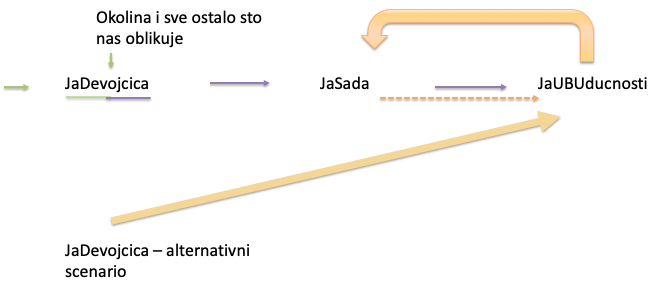
It’s never too late for creativity and it’s never impossible. However, it requires venturing into the unknown and imagining what lies beyond the unknown. Then ‘just’ follow the path to that beyond…
*
Wine, Bread, and Water
What to do when tension, impulse, and drive start to grow and are unstoppable? Usually, nothing, because it’s too late, but there is a time interval when action is possible. People suffering from cyclothymia are aware of their mood changes and, if they are ready to face this cyclicality, they can find ways to communicate with it and tame it. And this taming is never done violently. When we feel that we are not quite at peace with something, something oppresses, annoys, irritates, bites, and in any way disturbs us, it’s the moment to ask: ‘Okay, am I going to explode soon?’. If the answer is yes, then we have no choice but to accept: ‘Okay, I will explode in a moment, let’s see how’. And if the answer is no, maybe it’s true, and maybe it’s not. That’s the moment to take the first piece of bread. Just like in wine tasting, when a series of wines by fullness is started. It’s easy to continue quickly down the line, comparison speeds up. And then, there’s a piece of bread. To not go too far.
Of course, at the beginning, it’s difficult. Sometimes it’s easier to drink a glass of water. It doesn’t add calories, doesn’t break the sequence, but it’s still drinking. Something like an excuse or damage limitation, but not an acknowledgment of what is accumulating. Then one learns the hard way, post festum. Finally, one starts to nibble that bread. What was initially rejected as a diminisher of the fullness of taste slowly becomes a real enhancer of each individual taste. Continuously it becomes discreet, and discreet can be maintained in its expression.
Cyclothymia is not naive, in it all tastes blend and fall like an avalanche and we only remember the finale. Small pieces of self-listening separate the stages. No stage is bad, the accumulation of all led by the Shadow can take further from the original: tasting the finesse, fullness, and finale of each individual wine.
*
Everything is Black When There are No Receptors
The cosmos is black, yet colorful. Black, because everything for which our eyes have no receptors we perceive as black (there are a bunch of other explanations: https://donschool86.ru/hr/leksika/pochemu-v-kosmose-net-sveta-pochemu-kosmos-chernyi-pochemu-kosmos.html, https://express.24sata.hr/znanost/evo-zasto-je-nocno-nebo-mracno-iako-zvijezde-sjaju-9463, https://www.bbc.com/future/article/20150727-what-are-the-limits-of-human-vision), and colorful, because there’s so much that can be seen only when we process images obtained by devices that register microwaves, X-rays, and the like. This is interesting in itself, but it can also be very nicely connected to the human psyche.
What we cannot see, we call black. The unconscious and its various units, tissues, and organs are quite invisible. So, how could something invisible be understood, conceived, imagined? There must be the possibility of allowing ourselves the idea that there are things that are not (easily) accessible to us. We do not have receptors for everything, but that does not mean that something does not exist. There’s nothing particularly new here, indirect methods have been successful since ancient times. Yet, black still does not automatically stimulate us as a multitude of possibilities. Moreover, if we do happen to imagine that there is something in the dark, it is usually nightmarish images or memories of some scary stories we heard earlier. Rarely do we imagine something completely new and neutral, neither good nor bad. And the unconscious is just that: without the idea of morality and the polarity of good and evil. It is there, in us and around us, unimaginable, inhuman and human at the same time, and beyond time.
The natural reaction is to immediately reject and doubt to protect ourselves from the unknown or to blindly believe to appease the unknown. And then we distance ourselves from that unknown and again are within ourselves and our complexes of distrust, trust, flattery, rebellion, and everything else. Maybe the best thing is, if we first manage to be curious, and then willing to think that maybe we don’t have to just defend ourselves and that we don’t know everything, to add new thoughts. Maybe we doubt, but then healthily criticize that thought, and then that new one, some internal dialectic that refreshes the mind and really, indirectly, illuminates it, without seeing the light with its own eyes. Even if all these thoughts are deeply anthropomorphic, maybe, by their mixing, multiplying, teamwork, and individual originality, they will manage to add a few more receptors.
*
No, Don’t Save Me
It is undeniable that those who are hurt suffer, remember, ask ‘why me’, and reevaluate their role in the hurt. Even more undeniable is that all this leads to insecurity towards the Other, fear that the Other will hurt again, not understand the extent of the injury, or be frightened by the sudden vulnerability of the hurt in certain situations. And what do the injured most often do? There is no single rule; much depends on the type of personality, social rules of survival (and flexibility of possibilities of rebellion in a given society), interaction and compromise with others, and many other factors. But one thing is common. The injured will assume that other injured people will understand them more easily. And here begins another drama (after the first one, already suffered).
The injured instinctively recognize those who suffer in a similar way and hope that they won’t have to explain or hide, or find the words or the will to describe what happened to them, as they would have to with the Uninjured. And no, most often they won’t have to, but they often assume that every suffering is of the same depth, extent, and content. But it’s not. Some sufferings are deep and transparent. Some have two bottoms. Some vary in depth depending on the ground underneath. Some have sediments below and watery liquid above. In other words, everyone views others’ suffering through the filter of their own. Sometimes there is a desire to help the Other, understanding that it is not easy (no matter how), but there is no strength. Sometimes there is no will, sometimes it is not a priority, sometimes there is a desire, but it is not successful – obviously, there are thousands of versions.
While the Injured waits for help from another Injured, thinking that this is the safest way, they bypass the Uninjured. Sometimes this happens instinctively, sometimes out of conscious fear, and sometimes the possibility of help coming from the Uninjured is belittled. The Uninjured still know safety, their secure life can evoke various projections in the Injured (denial, belittling, trivializing, even discrimination). A significant number of Injured will unconsciously discriminate against help offered by the Uninjured. Of course, everything that is Unconscious exists somewhere in us. And the Shadow lurks for those small unverbalized unconsciousnesses that it can use to sabotage individuation and keep us in the current state. Thus, through the Shadow using irrationality/partial rationality (in any case, unchecked rationality), these Uninjured are distanced and their help (if they offer it, want to offer it, and know how to offer it) will reach the Injured less. In the meantime, the injured do not help the Injured as much as the Injured would like, so they then become disappointed in them, quickly stepping into the logical dead end: ‘If the Injured, knowing that I am Injured, hurt me, how much more would the Uninjured hurt me’, without knowing even a bit of the answer to that question. Here the Injured most often choose isolation from everyone.
Who is legitimate to help us when we are hurt? Can we endure the first wave of ignorance (not understanding the depth or content of suffering) to allow help to arrive? Is pride that restrains this desire for help also a brake on any kind of helping and pushing towards finding strength in ourselves? Is there permission to still accept the help of Others even though we know that priority is the one we create and build ourselves? Can we avoid rushing into hatred towards the ignorant, which, in a naturally different dimension and therefore incomparable, makes us also someone who hurts Others?
*
Compacting
There is much discussion about Attention Deficit Hyperactivity Disorder (ADHD), both in children and adults. A diagnosis that has become well-known in recent decades is often disputed, its prevalence explained by unfamiliarity and non-recognition of this disorder, and the medications used from early childhood often provoke contrary reactions. Meanwhile, many subtypes have been named: there’s a type with hypoattention (reduced attention) and hypoactivity (inhibition, slowed reactivity), then just hyperactivity, and comorbidities. When, in the meantime, during growth or after diagnosis, traumas occur or certain complexes are activated, the clinical picture becomes even more complicated and it is less clear how much ADHD is a consequence or cause or unrelated to the appearance of other mental states.
Regardless of the mechanisms of the disorder of activity and attention (and often other cognitive parameters, such as organization and planning), the changes in neurotransmitter levels and the number of synaptic receptors to which these disorders objectively apply, let’s look at something finer – why would the economically thrifty and always cunning brain agree to a high prevalence of ADHD? In other words, what is the evolutionary purpose of ADHD (if we accept the option that mental disorders that survive in human society are based on some evolutionary advantage that has been exhausted or lost measure in one generation)? Ontologically and transgenerationally, does this disorder have advantages? If ADHD occurs independently, does it later play a role in the genesis of other disorders, e.g., depression? Or does it occur before depression, compacting it, ‘distracting its attention’ and changing its destructive power? (The same could be said for other comorbidities, e.g., anxiety.)
There is often talk of an ever-faster world to which we must adapt more efficiently. The world is quite hyperactive and does not have much attention for individuals. Is ADHD an individual reflection of broad sociological changes? Maybe it doesn’t matter whether the world is fast and tires us out, maybe it’s just the fact that it’s fast and has too many possibilities that exhaust our filters, our usual tactics to choose something at the expense of something else? Does the fast ADHD actually slow down (in the long run) the individual and find his true measure? Is ADHD a way to reduce attention a little for everything, thus also for negative stimuli?
I don’t work with children diagnosed with these disorders, but with adults, who usually realize during a midlife crisis. In the beginning, when it is determined what it is about, there is a great relief (sometimes noticed in adults who discover they have Asperger’s syndrome) – everything that was difficult earlier becomes understandable. Simply, they are not strange, different, or incapable, they just have a different rhythm. Then begins the work with this new knowledge – what will happen if they ‘slow down’? Will something else change: vision of the world, relationships with others, needs for hobbies, or engaging activities. Then begins the work on identity. This identity was not different because of ADHD, but the disorder narrowed its expressions. When that is experienced, integrated, felt, then begins the work on individuation. Individuation is entirely possible with ADHD (treated with medication or not). Individuation is not lost to disorders, it can be hidden if we do not get to know ourselves. A disorder may muffle and mix some signposts, but identity awaits to be found. The unconscious leads when the conscious follows long-term goals that are not always the clearest. That’s why it’s important to determine the place of ADHD in life and what life would be like without it. Sometimes writing alternative autobiographies leads to the real one.
*
Distinctions
In psychotherapy, love is often mentioned, imagined, played out, denied, circumvented, kept silent, and discussed. However, this post is not about love, but about erotic transference that can often be interwoven through the intellectual-intimate relationship between a patient and a therapist.
The therapeutic relationship is different from all other relationships. Two people do not know each other and yet know each other exceptionally well, the relationship is asymmetrical (the therapist knows a lot about the patient, the patient knows little about the psychotherapist), the rules of trust are unequal (the patient can talk whatever they want about the psychotherapist outside of sessions, the therapist must not say anything about the patient), the relationship is intimate yet professional (there is physical distance and verbal closeness).
How then to distinguish what is real? Feelings are talked about. Old feelings are experienced or experiences recounted. Often there is a need to belong, to love, to be desired. These needs often exist in the therapist too (though the idea is that he/she has already worked on this in their personal therapy – I think it’s necessary if such feelings occur to the therapist to return to their therapy, only supervision). All feelings are welcome, but not all actions. All words and naming are useful. Erotic transference sometimes happens and should be immediately mentioned, talked about. Much has been written about this. What I would mention here is the lostness in what is real, what is desired, and what is imagined. What, then, are my real emotions if I am projecting onto someone something that I am seeking elsewhere? Can I love the therapist when I am only in a relationship with his/her Persona? Who am I really loving then? What he/she represents, a part of him/her that is not the whole? Or do I want to reach that whole to be different, special, distinguished, omnipotent?
There are many explanations and not all are psychopathological. However, the relationship with the Other is a relationship with the entire Other. Love is a relationship with all levels of the Other without losing the relationship with Oneself. If a little of my fantasy is enough, in a relationship with a part of Myself that I attach to the Other. If I am in a relationship with one part of the Other (and that’s enough), I probably identified it with my Animus (Anima). If I want more, the entire Other, outside the framework of therapy, it is a good moment to first examine my own completeness. Do I want the Other to complete me (and the therapist sounds like someone who might, in theory, know how)? The feelings that the patient experiences, calling them love, feeling them as love, and if we immediately devalue his/her understanding of the feeling of love, we enter a turbulent area. If I don’t even know whom I love, how to love Myself? How to love, if I don’t recognize love? Therefore, erotic transference is a very delicate phase of certain therapies where, before fear and shame, it is necessary first to find an entry into distinguishing the feelings that the patient calls love. When we name deeper feelings (insecurity, aggression, loneliness, envy, sadness, instinct, etc.), we will slowly return to resolving the mystery of love. And the erotic transference will gradually transform into therapeutic transference. For this, a lot of patience, courage, and good individual therapy of the therapist during their education and further life are necessary. When these conditions are met, trust occurs. When there is trust, it is not necessary to mix it up and wrongly call it love.
*
Static of the Fatal Pair
We always seek that fatal Other. We seek Ourselves in the Other. Someone most similar to ourselves who will knock us down with their ‘reading of our minds’ and a lock-and-key connection. Of course, the perfect reflection of Us in the Other, whether the same or different sex, is never 100%, but it can be idealized as if it is, or at least 99%. Seeking the familiar is not surprising. The disappointment of its discovery is. Imagine that perfect union – dynamics are devalued. Everything stands still.
This doesn’t mean that we should actively seek drama. Nor does it mean that we should artificially stop before some ‘happiness’ so as not to lose it once it is found. It simply means that static is harmful to our being. We change, everything changes, time passes. The fatal pair is under increasing pressure to, since it succeeded earlier, now always succeed in ‘perfection’. Static clings to dynamics. Dynamics are uncertain. Everything must be anticipated. Either this will happen through conversation and agreement on how to proceed (there must be a possibility for differentiation) or through the expectation of some magical telepathic connection (‘we will do the same’) or through artificially forcing ‘sameness’ (‘He/she will probably do it, so I will too’). Intuition is personal, no two people have identical intuition. If they could have it – identical, then that intuition could lead to the same actions only until some paradoxical, ambivalent situations and sooner or later, a complex of just one of the two people would be activated. This complex would seek a defensive reaction, intuition would take this into account, but for the other person in the fatal pair, this reaction would not be clear, because, although this ‘magical’ intuition is the same, it is based on something different. What is problematic is (besides the fact that identical intuition does not exist) that no two people have identical complexes. Even children grown up in the same families will react differently to traumas, depending on their place in the family, their role, relationship with others, personal unconscious, and personal piece of the collective unconscious. Simply, there are no two identical people (not epigenetically and not according to psychic structure) – there will always be some difference. The fatal pair is therefore fatal in the true sense of the word, as it does not accept the difference. It is only from the difference that a relationship is built.
*
Hyperempathy and Hypersensitivity – Often Lost in Others’ Drawers
Empathy is often valorized and indeed, at first glance, it represents a supreme virtue in relating to the Other. The Other suffers, exists, has their own opinion – by assuming and understanding this, we can enter into a relationship, leave it, or not ascribe something to them that they are not. The problem, as always in interpersonal relationships, is boundaries. What do I do when I understand the Other too much? What is too much, anyway? My view on this would be: too much is when it’s more than my existence in that relationship when the relationship with the Other eclipses an honest relationship with myself. Here I carefully say relationship, not love for oneself. Not so much because that expression has been overused to the point of losing the message for which it was created, but because it’s not necessary to love oneself. It’s necessary to know how we feel about ourselves. Love, hate, shame, suspicion, all these need to be called by their real names. Principally, naming feelings is already halfway to resolution. If we don’t lie (more-or-less to Others, that’s the scope of ethics, but if we don’t lie to ourselves, if there are no double messages in the base of our being, in the relationship of Self with Self), we can know the angle from which we look, something like a banal view of quantum mechanics, to know whether we are waiting for a wave or a particle. Our view of Others and Ourselves is just our view and there needs to be awareness that there are other views, but also that our view exists as another view for Others. And our view is ours and we can’t change it out of the blue but get to know it and its limitations and possibilities to change them or not.
Now, when we are sure that empathy is a useful virtue, let’s see if it’s universally useful. In other words, is it sometimes not useful? Here we return to that ‘too much’. (Too little empathy is clearly a deficit in the relationship with the Other that should not be immediately punished or belittled, it can stem from traumas and fears, not just pathological sources.)
Too much empathy, hyperempathy, and its mediator, its tool, hypersensitivity, are excessively porous boundaries outward. Everything is absorbed, there are too many stimuli, and all these stimuli have their explanations. Everyone can be understood. However, there is no selection. Everything is significant, everything is noticed. Utopia or saturation? Something like science fiction films about people with the ability of telepathy. Uncontrolled telepathy is chaos. After all, a person always has to have a list of priorities, even if it is dynamic and conditioned by various external, internal, or spiritual factors. This does not necessarily mean hierarchy. Hierarchy is dogmatic and rigid. Here we are talking about an elastic system that is constantly changing. Everything can be understood, but it is understood only when it passes through the filter of ‘Self’. Here we get stuck. That ‘Self’ is not always clear or has not learned to inspire trust or is not close.
There is no golden solution. Getting lost in someone else’s world or getting stuck in one’s isolated world is equally disastrous. Arranging everything around us and within us in one order (pyramid, ladder, however) is unnatural. Holding everything as possible, spontaneously receiving all stimuli is exhausting. Of course, as always, the right answer would be, moderately, not too little, not too much, but that is difficult to learn without an urgent need.
The best advice is: to ask. Ask ‘Self’: what is important to me now, do I exist, is the next action useful, not evil (it does not need to be good, as it is a broad, personal concept) and now, at this moment, necessary. Ask ‘Self’ if it has freely chosen to listen to a stimulus. Let go if something persistently penetrates and see what role it plays in our life. Don’t hesitate to stop something that wants to be heard, but don’t be a slave. Don’t be afraid to let the Other take care of their life. We can’t save everyone, that’s true. Usually, we try, get tired, and don’t save anyone (sometimes not even ourselves). Saving someone is already something. Saving Yourself is a lot. Not everything has to be systematically asked all the time – it’s enough to just pause and talk to yourself before we give all of ourselves, which we sometimes don’t even know completely, to someone who may not even recognize it.
*
Before-before + Before = Now
It is often said that the period of adolescence and its crises is a kind of rebellion against parental models of behavior and values. Childhood is about absorbing everything around us, making judgments through what is shown to us, and adapting to what is around us. Then pre-adolescence starts to show that there is something beyond the small enchanted circle we noticed as children. The different becomes more accessible, and the familiar intrigues us. So, crises occur, and everything is reexamined. Previous models are devalued, new ones are received from the environment. Then in post-adolescent age, everything calms down and stops – a certain stable identity with which we reconcile is established. Here, often, is the catch. This balanced identity is not always so balanced, as not all pains have been noticed, all disappointments spoken, and all angers worked through. Often our anger during the crisis stopped on the opposite side from where the crisis started. Also, sometimes the crisis was unfeasible (vulnerable parents, priorities related to external events, fear of self-realization due to its consequences for loved ones) and that ‘final’ identity is a shade of parental and family models.
However, crises are not for destruction but for questioning. If the family model is blindly replaced by the model of the environment, there is not much progress. If everything is destroyed and nothing emerges from the ashes, considerable creativity is needed to devise a new model. If the model was so unstable and non-existent, and a new axis has not been found, again it takes a lot of courage, persistence, and motivation to come to that small word with great power – identity.
Identity is the child of pre-pre, from where we originated, no matter how physiological or not it was, those are the first axioms and the first letters with which our soul communicates, and what we ourselves have tried to question, overturn, confront, or at least imagine that it is possible to confront. When we mix different perspectives from which we view life, the world, and ourselves, only then do we begin to be in contact with ourselves. Firstly, we move out of linearity and enter the sphericity of our relationship with everything, as everything can be seen from multiple angles. If we are capable of multiple views, we open the chance for empathy to settle in our interpersonal functioning. Then we can avoid the enforced and often overly burdensome need for creativity that kills spontaneity, a basic prerequisite for creativity. Creativity rather comes from a multitude of combinations (just as thought is created from a multitude of synaptic associations) that at one moment represent something greater than the sum of their own parts.
I am now and here everything that was pre-pre sprinkled with what was pre (with all possible fantasies of what will be) with my all-encompassing that amuses itself by questioning all this, not holding grudges and without moralizing, giving new chances.
*
Not Rereading the Same Crime Novel
Every decision-making process must come to an end. If we remain stuck in the purgatory of deciding, the consequences are often quite painful. Time passes, and passed time likes to accumulate various emotions and the most complicated thoughts and post-hoc analyses. Pre-decision making is sometimes very complex – there are so many factors to consider, so many unpleasant or insurmountable consequences to imagine, so many future guilts and regrets. And pre-decision making must, in some cases, take time.
The end is important. However the decision is made: by thinking, gambling, dreaming, imitating – that is no longer important afterwards. At the moment the decision is made, it’s like reading an Agatha Christie crime novel. Once is great, but there’s no need to read it again if everything is already known. Returning to pre-decisions is incredibly energetically costly (like putting spilled water back into the glass from which it was spilled).
It’s not easy to make decisions, but the most important part of decision-making is the discipline not to be greedy and start doubting the linearity of time. Whatever we come up with later, that’s later. Even a new decision that negates the old one is new. Sometimes it’s okay to have an ally in time and not defy its rhythm… And when it’s not, there is the Atemporal Unconscious. It activates whenever the moment of decision-making is not the actual end but a maybe. Each cycle of decision-making has its own line. Every new line is welcome.
*
Perfection Includes Time?
Perfectionists are everywhere in our society. There are enough psychological-anthropological-sociological discussions about the influence of the fast pace of our world and constant pressures that leave us forever frustrated because ‘it’s never enough’. What is less considered is that perfectionism is 100% and that in a very selective way. ‘I want to be 100% successful, but 0% unsuccessful.’ ‘I want to be 100% healthy, but 0% sick.’ That is, to some extent, easy to understand. But, what about ‘I want to be 100% honest’ – here the problems start. Perfectionism is, therefore, my personal system of valuing qualities, abilities, talents, etc., and then sticking a value to them that I want to inflate. Meanwhile, what is not ‘good’ according to my system is devalued, and I easily slide into splitting, ‘all or nothing’.
Okay, let’s see it differently – I clearly know that I want to be a perfectionist only in socially accepted categories – so, I eliminate categories: unhealthy, unsuccessful, terrible, because I really wouldn’t want to be 100% in those. I want to be 100% in everything that ‘is good’ for me. In this logical experiment, we can put empathy aside, because if I am, in addition to all this, 100% empathetic, I won’t be able to easily solve numerous ethical dilemmas – when to hurt someone, when to choose myself. So, let’s say empathy is also 100%, but there are no major risks to Others. I am 100% ‘what is good for me and does not harm others’. It’s getting tight.
What about time? If I am 100% in everything, I also have a 100% gain in time – my time reservoir is infinite. Does that mean I live forever? If not, I’m not really 100% in everything, I will have to die one day, which will be something that ‘is not good for me’. I have to be immortal to be truly 100%. Okay, that’s not possible, does that mean everything falls apart? I know it’s impossible (if it’s possible, if I’m immortal, that doesn’t mean I’m immediately perfect, but that’s another story), so here I accept less than 100%. Again, I make a selection. My 100% is completely personalized by my demands, complexes, and pressures. I know that 100% in anything is not possible (and even if it is once or twice, it’s not repeatable and permanent, a good example is Snow White’s stepmother and her experience with the mirror) – so those 100% are my choice to demand them, require them, provoke them.
Why not always want more? 100% is a fine stimulus – however, 100% means that everything less than 100% is insufficient – less than what is sought and in the end, there are only two options 100% and everything else – even 99% is closer to 0% than to 100%. The perfectionist keeps themselves in a permanently frustrated state.
If I am perfect, I must control time – if I am perfect, I have beaten myself, but actually, I haven’t fought against myself but against the perfectionism complex that we all carry. And it’s just a complex. Like every other, it grows as much as we feed it. The only way to get close to those famous and unnecessary 100% is – to accept that the desire for 100% in something comes from something that happened to us, which was probably very, very imperfect and usually, doesn’t belong to us at all.
Despite everything it can mess up, man/woman instinctively always fixes things… Just not all repairs are pleasant when they come at the wrong time or in the wrong context… Maybe the real question is when we want to be 100%, – who and what do we want to fix and is that even our job?
*
Time Detectives
At what moment did everything get stuck? One of the most important questions in psychotherapy. When did some part of us become alienated? When was a psycho-clone version of ourselves created? The psychotherapist often needs to have detective abilities. They chase virtually through space, and counterintuitively, grasp much more clearly through time. Sometimes the origin of a complex is hidden in generations past. They are found or intuited. Often they are located using everything that has been verbalized in a family – subtract all that from what would be logical to know and you find gaps. Then you dive into underwater caves with the white light of the Conscious and the colorful, congested Unconscious – the one that illuminates dreams, active imaginations, and instinctive reactions. Sometimes they are so deep that they are given only a vague name, mention, and conclusion. There are also fresh traumas that can be clearly determined, but whose interaction with the inner and intimate is unclear. It is known when something happened and everything is linked to it, but the communication between that something and deep pains, uncertainties, and unrest happened later. Then we fix the trauma instead of dealing with that connection. The psychotherapist must keep in mind Chronos, always know where Aion is, and see Kairos ahead of them. And to be able to do that, the psychotherapist must ask themselves what are their intimate connections with Time?
*
Ideal vs. Real World
It is wonderful to search for oneself. The reasons for this search are much less wonderful, but the realization that one wants to know and align our inner unknown with what we call identity is often a powerful (and anxious) desire. And there, all sorts of things are imagined – mostly some ideals, how I would like to be, how I would like to avoid being. Individuation gets confused with idealization. The Complete Self gets mixed up with the Ideal Self. For this reason, even the most delicate spiritual-philosophical-sensory path cannot do without a ‘reality check’. Reality is like a small number on the side of the aesthetic sign for the mathematical integral. It changes everything, but we see it second, never first. However, sometimes we see reality as the first all the time, and there imagination gets lost and the Unconscious retreats before the large and expensive gates of the Conscious. Sometimes that reality is hated, because for so long it was not seen as possible, even irrational. They are all necessary. The ideal without control by reality (to specify: with the help of reality) floats. The real without seeking contact with oneself sinks. Only their joint action creates optimal gravity. With it, one can walk.
*
On Ideal vs. Real World
Is Art as Therapy Really Art?
The artistic act is very often a reflection of the inner being. And that being can suffer. Art can heal by restraining, confronting, provoking, belittling, or simply identifying internal conflicts. Is that art, really, art or is it some kind of sophisticated art therapy? Of course, there is no clear boundary. Nor does there need to be – there are no specific recommendations, rules, or judgments. However, the work of a person who is in the process of suffering and a person who has completed a cycle of suffering (not just suffering, there are also ecstasies, reevaluations, enchantments, and existential crises) is different. One is not better than the other. They are just different. What differs is the impact on the viewer (reader, listener…). The transmission of something personal that is in process and seeking wants a response, seeks complementarity, healing, or impression. What has stopped at some peace, at some point, in some temporality, conveys new knowledge or a new relationship or new harmony. Then all that we take from that piece is absorbed into us and it mixes with ours (mostly our complexes) and a new process begins.
*
Necessity of Non-Identity
We often have our moral beliefs, our convictions, or loyalty to some family myth. And rationally we comply with them. But sometimes it’s not the best for our entire Self. For example, lying is not something we identify with, but lying can help in an uncomfortable situation. Sometimes this reaches consciousness, and we have to deal with all the pros and cons. Sometimes our Unconscious knows very well that bargaining with what we call identity can be prolonged or end unfavorably for Us in the future. Simply, we can’t align everything and convince ourselves that it’s harmless or necessary. And, likewise, sometimes, we suddenly do something and while our Conscious begins to be appalled, loses, or shames itself, some action has already been determined. It’s easy to attribute this to the Shadow. Of course, the Shadow is our inappropriate knight, a mercenary authorized by some part of us with which we partially agree, but not entirely and whom we do not know at all, so we can’t connect ourselves with those ominous actions. But that Shadow does the job delegated by the Unconscious. Sometimes the unconscious must override the Conscious to reach some, at that moment, unknown goal. The Conscious accepts responsibility because it sees what has been done, but the part with guilt is unclear. I didn’t want to lie, why did I lie? If I had just thought a little more, I would never have done it. And precisely because I didn’t know I would do it, I could do it. And that’s scary. The Unconscious is atemporal, knows much more than the Conscious Self. It has that part of Us that surprises us. Can we let go and trust? This is difficult for the Conscious, because it is based, among other things, on social norms, the concept of good and evil, on the moral. The Unconscious is everything that exists, has existed, and could exist, therefore it is amoral (not immoral). How to accept those parts of Ourselves, potentially unempathetic, bad, and evil, as the Conscious would disparage them from its perspective? How to trust that they won’t destroy everything the Conscious has built? How to believe that the Unconscious has a clear path for us? Especially if we remember that individuation is a path of harmony, but not a path of morals or immorality, good and evil, simply, individuation is a path. How, then, to let go? Most likely not at all, or at least not force it. The Unconscious will find a way anyway. The Unconscious will extract the stone from the mine, the Conscious will later polish it.
*
Individuation of Jon Snow
Like many, the series (and the first couple of books) ‘Game of Thrones’ marked the 2010s for me. And then the end came. And the end was painful. Now, everyone has their own explanation, their own reaction, their own criticism (some quite childish, like writing petitions to change the ending). I simply accepted it, worked through my disappointments, and moved on. All was well until I worked with a patient for whom this series was a good illustration of her inner processes. And so, talking with her about something of hers, I stepped into something of mine. I realized my projection, or rather, my intense projections. ‘Game of Thrones’ is a fine reflection of the psyche. There we have aggressive complexes, a psychopathic core, various other instances, Anima and Animus, different forms of Shadows, and an unidentified Self. I was disappointed when Jon Snow went into exile – I, because I wanted for him (for Me) to be king(queen). I was angry at him for betraying me, but he just chose his individuation which I judged and condemned. The beautiful Daenerys had her path which strayed from the right measure – I found myself affected, because my aggressive complex (and indeed my Animus and Shadow) wanted to overflow everything and identify with Me. More or less personal analyses of ‘Game of Thrones’ – what’s important and what I had to relearn is that everyone has their own individuation and that they don’t have an ethical component. Simply, the path is neither bad nor good, the path is the path and the more harmonious we are with it, the more at peace we are. My Self is honed in contact with projections. They are neither good nor bad, they are just projections.
*
Mother is Also the Other
I have spoken enough about the necessity of understanding the subtle, virtual boundary between the Self and the Other. It’s always simplified with images of circles or spheres or above and below, I myself often resort to this to illustrate something. However, it’s all much more entangled. Spheres are never round, and boundaries are like cellular ones, semi-permeable. The analogy of the psyche and the animal cell (the cell wall in plants seems to me a story of its own) has always appealed to me, as both have an organizational center, more or less rounded functions, and the flow of matter and energies from the outside. And each is an identity in itself and each cannot exist without what is around it.
Now, I return to one particular cell-psyche. Mother. And Mother is outside of me. In other words, she also has her defenses, her laws of survival, her myths, and her boundaries. Many children get lost here because they want to have a shared cytoplasm. There are mothers who are very aware that they do not want this. They have fought, consciously or unconsciously, for their boundaries and cannot just give up. The maternal instinct is not the same as the merging of one cell into another, cohabitation. Many works have been written about the fusion of mother and child, even more about differentiation and the necessary separation. I would stop at something obvious, yet hard to emotionally accept: the mother is a completely different person. This other person must survive herself, us, others. And this other person makes that survival in the most economical way for her. This doesn’t mean that this way is understandable to her herself, let alone to us. Even when a child in mature age through psychotherapy finds all this acceptable, it’s not on the child to give this gift (apple) of knowledge to the mother. She is the Other, and that Other follows its own path.
Of course, very similar for fathers…
*
Speed as a Defense
Rushing through concepts and understandings slows down the emotional integration of what is found and understood. In psychotherapy, it’s never enough to just understand – this understanding must also be integrated. That’s where the work on oneself often gets stuck. Everything is clear to me, why something works, what drives me, but I fail to change. It’s not enough to just define, it’s also necessary to defend (or not be satisfied with) the defined, and then, on top of all that, allow it to make sense. But what if the sense is rational, or the sense is okay, but it’s just an imposed sense, or it’s the sense of some idealized version of ourselves. Can we be patient and let all this metabolize? Usually not, because it slows us down and gives more time to old complexes to gather various arguments, recollections, or conspiracies against change. And then we rush. To prevent our complex from catching up, we continue to add hypotheses, rework them, reconvince ourselves. We do all this, waiting for the magic click, when everything integrates and change starts by itself. Sometimes these magics do happen. For example, ayahuasca is not a bad catalyst for magic. Still, sometimes that’s not enough, so ayahuasca sessions are added to refine something more. We don’t get addicted to the plant, but to the possibility of change. In a word, we run from change by ideating change. We have a perfect excuse: I’m working on myself. In reality, we’re working on working on ourselves. The speed of this work gives the illusion of success (far from it that it’s not entirely respectable, even that work is incredible – but it’s not enough!), and speed becomes a defense. Sometimes one must survive silence, emptiness, and stasis. To let new ideas find their engines.
*
Can the Shadow Control Emotions?
This is where the illusion lies. When it’s clichéd advice to ‘follow your heart,’ what does that actually mean? Current emotions, emotions that surge from complexes, feelings we want to have in the future, after some decision for which we ask ourselves what should we follow? To follow the ‘heart,’ it’s necessary to know where all organs are. The heart is a part of us, just a specialized mass that makes up a whole and exchanges with everything else up to the mighty boundaries of the skin (at least if we stop at the material). The same with internal forces. It’s healthy to follow emotions that are the resultant of endless vectors of time-varied Selves and the play of amoral (not immoral!) complexes. In other words, my emotions are a reflection of my inner being, of me. If we don’t know where they stem from, it’s very possible that they are corrupted. The Shadow has cast its tendrils, and our heart that we follow is actually the Shadow’s command to maintain the status quo that we follow. How to know? If we need to stop and think, it sounds mature, but it’s not quite nice, natural, animalistically instinctive. And yet if something seems instinctive to us, are we sure that it hasn’t been ‘trained’ by the Shadow for some time? Rationality gets easily stuck because the Conscious tires. The Unconscious contains within itself both fatigue and rest, ‘must’ and ‘a-mor.’ Therefore, the best connection with oneself starts through intuition. Intuition cannot be learned; it must be allowed to come on its own. And for intuition, faith in oneself is needed (and faith in the Future Self). That means, faith that somewhere within me there is a part that knows how to maturely support and protect me (and not immaturely like the Shadows). My job is not to sabotage that part, to let it find me. In short, the path to following the heart goes through peace with intuition.
*
Danger Outside of Work
A psychotherapist spends quite a bit of time getting to know themselves, identifying their complexes and shadows, and keeping them aside, but at the same time visible during the relationship with the patient. Of course, there’s also a lot of time invested in learning techniques, theories, and processes. And when one nicely enters the world of psychic energies and relationships, it’s important to know how not to use it in front of people who are not patients. When is it really possible not to notice something that we do for the larger part of the day and for which our senses and intuition are sharpened, because it should not be noticed, because it’s not ours to notice? And what to do if something still enters our psychic receptive field? Say it, feel it, meddle, push away? And what if it concerns people close to us? How to know that a friend confides in us because they need a friend, and not because our words are valued differently? And conversely, how to know that we can relax, without theorizing about countertransference, to say something bypassing the Therapist Persona? Are we allowed not to be therapists to close people? Or must we be exactly that?
There are many rules, there is a clear setting (psychoanalytic situation), there are a million healthy thoughts. And yet, there is context. When a therapist is with a patient, they operate two parallel universes: one universe is in the current relationship, the other is parallel, personal, one that is recognized, reminded, one that scans for possible awakenings of complexes and their contamination of the first universe. If the therapist is open to autoinspection of complexes (and this is, in principle, necessary for this craft), then the system imperfectly (because the unconscious does not allow for perfection) functions.
But when we are with friends, the first universe should not be activated, because we are in our own, personal space. And is there room for personal complexes? What about them? Recognizing and extinguishing, sabotages, putting hands over the mouth? Or, simply, verbalization. As always. Recognizing where we are, who we are with, and why we are (or are not) at peace with ourselves. And how many universes are activated.
*
Two Different Children
Despite all the apparent self-love, we easily fall into the traps of its covert tactics. Sometimes we save ourselves, that is, the part of us that needs to think of ourselves as a good person, as a counterbalance to some defined or blurred evil. Then we sacrifice what we think we love, what we think is important to us, and what we think is good for us. And the more we think all this, the more lavish and striking the sacrifice. What is good for me is often less important than what I think I am – good or noble. We always save our priority, that with which we truly identify or strive with all our might to be identified with. This in itself is not at all unusual. But on this path, various contradictory situations occur – often called by the vague term self-destructiveness, and here we get stuck. Self-destructiveness, of course, exists, but it is a means, not an end. The goal is not to self-destruct, the goal is to defend what is even holier than life-health-love.
Imagine we are the mother (regardless of whether we are male or female) of two children – the children are twins. However, they are very different. One child is seriously mentally handicapped with no possibility of improvement. The other child has no health problems. How do we treat the children? A big dilemma arises. Instinctively, we give more to the sick child, we are needed by it. The other has the capacity for survival. Is it fair (of course, moral questions have nothing to do with this, but they always get tangled up and it’s a long way for a parent to understand that the primary „injustice“ is also not an injustice and has no morality in itself)? No, because it’s not from that dimension. Is it less destructive for the future to focus on the healthy child? Is there any sensible answer at all, or does everything just happen on its own, with juices, intuition, good (read: never successfully good) intentions, and the like?
Now, let’s use this metaphor for something else. My environment is mine and no matter how much I reject it, it’s already there, because it was there before me, time has already established an indelible relationship with it. Rationally, I know that this environment doesn’t have the capacity to be with me now, at this moment, doesn’t understand, will understand later, will never understand, it doesn’t matter. Yet, I give it my energy which I could save for the healthy part of myself and direct that energy to something that will harmonize my trauma with my repairs. Sounds nice, but rational rarely appears without its antimatter – its irrational. Can I make such a sterile choice?
Okay, now a layer deeper. The same metaphor, but I am the mother of two mes, one complex and stuck and the other with the potential for growth. Will I neglect the part that can grow, just because it can grow? Will I discard the part that can’t go further, because it will never be able to go further, but is still some inalienable part of me? Or will I balance between them? Will I be able to balance? And will I be able to be just a mother, and not also other roles of my life?
It gets complicated. And there is no one answer. And therefore, just therefore, there is no wrong answer.
*
Nurturing the Inner Child
Sometimes there are so many traumas, so much resentment, and a bit of stubbornness that, all together, prevent that famous inner child within us from growing. We get stuck at a certain age. Biological and intellectual ages continue to count years, but psychological and emotional ones fail to overcome the barrier. We have so many inner children within us, but there is one that commands all of them and cannot move forward and without which we cannot move forward. Now, the theory is clear, not at all new. We try, we push, and we suffer. Sometimes it’s necessary to simply rest, to take that inner child to someone for babysitting. A therapist is usually the best choice, but one must have trust in rest. Small children are not just left with adults. Small children are left in safe hands, even the small children we are angry with. This is one, I wanted to write, technique in psychotherapy that is close to me, but the word ‘technique’ bothers me – it seems too manipulative and predetermined. It is about a relationship, like all others, that is built contextually. A therapist cannot babysit all the inner children of everyone. He cannot take them home or educate them. That is not the therapist’s task. However, the therapist is there to heal, and sometimes healing comes from rest. The inner child presses and suffocates. Sending it for a few hours-sessions-days-nights and seeing how it is without that pressure, if led without mixed messages and with clear communication with the therapist-babysitter, can yield tremendous results.
The first step is understanding the context and time of getting stuck. Then, comes the type of pressure, the quality of that relationship between the wounded child-tyrant and the (non)adult. Next is recognizing the emergence, effect, disengagement, and apparent presence of the child complex. Once the child is recognized, named correctly, and its “journey to the babysitter” is arranged with clear return guidelines and exchange with the (non)adult, one can proceed. Both the grown-up-subordinate and the little-too-strong practice. Growth comes from exchange and cooperation.
*
Is there free will in the moment of survival?
This is a rather intriguing question. There are various considerations, thought experiments, and even some neuroscientific studies that deal with free will. However, the most common tests of free will (decisions, choices, beliefs) have as their substrates the Conscious and (quite a bit) the Unconscious. What happens in instinctive reactions? The body dodges a furious slap or a fast boar – who decides there? Does free will have time to intervene, become involved, or simply observe actively what’s happening in the moment of survival? Or is it an internal program that overrides and skips all others, the one that is unquestionable, the red button? Does the Unconscious turn off the Consciousness that would interfere with the instinct and the Body? In other words, time stops. There is only an attempt at salvation. An intentional blackout of consciousness? Does the Personal Unconscious also get blocked or become overshadowed by the Collective Unconscious?What if a suicidal person finds themselves in an unplanned and rapidly developing dangerous situation? Is suicidal tendency only conscious? Can the unconscious be suicidal? Personal Unconscious or Personal intensified by the Collective? The collective unconscious, isn’t it completely non-suicidal? The Unconscious (in general) knows a lot, both the future and the long past, and what is neither good nor bad. Would the Personal Unconscious, and especially the Collective, dare to act without instructions from the Conscious? Maybe the Personal Unconscious can carry out silent and disguised desires of the Conscious that even the Conscious does not acknowledge, maybe it can find itself in dangerous situations to push the Conscious to express itself? However, can it follow the intention of the Conscious before the kairos moment? Which would mean: what I thought or knew I wanted was my Past self, in my current here self, can I rely on the Past self, because my Present self is momentarily turned off. So, in that now-here (kairos-unstable) moment, my Eternal self relies on Past selves (past chronos selves), but not on the Present self or linear-flow-of-time-self – in translation, the Collective Unconscious has overwritten the Conscious and the Personal Unconscious and thus performs the most archaic, where there is the least chance of error: The Body survives. The Present self is reactivated, maybe moved by this, maybe stunned, or perhaps extremely disappointed or angry. In any case, free will could not exist without the Conscious. Or more precisely: Free will cannot exist without the Conscious and the Personal Unconscious.
*
Is the right moment lying until the right moment?
What should we do when we suddenly understand something (especially if it’s related to the Other), but it’s not the right time. We keep it to ourselves, maybe three seconds, maybe two days, maybe fifty years. Are those three seconds (and other time intervals), actually, three seconds of lies? We know what we have realized, but we do not express it. Now, that’s a problem in various everyday situations, but in a session with a psychotherapist, the problem becomes a bit more complicated. Transparency, like neutrality, is necessary. Trusting the therapist is more important than trusting the patient. He is the one who is in a relationship with himself, which is sometimes full of distrust and bad experiences. It’s not naive to just open up to someone else, especially if that someone is the one you need to tell the most painful and vulnerable things. This trust is acquired slowly and based on it, the possibility of self-trust has a chance to be born. However, there are some pitfalls. One of them is whether the therapist „sees“ something and does not say it to the patient, or at least does not say it right away? Does he wait for the right moment? Does he wait to make sure he is right? Does he not want to rush too quickly if he is not sure? These are all human reactions, but how to trust someone who might know more about us than ourselves? And what should the therapist do – as soon as he feels something, should he immediately share it? As soon as he connects some stories, some comments, and some dreams, should he immediately expose them? Should he wait for the right moment and accept the burden of not-telling? Should he say he has some feeling-idea-intuition, but it’s too early to share it (this doesn’t sound too bad as an approach)? Or, simply, accept that 100% trust does not exist, that the analysand or patient must learn to trust enough, but not perfectly. To remind himself that there will always, no matter how much he works on himself, be some unfathomable shadow and some doubts. And to survive, to survive <100% (much less, somewhere between 65% and 80%) trust, to endure human nature in front of him and in himself. To accept imperfection?
*
Yarn Ball, or Why is There Something That Unites Both Holism and Reductionism?
Reductionism, the fragmentation of something, whether it’s a thing, entity, phenomenon, idea, or situation, is often an oversimplification – we know we’re neglecting something, but we must somehow establish a relationship with the phenomenon or idea and start from somewhere. More alarming is that, over time, the boundary between fragments, big or small, blurs (though artificially set to start somewhere, often randomly, or closest, most familiar, or most attractive) and we begin to believe that the reduced is equal to the Whole. Conversely, stubborn adherence to the whole avoids weakening through questioning, poor choice of reduction, or anxiety of where to start. What intrigues me here is our ability to perceive both the divisible and the indivisible simultaneously. We don’t have to choose sides. We can have both. Both 1 and . Both 1 and 1,000,000. Both 0.1 and 1. We can imagine 0 and 1. This sounds abstract, but it’s actually an illustration of what I’m talking about. Something big and indivisible is as comprehensible to us as something infinitely minuscule. An atom, for example, is easy to visualize and consider its size. We know about neutrons, electrons, etc., yet we can comprehend both an atom and its structure. The same for a cell, organ, human being, or planet. We need an entry point to relate to something and the ability to exit, adapt, and change.
What about the psyche? There’s a unifying Self with which we identify. Yet, there are all those parts and reductions of the Self – numerous complexes, various shadows, and diverse Animas (Anima). In terms of time, it’s similar. There are so many different stages of the Self through time, various turns that have happened or will happen in my Self, but I am still Me. How then to approach understanding this Self which doesn’t function in its unifying form, yet doesn’t function precisely because a reduced part has taken the lead? In other words, are we fighting for completeness by going into reduction? Yes, but we don’t go alone. We hold Ariadne’s red thread in our hands. As we delve into the dark caves of the unconscious, we still know where we started and how to get out if we need a little daylight. We can enter many times and return, we can wait tired for the next journey, or we can just continue. All options are possible. The only condition – not to let go of the thread that connects us to the complete Self. Of course, it’s possible to let go (anything is always possible), but wandering in the darkness of the unconscious is a lengthy and exhausting task, and eyes quickly forget light. Thus, the reduced mixes with the Whole. In another analogy, Mind and Body sometimes don’t function, and just observing from a holistic height that something isn’t working isn’t enough. We must descend into the depths, into precision, into darkness. The whole goes into parts, and parts reconnect with the Whole. Like a ball of yarn, you have to enter and start from somewhere. The yarn is the Whole. The idea of the yarn is both.
*
Kairos Body, the Faithful Knight of the Present
Like the story of the Shadow and its particles (or waves?), the Body is very attuned to kairos. In other words, the Body exists in the here and now. When faced with something incomprehensible, impenetrable, or overwhelmingly heavy at the moment – the Body reacts. It has a vast library, or more precisely, an experience library. A stimulus from somewhere warns: you might not reach the goal first, you might not reach the goal at all, you might say anything, someone might push you again, you might find yourself in a position where you are easily trapped or assaulted – countless „mights“ – countless choices. The mind can’t process them all, some are clearly unsuitable, so the choice between „can“ and „can’t“ is quick – for example, choosing not to remain lying down when an aggressor is preparing to pounce (I caricature the scene, of course). But there are so many that will only amplify ambivalence. If I don’t continue to fight for myself, I betray myself, but the challenge is too great and I am afraid. If I don’t win, I’ll be frustrated, but if I give up, I’ll mock myself, if I say something that I think is just, but doesn’t match others in my environment, will I be able to argue my words. Too much dense traffic for a mind already overbooked, as each option carries within it conscious and unconscious memories, old and accumulated feelings, realistic and complex-usurped predictions of the future. Too many different times prolonging the repetitiveness of the kairos moment and jamming personal chronos time which doesn’t wait for general chronos time. The body steps in. All those chronos times mean nothing to it. It simply overcomes that anxiously-entangled Mind at one moment and acts. Acts from its experience library. Chokes, hurts, falls, loses – in a word, sabotages, takes on the burden of failure and pain. Creates a diversion. The Mind no longer has to decide. The Body has done everything. And it continues again and again as needed. The Body protects the Mind (they are one, but not the same). The Mind doesn’t thank it, but accepts its taking over responsibility. It doesn’t matter to it. It is in kairos. Aion time only keeps it doing things for the Mind. Kairos time is the immediate action. Chronos time is just the recording of experience in the experience library. Yet, the Mind knows.
*
Shadow, How Old Are You at This Moment?
The concept of the Shadow, all that is dark and a reflection of us but behind our backs, unseen, is nothing new. We know well that there is something we don’t fully understand. If we don’t know what we don’t know, the Shadow has done its job of protection well. Because the Shadow protects. It protects like everything within us, all our instances, fragments, reflections, reductions, and generalizations, everything that is part of us and makes us Us, everything that cannot exist without us to be called We, all this protects us. It protects, simply because it exists, as one of the countless threads, particles, and twists of armor we’ve built since we instinctively realized the importance of the amniotic sac. And so, the Shadow protects, blindly, amorally, neutrally, just protects. And it gathers as its loyal mercenaries everything we wouldn’t choose to protect us in broad daylight: all that we would never associate with ourselves. Envious me? Never! Aggressive me? Impossible. And so on… And even worse, yet so human.But then, all this is the Shadow. Yet, if this Shadow is our other side, is it just my Mr. Hyde? The same me, only evil (to preserve “good me”)? Like the two-faced mayor from Batman? Or are my dark side and I not entirely compatible? How old is the Shadow while it protects us? Does it have just one age, or does that change? Is there one Shadow or many?Things get complicated here, because the Shadow is made up of our armors that were built in moments of difficulty, when it was necessary to react, to save. And there it got stuck, petrified – simply that experience was useful and got filed in the vast archive of experiences for “not needed” or “for later”. And there the ontogeny ended. That fragment of the Shadow has that specific age. And there are countless such fragments-mercenaries that will spring into action when needed, each with its own age. Different complexes will ignite in various crises, and these different complexes will have different energies and connect with some other diverse arsenal from the Shadow’s inexhaustibly rich offerings to respond to the crisis. The complex dates from earlier, but it is aware that I exist now, that I change. The Shadow doesn’t see this. In it, time is kairos, now, always now. And so suddenly we react to something that poked us with a childishly stubborn reaction, or a teenage raging anger – and we are surprised. Where did this come from? I am grown up. Maybe I am, but not everything within Me – there is an abundance of ages…
*
„It’s a Boy“
The complexity of emotions experienced by a pregnant woman who has been abused (especially sexually, but also in other ways) in childhood or early youth, usually by a man, and learns that her unborn child is a boy, should never be underestimated. What a mix of emotions! There’s hope that this boy will be different, a kind of correction to the unpleasantness generalized in the idea of a man – the mission is: correction, repair, a new story. Then, there’s fear of creating another male being, with the child being assigned the role of a future abuser. And conflict: the child is already loved – thus, I can love a man without fear – a mission of personal challenge, new opportunity, but also ambivalence – can I succeed? Then there’s the betrayal – if I love a male being, am I invalidating my own trauma? All these questions involve projection – we give another something of ourselves, without knowing if it is really so (in this case, we know it’s not at that moment, we’re in a relationship with a fantasy of something in the future) – of course, this is a defense mechanism, preparing us for self-explanation, protecting our ‘I’ that has probably worked a lot on its integration. Then come questions unrelated to the object – questioning one’s own capacity to love someone, especially a male. Can I love? Will I be a good mother? Will I be contaminated by these thoughts? Of course, there are dozens, even more, different combinations, analogies, anxious ruminations, and assumptions. Sometimes there’s nothing, not because everything is clear, but because it’s all painful and easier to avoid, to leave the past as far behind as possible, it has endangered us enough.
No option is either good or bad, no thought is either good or bad, no feeling is either good or bad – it’s necessary not to avoid the questions of the representation that the mother creates at the moment of knowing the gender of her child, not just because of this situation (similar with women abused by mothers who learn they are carrying a female child, women with strong inferiority complexes due to their gender, with various other complicated relationships in dysfunctional or less functional families). Gender is the first clear information the child gives us (probably there will be many variations on this text when people get more involved in choosing the traits of their offspring in the future, which is already happening more and more – there’s also the responsibility of choice, the responsibility of deciding the gender (or some other characteristic) for someone else). Suddenly, we must conform to a new truth. A lot gets mixed up, the future and past merge, the Conscious filters the Unconscious, the Unconscious breaks through in dreams and involuntary actions. Nothing is either good or bad, but it needs not to be unspeakable, uncomfortable, avoided, shameful, hidden behind the words „delicate“ and „personal“. When it’s questioned, examined, and when a well-intentioned (without judgment and unconscious mixing of countertransference intruders) possibility of exchange is offered, then spontaneity of the relationship can be allowed. Because spontaneity isn’t having taboos and letting action bounce off on its own. It’s having all options and letting action unfold on its own.
And of course, with all this story goes the one about the mission… Because that boy will be more comfortable being born without someone else’s burden on his chest…
*
I and I with Something
I identify with my identity, the enduring part within me, which I can always recognize as ‘I’ despite all changes. What happens when I experience a crisis, pain, or a trial, when I get lost? I suffer – the reasons and mechanisms are numerous: complexes activated, overshadowed by the Shadow of complexes or the overall Shadow, the influence of external energy, and its activation of my spectra of light. Then I must extricate myself from this state. I understand that my ‘I’ suffers, that I am still, more or less, ‘I’, but it’s not comfortable, and sometimes it really hurts. I can identify the problem, understand it, analyze it, and redistribute my energy. I do this alone or with a psychotherapist. It usually works, but it must be accepted that time is a necessary catalyst in a clear dosage and moment of application. Now, I’m interested in what happens when the center of the ‘I’ is so dark, lost in a forest without clear markers, subjected to rain or ice storms, and must be wrapped in the warm, waterproof blanket of antidepressants, the umbrella of anxiolytics, or the immobile, but impenetrable hut of antipsychotics. They will help it walk, warm up, or at least be safe. It can continue its journey through the forest, or at least sit in the hut until it’s warm enough. What does the ‘I’ do then? Does the ‘I’ accept the blanket and the rest? Does the ‘I’ think they change it? Do they really change it? The hut wants to be so waterproof that it’s hard to open, and it’s hard to dare to go out and check if the storm has stopped. The umbrella is sometimes not let go of, kept in hand or bag, giving a sense of security, just in case, if the rain comes unexpectedly and our legs are not fast enough (meaning there are some doubts in the ‘I’). And the blanket? Well, the blanket is warm, but it needs to be carried (and some blankets make us look less aesthetic, although when we get to the point of caring about our appearance in front of others, it probably means we are already close to exiting the forest). In any case, neither the blanket, the umbrella, nor the hut is ‘I’. Sometimes it’s cold for longer, and sometimes they are needed for longer. Sometimes they can be discarded quickly. Sometimes it’s seen that they don’t warm as much as our legs are fast. They are there to help. And they are objects that will survive our discarding them when we no longer need them. It’s up to us to walk (or warm up and gather energy) while they warm us so that afterward we have more trust in our legs. It’s not that we can’t do it alone, but why freeze when that energy can be used for walking…
*
About the Imposed Mission
Why children are made is an overly extensive and never fully graspable topic. Sometimes it’s a spontaneous process, sometimes without questioning, although it would be good if there were some. Occasionally, parents get lost in the need to control and understand everything. What interests me now is the mission that parents assign to their yet unborn children. Sometimes this mission crystallizes after birth, but more often, its inception is tied to the child’s physical beginning of existence, and most often, it existed even before the child was actually conceived. In other words, the psychological representation of the child is the beginning of the child’s existence (so as not to use the word „life“). Here begins the accumulation of energy, invocation of old complexes, delegation of what is too much, investments in the future. The idea of a child, before the organic child, is loaded with desires, hopes, fantasies. Many of these function as a comfortable nest – the child’s psyche arrives in a warm environment – an energetic (in terms of psychic energy) welcome exists. Of course, and unfortunately, there are other stories. Irrespective of the level of parental good intentions (greater, lesser, unfathomable), with all the somewhat good intentions that have empathic value, there is also a germ of parental psyche, and something of their self-love and their/their/their ego-desires for repair, realization, change, and protection. And so the child carries and brings some mission, some expectations, some pressures. Sometimes the mission is to give meaning to the parent’s life, sometimes to turn the course of life, sometimes to prevent the parents from continuing their previous life or to fix a life that has survived a trial. And then the child carries something that is not theirs. And then the child always tries to complete the mission, to satisfy it, but doesn’t quite know what its mission is. Sometimes it discovers, sometimes it doesn’t seek, sometimes it fears discovery, sometimes it’s too late, sometimes the fear of defeat is too strong.
The child must fight for a life without someone else’s mission, even if the parent doesn’t cooperate (usually doesn’t recognize, cannot recognize – hence the need for someone else to save them). And here the child can fall into a trap, recognizing in the parents their former child selves, their child part that needs a parent. Parents have children so that their children can be the parents they never had. The parent already feels guilty for not being a good parent, then that guilt makes it difficult and conditions the child to be a good parent to their parent. And everything gets tangled. And in the end, someone must speak up: „I won’t accept a mission that isn’t mine! I want time to move forward, not backward!“ But these words cost, they liberate, but also cost. They can’t be said if there isn’t some personal mission – and that’s another story. Can we discard someone else’s mission and put our own as a priority? Can we love ourselves from the moment we are ourselves, and not when we are what has been instilled in us? And again, how much of what is instilled in us makes us, and can we identify and discard it? In theory, the parent is the one who bears the rejection and surrenders to the course of time. Can we synchronize with that, even if the parent rejects time? Can we avoid the trap of victimhood and choose the linearity of time?
*
Where is the I-I?
In the insightful book rich in associations and assumptions, „Homo Deus“ by Yuval Noah Harari, which intrigued me greatly and I enjoyed, there is one huge gap of the unconscious. This isn’t something new; many scientists and thinkers, even psychotherapists who followed Anglo-Saxon thinking of the late 20th century, don’t spare much room for the unconscious in their work, often critiquing it less and more commonly (consciously?) avoiding it. This doesn’t diminish my enjoyment of the book, but I wondered at what point we diverge, what is different in Harari’s observation of the Self. He refers to the exceptional neuroscientist Michael Gazzaniga and his research on the differences between the right and left hemispheres. Gazzaniga places consciousness, which he calls the interpreter, and Harari further elaborates, calling it the Narrative Self, which gives the sense-experience of unity of consciousness. Cognitive and behavioral neuroscientists search for the connection between hardware (brain) and software (mind) – these findings are certainly significant. However, what catches my eye is the division of the Self into two Selves: the Self that narrates, makes sense, unites, and the Self that experiences. This reminds me of the Self-Chronos and Self-Kairos from one of the earlier posts. Missing is the Self-Aion! This is the Self that is constant, which is not greater or lesser than these other Selves. Of course, this isn’t some neuroscientific parallel to the Holy Trinity (although it seems like it now as I write this), but part of continuity: the Self in the moment (I experience, I am conscious of the current time), the Self that gives temporal orientation to it (Self before, Self now, Self after), and the enduring Self, the always-Self (and here’s the catch, this is what unites, not the Self-interpreter; the interpreter interprets, translates from saccadic-discrete experiences to continuous ones, something like a Fourier transformation – the unifier is the one who can jump into Before or After, because it has no barriers). The always-Self cannot do without the Unconscious, as it would overload Consciousness. So, Harari isn’t wrong, as his initial postulate is: there is no Unconscious. But if there is an Unconscious, there is also an Identity.
*
If I’m Not All-Powerful, Can I Heal You?
Whom do we seek help from? From someone who has it, or from someone who has already applied it to themselves and we’ve seen results? If we feel incurable, what will we do? Give up, or try one more time? Let’s say we try – to confront our endless affliction, to destroy, reduce, shake, forget, accept it, whatever, but just to give infinity at least some angle or edge. For perfect pain, we seek a perfect therapist. Perfect, because they can understand us, guide us, let us go, heal us. Perfect. Only, it doesn’t exist. If truly so perfect, they are curable in every aspect. To be curable from everything and have a panacea for us, they must have a panacea for themselves. In other words, a perfect therapist doesn’t die. But therapists do die. So, they are not that perfect. It means they lie to us when they say they can help. They are not all-powerful; my pain is more powerful than them. So, nothing. Should I look for someone else, maybe still all-powerful? Or test this one here? To pour out the truth to him/her that they are not all-powerful. And if they respond that they are: I win, because they lie and I can remain calm in my helplessness and anxiety (after all, the initial hypothesis is correct: I am incurable). If they respond that they are not: I win (what use is such a person, powerless, I am that myself!) – I can discard them, because they lied by giving me hope that I am curable. How to stay with this therapist who so easily admits powerlessness? And even doesn’t offer to leave. And there’s the decision. Just to discard (in cycles), to nourish the incurability of one’s psyche (and whatever goes with it) or just to accept that limited, but obviously transparent help. I give you what I have, even if it’s not enough, it will trigger something, and then we’ll see what next from that something. We’ll cooperate with time and with the exchange of words and impressions. I won’t give you all the power, because I don’t have it, but there is someone who might: our relationship.
*
The Cardinal and the King
The ego’s place is at the center. It has no further to go; this center is its home of titles and destinies, however theatrical it may sound. In fact, if the Self (Ego) moves out of the center, a significant imbalance occurs – here we can easily notice a slip into the psychotic. Most often, the self remains in the center, like a true prince and king, without any possibility of retirement or rest. But not every Self is filled with this calling, and not every Self easily holds the reins and other ribbons of its kingdom. Sometimes it cannot, sometimes it’s too much, sometimes it hasn’t learned (most often there was no one to guide it and to allow freedom of choice and mistakes). The Self can suffer – seeing that the kingdom does not progress and that it is not the most suitable king. However, there is no other to replace it.
The king may not be skilled in mastering power, but the astute cardinal is. The cardinal can never be a true king, but he can find ways to convey the „right“ ideas to the king. The cardinal may start his path of intrigue with a well-meaning first step – to save the kingdom, the reputation, and all the little complexes and primary images. The center must remain at the center, because without it, there is no sustainable kingdom.
Then the cardinal casts a Shadow over the king. He shines brightly with his well-intentioned deeds and grows a little. The more he grows, the larger the Shadow becomes. At one point, the Shadow causes an eclipse of the center. The Self sees that it is darker than before, but gets used to it. There’s that light beside which provides stability. And so, the Self begins to see through that Shadow, that shade becomes familiar and usual.
How can the Self cast off the Shadow? To attack the cardinal, that powerful complex probably made up of internalized parents who think they mean well, but subtly overshadow the Self? Possible, but often done too hastily, imprecisely, and incompletely. And then the Shadow just grows. So, before casting off the Shadow, maybe it’s possible to talk to it a bit, get to know it, see what it does and why it thinks it’s on some benevolent mission? Then thank it for its good intention, but draw attention to collateral effects and pains. Once it is known, the path to the cardinal will be easier. In the meantime, it might be handy to look at other lights. They don’t radiate like the cardinal, but they still shine. Before we discard the Shadow that filters everything and is itself sticky and insatiable, we can find sources of some dim light. And maybe we can even close our eyes. If we close our eyes, light isn’t that important anyway (nor is the Shadow). Get used to the darkness a bit and start orienting ourselves in it. When we open our eyes again, that Shadow won’t be so dark, and we’ll start to glimpse something outside. What’s certain is that we shouldn’t seek light from outside. It might help, but the cardinal will still shine. We slowly observe around us, unite, and talk with those lights, and build our own, personal little light. Once it seems that its flame is somewhat stable, perhaps the Shadow will retreat. Anyway, whether we radiate or flicker, let’s try to be guided by the light of that central Self, but not forget that even its strongest light may have some filter of a Shadow that smothers it.
*
The Tyrant Complex and the Narcissist Complex – the Intricate Paths of Good Intentions
The tyrant within us lives secretly, but persistently. We hear its small voice dissuading us from risky actions, informing us of our inadequacy and fearlessness for those very actions. It fights for the status quo with all its actions, both noticeable ones, such as self-deprecation, and the silent intrigues that sabotage every first or second step towards change. The tyrant does not know it is a tyrant – it truly believes it is right and doing the best it can. Its good intentions are indisputable to itself. It knows it has so far well guided the psyche and its manifestations, so why stop now! The truth is that it risks disturbing and quieting the self, leading to frustration and loss of self-belief, but again, this is a lesser price to pay than the risk of actual change.
Thus, we come into contact with something external, with some Other or some situation. This something or someone encourages us to think it might be nice to move a bit, to explore a new possibility, to peek through a crack in the high wall. The tyrant senses rebellion and rushes to quell it, whispering to the self why change is unprofitable – the tyrant’s most common arguments are carefully poking at the weak points of the self and shaking the fragile legs of the chair it sits on. Self-evaluation becomes dejected.
However, this time the self wants to persist – it’s true that what the tyrant whispers stings. The self must defend against this belittling. So, the self places a weight on the opposite side – what better tool than the complex of the narcissist? The narcissist brings out all its props: its loyalty to the grandeur of the self, its hastily constructed boundaries (but still boundaries), its polished memories of others’ evil glances and its collaborations with envy, projections, and a bit of that self-love that excludes „love for the Other“. And the tyrant observes this tool, but does not break it. In fact, it secretly feeds it – the tyrant also protects. This protection quite nicely clings to that unempathetic, exclusive self-love (not the fine, broad, and all-angles-viewing spherical self-love) of the narcissist. The narcissist imagines a strong self, the initial self is pleasantly tickled by this, finally, all-powerful self that could dismiss the tyrant and restore balance to the complete psyche. However… The narcissist in contact with Others knows to keep a secret – that this hypertrophic self is actually a big balloon hiding a submissive self. The narcissist has a mission and does not reveal the secret, but this persistence depends on stimuli, on Others, on the size of the secret, on the tyrant’s tinkling. The self is not quite satisfied with having some secret there. The self wants to find its authentic value, not some grafted one. The narcissist can help the self to break free from its dependent relationship with the tyrant. And just playing some role (Persona takes up this job and carries the narcissist) can show a different reality and rescue the self from the tyrant’s dogma. However, this version is quite idealistic – the self needs to know when to regain control, take power from the tyrant and reduce the services of the narcissist. Sounds nice, but there are many parameters that need to be adjusted (the right time, an understanding narcissist, the ability of the self for healing and maturity). Most often, the narcissist enters into a coalition with the tyrant, and the self remains in some other-third plan, increasingly distancing itself from its approach to wholeness. Or, the narcissist cannot carry the lie, so it resorts to perfection – „the only way to beat the tyrant is to actually be perfect, to make my narcissism authentic“. The Complex 100% or the Perfection Complex is quite nicely and secretly supported by the tyrant – it serves the tyrant, as the tyrant well knows that nothing is 100% – in this game, the self remains eternally frustrated – eternally dependent on the hope of perfection. The self strays from the original goal of change and strives to perfect itself.
How to get out of this tangled situation filled with so much pain and dissatisfaction, where in essence, everyone is in this game to somehow (clumsily) help. It’s pointless to attack the tyrant. It feeds on the attack. So, start from the back, from all those auxiliary complexes that have grafted onto each other. Identify them, talk to them, and – grieve. Grieve that it’s never 100%, grieve that we are not better than Others, grieve that we can fall into the trap of dependency, grieve that we will sacrifice anything to transform ourselves. Grieve, because in doing so, we give the possibility of rejecting taboos („I couldn’t possibly“, „I never would“, „that’s not me“). Grieve, because we give a chance to a life without something to gain all those lives with something. After all, the self will not be able to use tools and strategies, it will have to come out into the open and – talk, communicate, look (and support that self-love, but without excluding the value of the Other).
*
Three Times and One Self

Photo by Tatiana Syrikova on Pexels.com
The ancient Greeks had three words for time: Aion (eternity), Chronos (the flow of time from the past to the future), and Kairos (the here and now moment). Isn’t it the same with the Self? There is one Self that is my complete Self, my Aion-Self, something like the Self: Conscious and unconscious Self, always Self, Self in which I am both a baby and an old woman, but all these Selves constantly and inseparably together – both baby and old woman. Then there is Chronos-Self, every one of my Selves, Self in 1986, Self in 1995, Self in 2007, Self in 2038, linear Selves, which I can remember, which I will be, Selves that change but are still touchable in my psyche. Finally, Kairos Self – the only Self that is now and which describes me at this moment. Changeable Self, from nanosecond to nanosecond and faster. Self now, Self sliding through Chronos-Self, but not that. And which is part of Aion-Self, every Kairos-Self in Aion-Self and makes that Aion-Self alive and very dynamic. Isn’t that what being Self is, that all these Selves, especially Aion-Self and Kairos-Self are in harmony? That Kairos-Self has the freedom of choice, and Aion-Self the freedom of presence in Kairos-Self?
*
Too Much Adaptation
When the Self is alone, complexes can be harmonized – without external influences, balance is maintained. Then imagine a situation, someone we know comes, and there’s no threat from that person. Their complexes are occasionally recognized, our Persona, the social mask, activates and preserves a healthy relationship – what doesn’t belong to us we prevent from reaching our complexes’ activation button, we might allow stronger stimuli, but our empathy also does the job of understanding the Other – in any case, we adapt to the benign Other. Now, another option: an unknown Other comes, maybe well-meaning, maybe not, it doesn’t matter. What to do here – well, the Persona adjusts, carefully monitors, complexes are more vulnerable, as they are not sure what might happen, but in any case, adaptation to the Other is applied here too, only much more is happening, a wider part of our psyche is on alert, maybe it lasts longer, intuition jumps in to help. And what happens if two unknown people come at the same time – adaptation becomes more complex, if they come together, there is that „They“ moment, not just He(She) and He(She). And now even more complex – several people. Too much adaptation. Generally, the social mask is set to preserve the Self.
What happens if the Self is very empathetic? Adaptation to the benign Other may be harmless in terms of conscious harm, but it can exhaust the empathetic Self. Adaptation to the unknown Self has a moment of excitement, curiosity – a new soul is met, there is caution, but there is also connection – of course, this can also be exhausting later. Two people, even more, but achievable, with some compromises that the Self willingly carries out without equipping its Personas with strong enough walls. Finally, many people, a group – an empathetic Self that is extremely sensitive on an individual or „multi-individual“ level, starts to get lost on a collective level, can no longer and, frustratingly saturated with its talent, but also angry at giving so much without much reciprocity, begins to touch the realm of misanthropy. Too many people are an attack on the Self. The Self retreats. It’s still a fine empathetic Self in a 1:1 relationship, possibly 1:2 (although sometimes it learns something about how to strengthen boundaries and dress in opaque Persona), but in the Group-Self relationship, Persona can easily slip into collective misanthropies.
*
Words Heal
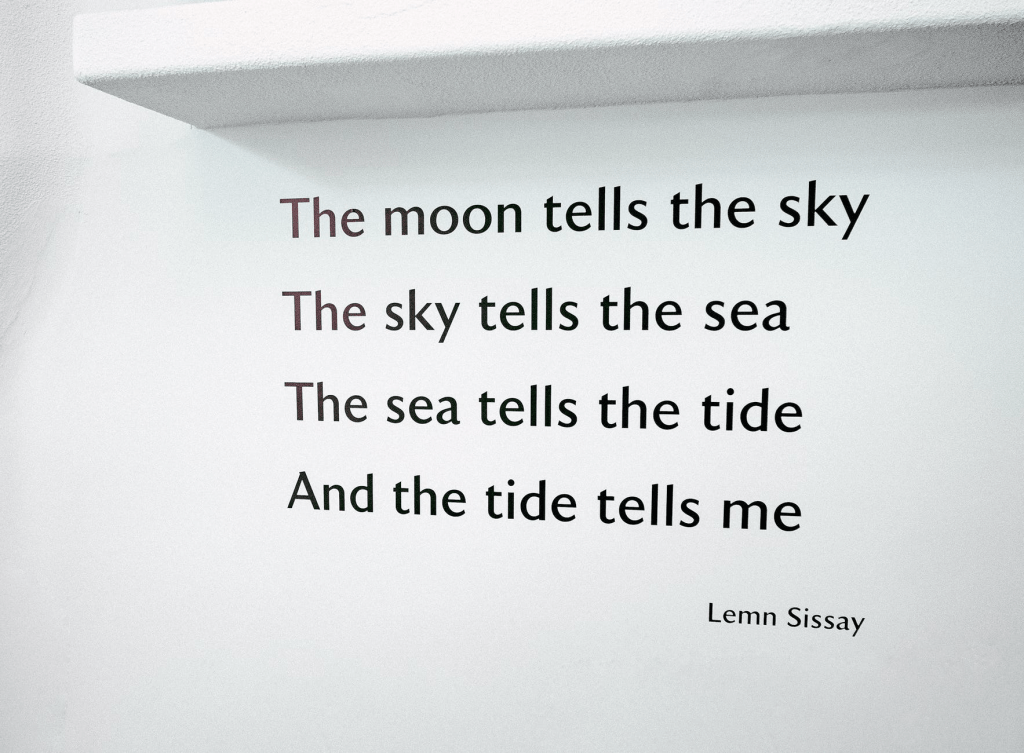
Photo by Lisa Fotios on Pexels.com
When spoken, it exists. When it exists, it can be healed.
That’s why we do a transgenerational approach. There is so much unspeakable and so much unimaginable. How to heal if we don’t know what we are healing? And why does only someone wake up and wants, must, can’t help but heal all the generations before him/her? Why is one child born in a generation of several children, sensitive enough to feel the unrest of previous generations? And then they have to do something because the unrest screams through anxiety. And then they dig to understand where the original trauma was, sometimes they find it, more often not, but they feel something and give space to that something that still wanders like a lonely ghost. It wanders and ravages and lurks, invisible and inexplicable. And then that sensitive one, who thinks they are the weakest part of the family (but actually is the strongest, because they are the only one capable of recognizing that wandering ghost, and even more than that, to challenge it, name it and, peacefully, bury it) wakes up and can’t ignore it. Why are some more sensitive than others? A combination, accumulation, critical mass – whatever the principle or more of them – some qualities appear and disappear, some appear too early, some too late, some get stuck, and some, simply, persist until the ghost, the original trauma, finds its peace.
And often, indeed, it is enough to name, recognize, call by the real name, not to ignore, not to deny, not to trivialize, and finally, to communicate to restore harmony… To show the pea between the layers of bedding at last…
*
Group-1=I
<img data-attachment-id=“472″ data-permalink=“https://psymultiverses.com/pexels-photo-255469/“ data-orig-file=“https://psymultiverses.com/wp-content/uploads/2020/05/pexels-photo-255469.jpeg“ data-orig-size=“1880,1253″ data-comments-opened=“1″ data-image-meta=“{„aperture“:“0″,“credit“:““,“camera“:““,“caption“:““,“created_timestamp“:“0″,“copyright“:““,“focal_length“:“0″,“iso“:“0″,“shutter_speed“:“0″,“title“:““,“orientation“:“0″}“ data-image-title=“full frame shot of green peas“ data-image-description=““ data-image-caption=“<p>Photo by Pixabay on <a href=“https://www.pexels.com/photo/full-frame-shot-of-green-peas-255469/“ rel=“nofollow“>Pexels.com</a>
Even if I’m in a Group, I am I. And at the moment I merge with the Group and it seems that the boundaries are blurring, there is a realization of me here and the Group around me. Even the sentence „I am the group“ shows that there is the word „am“ which connects – in a word – the Group is the Other. The Group is always someone else to me no matter how close it gets. I am in a community and have all the characteristics of the community, for example, I am a woman or I am a human being. Yes, I am, so, I am the Group. But I know that I am a woman and a human being from my perspective and there is always a chance that I am not exactly that. The chances are minimal, but they exist. Now, if it’s confirmed that I’m a member of the Group because I have all the characteristics and conditions for belonging, does that mean that everything that is the Group, is also I? Does it mean that anyone from the Group can represent me? If we are the same, it means they will do a good job representing me even when I’m not there. I should have complete trust because that someone who represents me is the same as I am. But, although that someone is also a human being or also a woman, does it mean that we can agree on anything else? Do I think the same as the Group about ecology, feminism, economy, terraforming? Probably not, because although we are a Group, we are not made of the same complexes, each of our Selves is different. Every Self together makes up the Collective Conscious, all Collective Unconscious touch and interpenetrate, but not the Self. What is individual is connected with its roots, all around it in different dimensions with the collective, but I am not consciously the Other. I am part of the Group, and I am not. And so it is for everyone, Each I is the Group minus that I, something like (Group-1) to infinity (or however many of us are in the group).
Why all this? Because there is no absolute fusion. There is no total conscious Self that merges with all its completeness with the group, except if I have completed my individuation and the Group is all who have completed their individuations. In that case, there are no more complexes, identical archetypal images are the means of communication – is this a Star Trek Borg society? Borg Nirvana? Can we then even talk about I? No, then I becomes the great Self. Are we really looking for that? Or some personal individuation with harmony and knowledge of one’s complexes, but without erasing?
*
Liberating Freedom from Taboos
Freedom is being able to do everything, freedom is having all choices. But do we really use it? There are taboos given by society, religion, ethnic group, some other interest groups, and so on. We easily notice them, sometimes they even cry out to be noticed, mostly they are either unclear in form but clear in content, or vice versa – in any case, clarity and ambiguity are in some entropic balance. And we can accept them, reject them, hate them, and generally, we know they exist. But there are some less clear (and thus less balanced) taboos. These are the ones that come from ourselves and we don’t even think about them being there. And not only are they there, but they also act.
How much freedom do we really give ourselves? Ourselves, regardless of external factors! If someone annoys me, is there an option to kill them? Generally not. It doesn’t exist because we don’t kill (social and various other norms) – okay, that’s clear. But do I give myself the freedom to even consider the option of killing someone? Most likely not. This option is rarely thought of, immediately automatically dismissed, again for „obvious“ reasons (prison, it’s not done, what will others think, we’ll burn in hell, etc.) – still, rarely is this option considered and then discarded for better reasons, such as, „I – this Self here does not kill, because it doesn’t want to, even if we lived in a society where it’s okay to kill, it doesn’t seem like an adequate reaction to me, I don’t want to take another’s life because….“ – and now various subjective reasons. Now, the example of killing is quite extreme, so it’s easy to notice, but where are all the other invisible taboos?
How many people really give themselves the option to actually leave in a conflict or to really say what bothers them? How many can consider all the variants of solving a situation: for example, not to follow family myths, not to tell someone that we love them, to do the opposite of the community? There are countless parameters, many things mix in making any decision. Still, are we really free for all choices? Can we add extreme solutions to the „pro vs. contra“ list? I think it liberates. Having the option to quit a job, even though it is rationally known that the period after will be uncertain; having the possibility to say „no“ at the last moment before getting married, even though „it’s not done“, imagining the option of divorce even though there are small children or sick household members, abandoning everything for a sense of completeness. None of this needs to be done. However, it must be imagined. Even if the consequences are catastrophic, it’s not bad to imagine the moment before them. Not having taboos in front of oneself is to imagine oneself whole, both terrible and wonderful, disgusting and evil, naive and well-intentioned, cunning and hyena-like, tender and lukewarm, fiery and mighty, helpless and cowardly, opportunistic, and every other (and versions in other genders). Simply, look at the situation from every angle, then choose from the center. Not to scotomize some options, because… „it’s excluded“.
*
Syndrome of Children of Emotionally Unstable Parents
It’s not trivial to be the child of emotionally unstable, often called borderline or marginal patients. The patients themselves have many difficulties in social and intimate relationships, their Self is often suppressed by doubts and self-criticisms, emptiness lurks in moments of success. However, this story is not about them, as there are many books and psychotherapeutic approaches about them, and there will probably be even more. I have always been fascinated by the ontology of the children of borderline patients. Of course, I don’t want to generalize, there are so many factors that can refute what I am about to write in a few minutes.
Yet, what often surprised me is that these children (whom I met as adults) were often themselves qualified as emotionally unstable. Sometimes it would happen while talking about their traumas they mentioned problems, behavior, and personalities of their parents who were already diagnosed or showed symptoms typical of this personality disorder. Sometimes they just had symptoms that suggested exploring borderline issues, not to label the person but to make their behavior make sense to them and feel that they are not alone and that what happens to them has been described and can be resolved. However, what I find interesting is examining the relationship of these children’s parents then and now, their criticism, insights, and especially, their attitude towards parenthood. In short, sometimes it can be noticed that the model of parenthood they grew up with was what seemed to them at the time the only correct one. Even as they grew older, when they noticed the harmfulness of seeing the world in black and white or the excessiveness of expressing some emotions or the emptiness that would engulf everything at times, they had to find the right measure of this new information. But how to notice the right measure, if the measure was not sufficiently validated during childhood. How to relate to the turquoise color in a world where only blue and green exist? Even those who do not see can have children who see. However, it is necessary to tell them that it is possible to see. Sometimes children of emotionally unstable patients have the possibility for all spectra of emotions, with all modalities and gentleness of their transformations, sometimes they have a measure for everything, sometimes they know how to establish a quality relationship with emptiness. Sometimes everything is just like with any other children, except that, because they can do all that, they surpass, betray or criticize what was given to them in childhood. Or sometimes they want to distance themselves from that past, but the intensity of those complexes established in that past takes over and overlooks the Self. Sometimes the child is unconsciously (or consciously) in contact with the difficulties the parent had, empathy masks love or mixes with love (and here starts the story about hypersensitive personalities with high potential…) and being different is to stop caring for a suffering parent. There are many examples.
What seems necessary, at least to me, is to give them space for their identity. If in childhood they had to fight with a parenting model that was reduced for some reason or there was no space for them to have their own, their very own place, we must not limit the expanse of their Self now. In other words, before we start talking about the seeds that repeat, it would be nice to see what is unique, what is forgotten, what is sacrificed, and what is beyond the boundary. Maybe the child of emotionally unstable parents is not emotionally unstable, but just that, a child who has adapted to emotionally unstable parents and needs support to become what it is, without labels.
*
Tyranny of the Helplessness Complex
The feeling of being unable to control is terrifying. Not some excessive control, just ordinary control. Knowing that if you’re late, you can run, if a car starts speeding – you can open the door and jump out, or if someone close is dying, you can give them medicine and help. Simply, sometimes you can’t do anything. You’re in a bus or a plane, that close one has leukemia or has suffered a stroke, snow is falling and it’s cold, and you’re 20 km away from your tent in short sleeves. And then it wakes up and it’s usual for it to be there and to prod as only complexes can, insidiously and consuming the entire psychic field. And this complex then has quite a lot of arguments: you really can’t do anything, you really are helpless and you really have to follow the situation until the possibility of change (your position, your field of action, or the situation itself).
Yet, this complex can intertwine into normal life flows even without the car skidding, strong turbulence, or unexpected storm. Sometimes even the slightest thought that the car could break down, or the weather or people, because everything is perishable under certain circumstances, causes anxiety as if it has already happened or as if it will inevitably happen. Helplessness is a feeling of „without help“, but also of anger and frustration due to the loss of power, the power to lead your own life.
The first thing that comes to mind when I hear that word is the hopelessness of laboratory rats in neuroscientific experiments studying depression. At one point they lose even the possibility that they could save themselves and overlook even the open doors of the cage. In the complex of helplessness, the doors are always open, but the complex constantly turns the Self to look the other way, to overlook that it is possible to leave. Because if the Self left, the complex would evaporate, its mission of guarding, reminding, and teasing would dry up. The complex disappears because at some point we didn’t have some power and had to learn that this is part of life. It’s a handy and important lesson – nothing is perfect, harmonious, and just pleasant. But the problem is that in „nothing is perfect“, it is forgotten that „nothing is always imperfect, just chaotic and just unpleasant“. The complex reminds of fear and warns of caution necessary for survival. The democracy of the other option makes less sense because if the complex also remembered that it is sometimes possible to have power, it is not overly encouraging for glorifying caution. The complex feeds on this murky moral derived from some primary experience. And so, it turns on and patiently guards and watches over the Self. But sometimes the Self must take risks. Sometimes the Self can consider its helplessness, but decide to see what happens behind the open doors despite it. Sometimes the Self leaves too quickly and suppresses the complex with skilled anxiety breakers, the complex loses its most powerful weapon and weakens, but it’s still there somewhere behind. Sometimes the complex makes sense, but only to an extent – caution is a virtue in a certain amount. The complex doesn’t have to be destroyed or killed, it just needs to be recognized. Because the complex of helplessness isn’t just helplessness in a car, plane, and far from the tent. It’s also when we don’t know how to help the Other, when we don’t know how to decide something that affects the Other, when we know we need to metabolize a feeling and it will be better later, but we are helpless in the face of the intensity of that feeling or impulse. We feel helpless towards ourselves, because we identify with the complex. That fine, mature Self wants us to be whole and objective in relation to our power/impotence. But instead of looking from that central position, we look from that twisted, slightly shifted from the center, where we quietly and unnoticeably merge with the complex and think it is right and that its feelings are our feelings. But they are not always. And feelings can deceive if they come from a place where We are not completely and completely We. Intuition always helps, because it is immune to complexes, it comes from afar, but it is the easiest to inhibit by thinking and the desire to regain power. Therefore, the only way not to be misled by the complex of helplessness is to ask ourselves if we are in it and, if it seems possible that we are, to talk to it. Does it really want to protect us by pretending to be us? Because that’s not really protection, but some kind of white, twisted, well-intentioned lie, but still a lie. Because when the Self is in the center, there is neither power nor impotence, there is only so much reality of the given moment.
*
Tanks on the Border
And so, slowly, we understand where We are, and where We are not. More or less, we draw these virtual, but so energetically tangible boundaries. And it’s clear. And it works. But the boundaries are under attack. Someone finds ways to undermine them, to jump over them, to sneak into our realm with the help of a Trojan horse. And that’s not right. But what do we do then – deploy our army along the borders and attack? Conduct covert operations to find and eliminate the intruder? Use all our existing forces to find the intruder? Or ignore the whole story?
Sometimes someone attacks because they want to attack. Sometimes someone attacks because they don’t know any other way. Sometimes someone attacks out of instinct, fearing to be attacked themselves. And there are many more of these “sometimes someone attacks …”. Spending energy on explaining why someone is attacking us at our borders, we pay the price with our time and our energy. We can do that if it makes sense, if the gain is sufficient to justify the additional losses. But if it’s all in vain, if we just want to prove to ourselves, or someone else, that we are not indifferent to others’ attacks, we can easily get stuck in the trap of eternal quest for justice. In the end, we pay more for those tanks on the border than the damage caused by the intruder. Or, we pay with our hypertrophic empathy understanding the intruder’s impulses, even though they cost us. So how to find the right measure?
How to accept that Others will occasionally try to penetrate, consciously or unconsciously, intentionally or inadvertently? How to accept that sometimes we will fail to maintain boundaries, and sometimes we will strengthen them too much. The decision on strategy will come from the context, whether the attack reminds us of something past, whether it associates us with our weakness or hurts us, just because it really hurts, without any symbolism, whether we were in the Other’s way or put ourselves in their way. The only thing we can do is use a little of the aforementioned energy to understand why it hurts and why we chose that strategy. In other words, although the Other “stimulated” us for any reason known to him/her, or we just wished (without even knowing) for that stimulation, the most powerful reaction is to: learn something about ourselves. To learn how we react, to observe our instincts, to figure out whether change is interesting – to use the newly gained energy for – the Future Self!
*
An Old Dilemma
If my Self is like Others, am I still myself? To be myself, I must be different. But I shouldn’t be too different, because then I’m not adapted. If I’m not adapted, then I’m not like Others which means I’ve missed something in the social field, I haven’t learned a lesson (is emotional intelligence not proportional to social?). And if I am adapted, where does healthy adaptability to Others end and when does the unhealthy tyranny of Others begin? Where do I end? It’s an age-old question.
How do I create porous boundaries, to let Others stimulate and inspire me, to share, to build, to exchange, but to have something where Others don’t penetrate? Now, looking at it more generally – should I be like Others? Would it be good for me to get closer to Others, but only a little, so as not to lose myself?
Much of this is seen in everyday neurotic examinations. I want to be myself, and my identity is still not well known to me, it still surprises me and I still struggle to incorporate everything that floats and dives through parts of Me Unconscious, and now, where in all this do I mix with something so foreign, with the Other? Caution and distrust penetrate…
Yet, there are many people for whom this identity is so strange, powerful, and unknown that they would rather join the Other who will lead. However, this is not a repentant or humble following of the Other, the Other is not needed as a guru, our Self still holds to itself, so it seeks fusion. Fusion means that we are together something Third, neither I nor You, but a new being composed of the two of us (or more of us, sometimes it’s fusion with a group). Here, adaptation is done openly, but still without surrendering the Self. However, the Self here is not free, as it is stuck in that fusion which must be perfect and absolute at all times to remain functional. And as two different Selves have different unconsciousness, things get complicated and the fusion betrays. Disappointment, betrayal, and abandonment follow.
There is also that version with subjugation and losing oneself in the Other, but I think its dysfunctionality is quite clear.
So, the best way to be I among all those Others, to be adapted so I can understand, accept, endure, bear Others, not to betray myself, nor to demean or devalue (or idealize) Others is to – delve into my Unconscious. Because there lie the traps of identity, shadows, and dark corners. To coexist alongside the external world, it would be nice to first visit that inner, tangled, and dark universe.
*
Tyrannical Defense
Defense is there to protect, but it can get carried away. What was once a good mother, a good angel, good forgetting, good repression, or good altruism, suddenly turns against you because it can’t stop defending you, it has become addicted to defending. Defending becomes more important than the one being defended. The Self doesn’t know how to deal with defenses that have forgotten that they are not the Self, but are there to protect the Self. The Self often gives in, because the defenses remind it of all they have done for its good. The Self remembers, imagines, and agrees. Maybe the Self got carried away (carried itself away?) by external influences, by an ideal Self that is always lurking, influenced by an enchanting and fantasized Future Self, while there are so many Past Selves that have, after all, survived until now, thanks to those very defenses. And so, in a circle. The defenses have become addicted to the central place, to their benefit, to their secure machinery, to the powerful status quo. How does the Self get out of this circle, because maybe – just maybe, those defenses are a little exhausted and rusty, maybe the world has become a bit different, or maybe the Self doesn’t care what the reason is, it just suddenly realized that it wants to try something new, the moment has ripened for change. And what happens then?
Defenses start to defend the old (and increasingly past) Self from the new, rebellious Self. If a real Other gets involved, for example, a therapist who joins forces with this weak but persistent Self that wants to change everything and try various fruits, and tries to support it until it becomes stronger, they too can easily enter the group of enemies of the defenses. How to see which Self is the real Self? Well, the one we really want to be, the one we strive for, the one we imagine we will reach and which will bring us harmony with ourselves and completeness, fullness – meaning, we await our own intuition, to settle down and lazily sprawl out and nonchalantly, without pressure, orient us towards which Self we are going. So, the most important thing: without pressure, slowly, patiently – find that full and complete Self. It’s not quite like the rebellious Self, a bit more ordinary, and not as rigid as the defenses would like to shape it, but rather, a dynamic, open Self, not at all perfect, but not traumatized by that imperfection. In other words, first identify the Self we are looking for, give a little trust to intuition (and not confuse it with something it is not) along the way. When we know which side of the universe to turn to, before we take a step, we must first regain sovereignty in our own kingdom. So, the Self comes before defenses, they are there to help me, but not to decide for me. When defenses return to their original frames, to follow the Present Self that has detected the full and complete Self (the defenses will see through if it is not a full and complete Self at the end of the story and if it is not motivated and clearly a Present Self commanding them, see through and reject – they will rather hold their position than surrender to a reduced, partial Self, because they – do not respect it), then they will once again become fine comrades and assistants. The Present Self should not discard them, nor the Past Selves – they did what they could, but now it’s time for the Present Self to go towards its completeness. And with the defenses, well – knowing them, noticing them, talking to them, but also criticizing them, considering and examining them. Caution and distrust are not the same. Caution towards defenses concerns future actions, distrust is based on imagining that the future will be like the past. And we never know that.
*
Permission for Messiahship
When we look from the outside, we see all the multidimensionality of another being. Of course, our gaze passes through our own filters. We will never see the other from all sides. His/Her relief is too complex for our “view” even if we look with feelings, intuition, and instincts. So, we don’t see everything, but we see differently than the person can ever see themselves. Their experiences of themselves are entirely subjective and reflections of the objective that are transformed into the subjective. So, we look at something that is the same, but we do not see the same, and what we see may be much more refined and precise and from a clearer angle than what the person carrying it within perceives.
The question is, how to communicate what we see. Not saying is a lie, or unspeakable, or a concealment, in any case, a conscious reaction that is assumed and includes the other’s ignorance or unawareness. Just saying is to liberate oneself and transfer to the Other, but that Other needs to continue further with this new and unforeseen knowledge. Beating around the bush and looking for the right moment kills spontaneity and undermines trust. So, how to inform the Other about what we have noticed -felt-experienced in Him(Her) without causing any psycho-earthquake? Maybe with permission. Maybe our advice, messiahship, help, insight, orientation is something that makes sense, but lacks the right temporality. Maybe it’s too early, maybe unnecessary, maybe out of sync with other priorities. We don’t know the Other. Helping them without asking for permission is not help but imposition. Allowing someone to delve into something of ours is courage. Accepting a rejected permission is reconciliation with the Other, a kind of empathy. Repeating the request for permission is a risk that we sometimes accept, along with accepting the responsibility for what follows. We have no right to change Others if they haven’t allowed us. Because then the change is ours, not theirs. Then it is our individuation, not theirs. Then it is our path that we would share with the Other. Individuation is not shared. It starts from the collective and returns to the collective, but the path must be personal. And not everyone’s good is the same good, nor is the same evil evil. Empathy is sometimes giving permission, sometimes accepting rejection. Behind it always stands the same: for there to be empathy, there must be difference. For there to be difference, there must be acceptance of small transformations and departures from the same. And on that path of departure, there are always some kinds of tears.
*
The Safety of Forgetting
But what if the last years of life spent in forgetfulness and the fog of one’s own conscious and constructed identity are not just a cruel fate and an irreversible disease? What if forgetting in those last years is the last line of defense for the Self? Maybe the Self can’t go any further, maybe individuation got stuck. Maybe it couldn’t go further for any reason, most often because of the weakness of the Self, but often also for reasons that have nothing to do with that or any weakness. Maybe the Self tried, but there were too many other brakes. In any case, time is running out, and the balance of life is getting heavier. Everything that has not been confronted in mature ways, with open eyes, verbalized words, meaningful actions is still present and continues to press. That means there is something unfinished from our process of individuation that will not be able to be completed by the end of life. And that something does not sound like success. What will the Self do now? Former defenses have not borne fruit (because it remembers and knows that there is something that creaks, irritates, and troubles). Returning to the state before them is impossible – so the best thing is to erase – erase everything. Erase self-punishing? Or is it an act of supreme selfishness, immersing in something that gives meaning, is reinterpreted as a victim and, at the same time, does not have to confront, conflict, and lose? Maybe total forgetfulness is a diversion from the path of individuation, into some hidden dead-end. Could dementia (not every kind, like Lewy bodies or Pick’s, but maybe these mixed, vascular, and Alzheimer’s forms) be the last defense mechanism, the last protection of the Self, because the Self is too penetrating, sees too much, and remembers too much?
*
Reflections on Craft and Art
Over the weekend, I read or rather was possessed by a book by Jo Nesbø. I don’t often read crime stories and I gave Scandinavian crime fiction a chance out of mere curiosity. Reading 700 pages in two days was not an urge for self-praise or pride in reading speed, but a drive to get out as soon as possible. The book drew me in and wouldn’t let me go and I didn’t even know how it happened to me. The book here is not important, nor is the crime story, more something that hit me a little later, when I realized that it was the style that had seduced me. This was a craft book, not an artistic one. Written as it should be, finely measured to scan all dopamine receptors and tickle them.
Craft and artistic book – the differences? In a craft book, we are all treated the same. We are all exposed to the same stimuli that work similarly to everyone. Some may not like it, there are layers of the Unconscious, experiences, associations, inclinations. Still, the craft book aims for quantity. Reading it (probably the same with visual arts) I imagine what is inside following what is given to me, I am carried by it and I belong to something, a group that recognizes that something. In a craft book, it’s like with fine craft bracelets and earrings, I am protected, I have the same aesthetics as others. I don’t stand out. Again, I won’t just any bracelet, I want the one that suits me and that I find most beautiful – the most beautiful to me. I’m looking for personality in the general. So it’s not enough for me to be like others, I would like to be a little more special in that general.
Then I read an artistic book. It does not aim to be recognized by everyone, its goal is to hit someone in the heart and change them, to recognize someone. It is more elitist, not because it is of higher quality but because it is more selective. And now, I read this book and it shakes me and enters all pores and pinches from the inside. I feel that something personal of mine is recognized, I identify with some part that I knew existed in me, or I didn’t know, but I suspected, or it surprises me with my ignorance of its existence in me. And then my personal dissolves and melts in front of the knowledge that someone or many (because the book, after all, has passed some barriers to be published) felt the same. The personal now seeks the general. Now I seek the opposite, I seek that my earrings are accepted and recognized.
We cannot please everything if we stand at an extreme. It is necessary to walk through styles.
*
Complex Tree
In systemic psychotherapy, family trees and the study of genograms, which are a kind of visual representation of family connections, are extensively used. They mark, along with the usual communication/legend, relationships, connections, marriages, divorces, deaths, illnesses, abortions, miscarriages, strained relationships, fusions – in a word, everything we consciously know about our extended families and we try to understand the system, our place, our role, the weight of what we carry and what is transmitted. There is also the idealized genogram, representing how we would like things to unfold.
However, genograms do not touch the Unconscious much. In Jungian clinics, genograms are not made – of course, depth psychotherapy involves psycho-archaeology, digging into great depths, sometimes drawing, dreaming a lot, and generally giving importance to the Past. Therefore, it seems appropriate to me a hybrid of these two approaches – a genogram of complexes.
It is not at all unnecessary to spend an hour drawing all the classic, conscious relationships, then expanding to everything that is missing, but conscious. Finally, when the skeleton is there, the shaping begins. Which Animi are present, which Anima were fatal, who had a victim complex, who got stuck working on themselves and shifted everything to the next generation? Which Shadows repeat? Which Selves are in the center, and which are slightly sliding? Who overwhelmed whom, who set boundaries?
A complex genogram of complexes that, therefore, is drawn in different colors (it is very interesting to leave the choice of colors to the patient, not everyone’s Shadow is black or Anima red) after several chopped and finely metabolized hours of work can give fine, colored landscapes.
It is possible to see the course of individuation in one family. There are secrets, doubts, unspeakable and blocking things that incarnate in one at a moment, in one generation, or in one person. Sometimes, a person who suddenly awakens with something foreign, yet personal, because that foreign part is a part of their story, may be ready to continue the work, sometimes not, just freezes it for later or never or lets that awakening happen to someone next. Complexes do not have the same temporality nor spatial boundaries. They are nodes that exist until we untangle them. And someone always untangles them at some point, to continue mastering, recognizing, and untying the next nodes.
*
We Are Not Exactly Round
No, we are not round, amorphous, changeable, and dynamic, something like amoebas, our Psyche is a very unstable, yet, thanks to that, persistent and organized entity. The Conscious and the Unconscious are mixed in every part of Us. It’s not that the Conscious is outside, and the Unconscious is inside. In every part, both are present (like some kind of matter and antimatter?).
Something like this, like on diagram “0”, like a creature with tentacles that extends and retracts its tendrils, which senses danger, but also is attracted to pleasantness. Simply surviving. Inside, there is Darkness and Light on a seesaw, male and female principles, comparison with others, vertical and horizontal and many other personal little complexes and big complexities, everything that makes us a unique combination, like a personal psychological code, persistent, but open to modifications:
And sometimes, someone Else comes too close, the Persona thins, sneaks away or stretches, or maybe even collaborates with that Other – the contamination begins:
Then, sometimes the Other is at a distance, but still its radiation, observation of it or anything else living, non-living, and virtual mixes with our Inner. And then the suitable complex is fed and grows and casts shadows, floods, exploits an existing shadow or just blurs that Self, that Organizational Center of the Self. And then that Self doesn’t manage quite independently and uncorrupted. Neuroses, internal conflicts, are a good example:
And sometimes the force is so strong, it wants to change something so badly because it thinks it protects better, leads better, because it can’t do otherwise, because it has twisted and grown so much that it has to survive, in short, sometimes that hypertrophic complex pushes aside, displaces the Center. The psychotic is attracted to the throne, the Self struggles to find its way back to the Center, sometimes it needs a medication-lamp to illuminate the path, or at least to send persistent messages to its former central place:
And, I return again, the Unconscious and Conscious are present in every psychon of this living (right?) entity. And in every Unconscious, there is something of the Collective Unconscious… Here the concept of boundaries is much closer to some quantum metaphors than these written/drawn boundaries we consciously feel…
*
When I Change, Am I Still Me?
There’s a big question that concerns all sorts of transformations and evolutions: do we change so much on the path of individuation (and other changes) that at one point we become so distant from the initial Self that it becomes a slightly different Self? The focus, heart, and essence of our identity is what we return to, what is stable and unchangeable. But, is it really so? Memories and recollections are sometimes perishable goods. Overcoming complexes and establishing harmony, a pact or compromise with them changes our reactions and our deviations from the usual. Illuminating the Shadow is a different angle of light that falls on the Self. These are all gradual and small changes. And just at one moment, something new is created. Can the new overcome Zeno’s tortoise and jump into the line behind the word „FINISH“? Like in evolution, when dinosaurs become more and more complex until they become birds. They still originate from enormous reptiles, but, again, they are something else. It is often said that we contain stardust, we have imprints of everything before us, everything that will become of us. How much of all that truly belongs to us?
*
Identity and the Unconscious, Who Actually Decides?
I am Me, I have various visible and invisible, conscious and unconscious boundaries, I extend to a certain point and I know when I am Me and when I am not Me. Or at least it seems so. On a conscious level, it seems to be the case, although we are often ‘possessed’ or ‘overwhelmed’ by Others, so the big question is how much we are really ourselves, and how much we are contaminated by foreign energies and our Self at its center has something that has crept in and pretends to be the Self, but it is not. More precisely, the question is how much our Conscious contains the Unconscious within itself and where that Unconscious comes from.
On the unconscious level, it’s different – there are no such doubts: the Conscious barely enters there, its roots are in the Unconscious, and even when it first arrives in the Unconscious, it easily permeates it. However, there is another mixing with the environment – through the Collective Unconscious that permeates the Personal Unconscious. There are no illusions or contaminations here, these are open spaces without boundaries and customs, free passage is allowed. Yet, something is Personal, something is Personal permeated by the Collective, something Collective casting a reflection on the Personal – we are not alone existing by ourselves.
It reminds me of the embedding of a fetus in the uterus and the creation of the placenta or the embryonic development of mixed neural structures, neurons with interneurons, surrounded by astrocytes and glia – a larger organization that looks chaotic from the outside. Alone and with everyone, separate and never isolated. One and all. Where then does free will come from, when is it my own and independent free will? Who decides here?
*
My Body the Aggressor
Similar to the previous post dealing with chronic diseases, the question of something that is inescapably disturbing and often present, with which we must live, also extends to the question of the body, our relationship with our body. I am my body, of course. I control my body, but my body exhibits excellent rebellious actions from time to time. Sometimes it clumsily protects, sometimes it sabotages ruthlessly, sometimes it numbs itself thus reducing contact with traumatic re-stimulations, sometimes it ignores our Logos or openly allies with destructive emotions. In any case, the Body exists and, although it is often quiet and discreet, knows very well how to occupy the main place of our mind.
So, how do we deal with the Body? With respect, but not with submission. With communication, but not with commands. The body is like a loyal protector that reacts immediately and now. And sometimes immediately and now do not have the same goals as later. Current, short-term, and long-term goals are not quite the same. We, that is to say the Self, unify them. And that Self needs to find a way to communicate to the Body, which is a tiny but proud (and irreplaceable) part of it, to trust it and that it is not betrayal or disrespect, just „now“ is not the same as „later“. The Self and the Body are together, but they often forget that. Often the Body protects the Self so much that the Self gets offended and angry at the Body, then the Body gets confused. And the Body is useful and necessary, but the Body can’t do everything. We have to be with it, not against it. This is especially true in the case of victims of sexual and physical violence. We protect Us – Our Body does not betray us, it just tries to work within the range of what it is capable of doing to protect us, but we need to find the code, to understand it, and either to follow it or to tell it that this is not the way that suits us, or to mention to it that it was a way that maybe suited us, but has since changed, and now we need something new. Everything is a matter of internal agreement and trust.
*
Chronic Illness and Free Will
A brief question that arises when I encounter people with chronic illnesses and problems. I will avoid here the psychiatrization of the causes of these diseases or disorders. I will stop at some of the most common, often genetically transmissible and non-psychiatric diseases (e.g., multiple sclerosis, rheumatoid arthritis, diabetes). There is a person, a complete person as they were before the disease (or before knowledge of the disease, or before the first symptoms) and there is a disease that activates an archetypal image, engages the person’s energy and feeds it with the importance given to it – a complex is formed. The disease complex, as a being within us, a saboteur, companion, alarmist, patient, victim, angry one, whisperer. Living with it is a challenge. Giving importance to the reason (why we live with it) encourages it in its role (whatever it may be, not necessarily negative, it can easily be protective). In any case, it’s not easy with it and it’s not unusual that we would detach it from ourselves or merge with it. „I am sick, therefore I am the disease“ or „I am in no way the disease, it has nothing to do with me, it’s because of…“. How to find an adequate distance from something that is in us, with us, around us, something we do not want, and yet it won’t go away? „I don’t want you, but I must be with you“ – this something drains our energy. Fighting against it and giving it our energy that could have more useful uses than to be spent on the „irreparable“ or „difficult to repair“ or „not dependent on us to repair“, only leads to a bad redistribution of resources („I already have little and still give them to the one who exhausts me“). The only way to organize ourselves in relation to the „inescapable roommate“ is to focus all our energy on what feeds us, instead of feeding what eats us.
*
Who Am I Fooling When I Don’t Want to Lie
There’s a question that often arises from working with the Social Mask/Persona in psychotherapy. The patient identifies their social masks, how they protect themselves from Others, how they present themselves to Others, and how they change in relation to different Others. These revelations are sometimes easier, sometimes more complicated, depending on various other parameters, less interesting for this story. However, at one point they notice something: I am somewhere inside, sometimes vulnerable, sometimes strong, all sorts in fact, and when I am with Others, I do not show everything that I am. So, am I lying? I think of myself as honest and authentic and — boom! It’s not quite like that. The choice is now conscious (Persona is unconsciously built, but can be made conscious, and now, when we are in contact with it, what to do with the responsibility for it). This is something I often call hyper-honesty that sets up as a conflict (someone would say, adopted by the Super-Ego). If I don’t give my whole self to the Other, I’m lying, if I’m lying, I’m not a good person or I’m not the person I thought I was. Again, if I give myself, then what? Does it mean that I’m protecting myself? Does it mean that I’m selfish, self-loving, self-protective, just-me-me-me. Here we stumble upon the prejudice about selfishness. It’s not needed, it’s not good, but actually a moderate amount is necessary. To love Oneself a little more than Others without endangering the Other. Because, after all, what is really love (not infatuation and passion where Animus and Anima perform their mating rituals, but love, what crystallizes a few weeks-months after the beginning of the relationship, after the first encounter with de-idealization)? To accept the Other to express their personality, their thoughts and feelings and their Self even if it does not suit us, to accept that the Other is not Me, and yet to stay with Him/Her; and vice versa, to accept our ability, thought-feeling, sometimes the necessity that sometimes there is also an option to hurt the Other for ourselves, not to run away, not to taboo, just to accept the reality of that option and then make a choice. That is love, free choice. Love for oneself so that the Other can be loved. Empathy for others so that empathy can be chosen when we choose for ourselves. A gentle dance of empathy and self-love…
And now, I return to (hyper)honesty. How to calm the Self that wants to be loved and accepted as it is, yet not expose it to dangers? How to filter relationships, and how to balance in these different relationships, especially when they start to intertwine? How to accept that we are actually the ones who make the differences, distances, closeness, closing, opening, and all other maneuvers that affect Others. How to reconcile with free choice if it calls into question our reevaluation of equality, value, hierarchy, and especially prejudices, because most of our defenses happen before the danger really materializes?
So, can I protect myself, agree with that protection, and accept that what I give around is different for different people, situations, times, circumstances, combinations of people – if I am in agreement with myself, is there room for ambivalence (or at least criticism, reassessment, flexibility) in my value systems?
*
Traps of the Counselor
How should we behave when we see something that needs to change in the Other, but the Other does not see it? The most common and mature response is: let them mature and find their own path. However, what happens in situations when: the Other asks us for help at a specific moment, the Other does not ask for help, but the risk is too high to leave them alone, the Other cannot take care of themselves, our job is to help the Other?
Let’s see, step by step, visually, what is happening and what can go (un)expectedly.
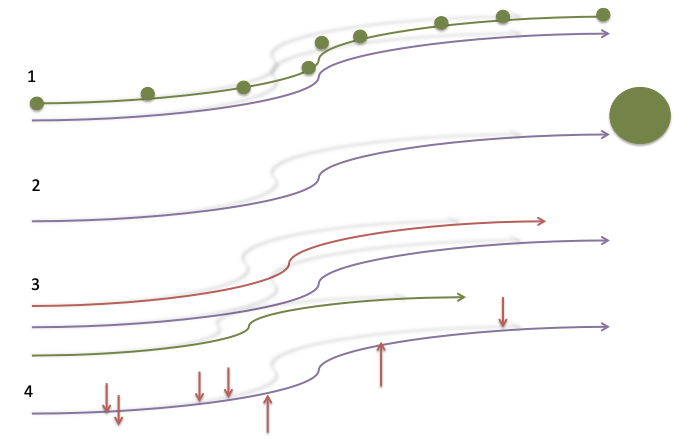
- The Other has some crisis, dilemma, anything, and confides in us. They either do not ask for specific help but would welcome it, or they do ask for it because it’s something we have experience in. Our Self gets flustered and accepts. Watches over the Other and goes along with them. And does not notice when it should let the Other go. The Other needs to move and continue their path of individuation, otherwise, it is not their path. We contaminate them. The wise elder turns into „I know better than you“ or „let me help you this one more time“. Regardless of where the first request comes from, whether it is justified or not. No matter how the wise elder changed the life (the wise elder should not really be about blushing, but if they want, why not, but without addiction – and the wise elder can fall into the trap of the complex of the wise elder and the savior) of the Other. The Other must continue on their own, otherwise, the question is: whose path is it really?
- „I know what is good for you, but you don’t yet. Don’t worry, you will realize and see that I am right.“ „I won’t watch over you like a mother (or wise elder), I will wait for you at the end of the path.“ „You will thank me when you arrive.“ We don’t ask what is good, what is fair, what is neutral, what is necessary, what is essential, what makes the Other the Other. We take only what we have seen or think we have seen or what we are afraid would be our failure if we see and do not react. We interfere, but passively. We are not active as in number 1, but we are not outside the path of the Other either. We wait and frustrate the Other. We don’t let them go alone, thinking that we are giving them freedom. Our psychic energy stiffens if the Other strays from the path. Our path begins to intersect with the path of the Other and to stagnate, because we wait actively, but passively. We don’t move, but our Unconscious does not have a naive position.
- The Other is a child or is very sick or sometimes does not know who they are. We oscillate between 1 and 2. We give freedom, come, then leave. We try to read the signs and get out of the way, then when needed, we return. But, we are not free. The Other does as much as they can, but we get tangled. We come, then leave. We think that is something, we think we are not bothering. We give double messages. We are here, then we are not. We help a little, then let go. Both the arrogant wise elder and the kind-wise elder and the gentle mother and the exhausted parent, we are all that. And that physical or psychic child gets lost. At one point we let them go so as not to let ourselves go. Here the dilemma starts.
- The situation is clear. We are there and help, but we are not there when we have no contact. We are neither mother nor father nor lover nor friend. We are not even a shadow, and our wisdom is paid for. No matter how we help, that is our job. We are there, then we are not. But when we are there, we are there. And everything is clear. How do we not get tangled up in the savior complex, in exhaustion and the stuck nurturer, or in the all-powerful guru? The answer is in the discreet as opposed to the continuous or periodically chaotic. We are there, we appear when needed, when it is clear why we are there and when it is even clearer that we will not be there forever. Everything is clear, there are no lies. We come and stimulate. We ask: „What if?“. We ask: „How would it be?“ We ask: „Where are you going, do you like it, will you love to go there tomorrow?“ We ask, but we don’t give the answer. We stimulate. We create sparks and from that spark sometimes a flame is made, and sometimes nothing is made. But we move on. And still, we spark without causing a fire. Our path shakes every time, but we remember every time which is our path and whether that spark should tell us something. In a word, we are neither too old wise men nor too young mothers, we are more like the parent of an eighteen-year-old who is going into the world and we let them go, but we don’t close the door. Our path is perpendicular to the path of the Other – we are not in the same dimension. That is the difference. Each of us has their own dimension.
*
Empathy/Time
Good harmony between empathy (the relationship towards the Other, protecting the Other) and individuality/selfishness (the relationship towards Oneself, protecting Oneself) is necessary for us to be a solid, clear, and ready for the dynamics of the One. I have already written about this, and it is confirmed in the clinic on a daily basis. However, not all empathy is the same, nor is every selfishness easy to compare. These are not absolute values, nor do they have clearly defined coordinates in the vast measurement system of the universe.
That there exists ‘good’ empathy and ‘bad’ selfishness is not far to see. Openness towards others, preoccupation with oneself, these are themes that have been discussed for too long in works, newspaper articles, and simple, everyday conversations. However, selfishness (we can also call it individuality, self-love and similar, but I like that often despised term – selfishness, because it carries a pejorative note, that shadow of a healthy relationship and, therefore, I think it is necessary to welcome it from that perspective and directly confront possible prejudices) can be, and should be, very healthy. Without a clear and integrated love for oneself, there is no possibility to enter into a relationship with the Other. Moreover, to compensate for what is lacking in that self-love can only burden and contaminate the relationship towards the Other. Likewise, unhealthy empathy without clear brakes, sufficient distance for contemplation of the whole relationship with the Other, easily turns into a detour.
Now, I would like to look at another trap of empathy – temporality. At one moment we are in contact with the Other. Assuming that we project minimally into that person, that our complexes are relatively unactivated with that person and that the relationship is truly a relationship of the Other and Me, not Me and Me in the Other. The Other at that moment is overwhelmed by their complex or some archetype is activated through some symbol. Regardless of how, let’s assume it’s a complex, the Other fails to position themselves in the situation through their Self, they are reduced to that complex and their Complete Self connects over the eyes and is led only by the sweet, smooth voice of the complex. And then we are there, my Self which is, in theory, complete enough to perceive the situation and its rational and irrational functions. The energy of the Other does not leave me inert. I feel pain/excitement/tension/something strong in the Other. However, I am not overwhelmed by their complex. The complex itself is irrelevant, I only feel the person under the complex.
So, the relationship towards the Other exists, it is ‘tangible.’ This is happening at this moment. It is not mine to save the other, they can only save themselves, using their ability to reintegrate, reassemble and lead themselves further. Otherwise, if I save them, help again comes from outside, they are placed in a passive role, and only an active role can give them enough energy to override the energy of the complex. Ok, so far so clear. But, there is something that complicates all this. As I wrote above, he (or she, it doesn’t matter) is (almost, almost) possessed by something that occupies the entire mental space. This is one intense present. I feel them from the outside, but without the same quality, because I am not them. Also, I am aware that this is now, but I can also reach the knowledge of the usual flow of time (past-present-future), because I am not stuck in just one instance of myself. My empathy mixes with my projections and fantasies about the continuation of the given situation. So, I have empathy, but I immediately activate intuition, as well as rational functions (planning, estimation, etc.). And there can be a dilemma – from my position I see something that the Other does not see and cannot see. What do I do? As I wrote earlier, I leave it to the Other to discover temporality when its time comes, to build within themselves what will give them the energy to activate themselves and better calibrate on the path of their individuation (not mine, because mine is separate from theirs and mine is more helped by respecting the autonomy of the Other than jumping in to help and satisfying some of my hero and caretaker complexes, but more on that later). Still, now I have to endure and assess – is it my complex or real help, is it moral (according to my own moral principles, according to the moral principles of the group and species to which I belong) and is the benefit more significant than the risk. Too many questions that risk opening my gate of the Self with all its rational traps and intellectual associations. So, before the Other, I first have an instinctive reaction and very quickly intuition whispers to me what next. A few nanoseconds later everything conscious and logical in me is lit and I return to the usual temporality from which the Other is preserved or distanced or punished or anything that at that moment belongs to the Other, not me. Here begins our separation which should be respected. Empathy is a feeling, empathy is not a logical process. Empathy is a relationship, dynamic and unstable, discrete, not continuous, jerky, repeatable, but never the same. Empathy that has a conscious temporal component is very likely contaminated with the Self.
*
The Collective Unconscious in a galaxy, far away
If we accept that our Collective Unconscious contains all the unconscious layers of all living organisms on our planet, and the Self (with a capital S, Self, Soi) is composed of all Conscious and Unconscious of our planet, one question arises: when did it all begin?Were archetypes born with the birth of life on our Earth? Is self possible only with the emergence of life? Was Consciousness (Christine Hardy would call it a semantic field – here’s a link to one of her books in French: https://books.google.ch/books/about/La_pr%C3%A9diction_de_Jung.html?id=BQHDtgAACAAJ&redir_esc=y where her theory of consciousness is described in detail) there before us (all, all of us)?Even if so, the question is what happens on other worlds, especially very distant worlds, in other distant galactic clusters. If we accept the possibility that life in some forms exists on exoplanets, regardless of the stage of evolution of that life, is the Collective Unconscious of that world and those worlds different from our anima mundi? Is the Self actually the Self of the entire universe from the moment of the Big Bang? Would a multiverse be different according to different semantic fields/collective unconscious/consciousness/Self? If different multiverses are theoretically possible with different local physical laws, is the psychoid function then completely altered? In other words, in some science fiction work, Earthlings from here meet Earthlings from somewhere else – can they communicate (linguistically probably to some extent, but do they share the same psyche, is empathy possible?)? To what extent is language a sufficient link – rather what would be the relation language-transcendental function of a society? Can a foreign Self, if it truly exists as foreign (on some hypothetical ‘living’ exoplanet), transform us (this is something I slightly fantasize about in this story in French: https://livre.fnac.com/a10748310/Dragana-Favre-Entrelacs) which I continuously change by translating into Serbian…)?Finally, if there is one Self of our Cosmos (from the Big Bang, to the end of expansion and beyond), does that mean we already have a glimpse of those other worlds somewhere in the depths of our Unconscious?
*
And then, what about children?
This is not a story about collapsology and ecology nor about economics. This is a story about the difference between the desire to have a child and the desire to be a parent. They are not the same.
The question of the desire for a child is often posed in the clinic. ‘Were you a wanted child?’, ‘What is your relationship with the idea of having a child?’ and similar. However, what we most often do is place emphasis on the child. It is not the child that invades our life. It is not the desire for something, at that moment, virtual, idealized and non-existent that guides us. The child is an object that exists as an idea and this idea can incarnate into something tangible. But, by then the child is already here and exists. ‘Do you want a child?’ is a question that invites something that appears from the external world (which, actually, isn’t inaccurate), something that comes and changes us. However, we change ourselves. We decide to be a parent. That means we decide to change ourselves. This Our-Self transforms into a new version of ourselves, with some new qualities. Of course, the idea of a parent is ‘just’ an idea, it is also virtual and intangible, but our projection is different from the projection of having a child. I am the one who changes. It is not the child that changes me. So, several months (years…) before the child’s physical form, the representation of the child can already exist and start to make a nest for our projections which we will host them with, both good and other (and especially the thirteenth) fairies give them gifts (add to the tabula that isn’t yet written). So, shall we provide the child with relative freedom (because projections are always inevitable and part of creating the child’s self, so absolute freedom is impossible and even unacceptable) or shall we assign them an active role in our life (with all that this active role does to our life).
Therefore, the issue is about projecting ourselves into the future in a new context. Only healthy self-interest can contribute to harmony and balance with measured and so much needed empathy, in this case, empathy towards the unborn child.
*
Shadow’s Shadow
The shadow is everything we don’t see in ourselves (references can be found in most of Jung’s works), the part with which we are not in contact, but which is in contact with us. The shadow is dark, but as stated in Completed Works 10, on page 872 (I’m completely paraphrasing) CG Jung says: „Anyone who notices the Shadow and the Light at the same time, sees themselves from both sides of the coin and thus sees their center“, he adds: „Good does not become better when it is exaggerated, but becomes worse. A little evil becomes a great evil if it is denied and made taboo. The shadow is part of human nature and only at night does the shadow not exist.“
The shadow of the Wise Old Man is Peter Pan, the shadow of the Evil is Good, the shadow of Yin is Yang, the shadow of what I think I am is what I think I am not. The Shadow of the Shadow also exists – the moment when the Shadow begins to reveal itself and come into the light of day, when the Shadow is integrated and when it makes its resistance. The Shadow’s Shadow is neither good nor bad, neither opposite to the Shadow nor identical to the Ego. The Shadow’s Shadow is just a response to the light hitting the eyes of the Shadow. The Shadow’s Shadow tries to keep the shadow where it was. The Ego, when ready, wants to integrate it. The shadow is shy. The shadow screams out when it can, but hides in nooks and crannies when we summon it. We must not scare the shadow to make it come, we must not judge it, we must not submit to it. Because the shadow is there to serve, not to lead. The Shadow’s Shadow hides in depressive self-deprecation, in blaming the Shadow, in excessive acceptance of the Shadow. The Shadow’s Shadow can hide for a long time.
*
Current Self and Future Self
I am now and although I will be some future self, I do not know that future self. My past self is what I remember to some extent, interwoven with small corrections and photoshopped by brain activities. This past self is changeable, prone to transformations according to the filter used by the current self. Yet, this self has some outlines of truth and immutability. It has its own axis around which it revolves. The current self is the current analysis of the environment. The current self is somewhat responsible for assessing the current situation. The current self can collaborate with the thousands and millions of past selves (whose number increases every nanosecond), their interactions are possible, but contamination of the current self by one, and especially by several past selves can lead astray. The current self must be aware of contamination by past selves. It doesn’t mean it should be immune or overly cautious, just aware that contamination by past selves is possible and try to be conscious of it before any action. Past selves are the filter of the current self – the integrity of the self is maintained this way. They are its helpers, but they are no longer the leaders. The leader-unifier-decision-maker is always the current self, which is always in function of time. Time is understood here in the Bergsonian sense and in the current understanding of theoretical physics (nicely shown in Carlo Rovelli’s book „L’Ordre du Temps“) – time that actually does not exist, that changes continuously and is actually a complicated composition of the whole universe and all its coordinates, elements, and systems at a given moment.
From this perspective, the current self can never know what the future self will be like. The current self may have unconscious inflows and invasions that can, in very rare and specific situations (dreams, synchronicity, pure consciousness summons in certain meditations), have „contact“ with some future selves. However, in most cases, the current self is tied to consciousness and the future self is an imagination of that consciousness and the current self. In other words, the current self can only guess how it will behave and what the future self will be like. These assumptions often carry an emotional valence, and this emotional valence often manifests through anxiety and anticipation. The current self looks from the context of this here and now time. It lacks elements to have a clear scope of experience of the future self. Still, the current self holds control now. This control here and now maintains consistency and the aforementioned integrity, which is, of course, useful and often necessary. However, when this control spills over into the future, then the current self contaminates the future selves and creates an invasion of their spontaneous development. Also, it can give them additional pressure and accumulate a potential pre-burn-out that can be activated when the future self becomes the current self, because that future self already has a reservoir of anxiety that does not belong to it.
For the future self to evolve and have successful adaptation mechanisms at the moment it becomes current, it is necessary for the current self to trust its future selves. I here and now do not know what it will be like in the future. Will I learn a lesson, a skill, will I be able to remember the right words, will I blush or will I get angry at the slightest stimulus. I do not know. My current self tries to prolong its power (control, security of integrity (and identity)) by transferring to the future self what it thinks the future self will be. But, the current self does not know. Therefore, the only safe way is for the current self to support (and in a way believe in) all future selves. If the current self „frees“ all future selves from expectations, pressure, and concrete assumptions, and retains only the assumption that the future selves will find ways to adapt to the given situation, that they will have enough skills, knowledge, and composure to apply them, and that the future selves will have some other qualities that the current self does not possess at this moment (because it cannot possess them, because it is too early, because it has not had a way to learn them, perfect them, because the situation has not yet happened, or because it is not known whether it will happen, because the list of variables is inexhaustible). The current self at that moment should be freed from envy and comparison with future selves, because the current self and future selves are not in the same time dimension and therefore there is no point or need to compare them. The current self should leave the future to future selves. By doing so, future selves have the freedom to learn and transform, and current selves, which will in the meantime become past selves, will have less energy tension in themselves that could contaminate some future current selves.
This principle is general, corresponding to self-confidence, anticipation, transmission of values, and confrontation with time and death.
Of course, the current self is not to blame if it cannot achieve all this at once. The current self has a choice of trust.
*
Balance
There are numerous scientific, philosophical, and theological conclusions that everything is in moderation-harmony-balance. Generally, every new idea disturbs the peace that has been slowly settling and solidifying for decades. This disturbance breaks enthalpy, annoys, entices, repels, and slowly creeps into the cracks of the former peace. If the idea is harmless, modest, non-destructive, then it is very likely that it will just slip through and assimilate with the environment that will soon (or a little less soon) accept it as if it had always been there. There are also ideas that are too bold and loud, or simply awkward and visible. They are hard to fit into holes and cracks. Then rejection, expulsion, belittlement, and underestimation occur. The idea is, however, big enough to attract various views. Slowly, two camps form, action and reaction, these and those, for and against. Until slowly a third one is created that says „both one and the other.“ Probably these lines are a bit of a banalization. However, the psyche likes balance, not the static and final one. The psyche likes dynamic balance. Everything moves, everything is there, nothing must not be, but the maintenance (psychic) energy is still a valid law.
The Three Thermodynamic Laws plus zero can also be applied to the psyche. Far from it that I want to refer to quantum medicine or the esoteric corners of my dear Jungian corners. Simply, the analogy has a neon shimmer.
For this reason, here are a few lines about thermodynamic laws…
The first says:
„The total energy of a system and its environment is constant; energy cannot be destroyed or created; it can only be transformed from one form into another.“
(all this is nicely summarized at this link: http://www.ffh.bg.ac.rs/Dokumenti/Biljana%20geografi/GF%20TERMODINAMIKA%2009_10.pdf)
The second law, as Wikipedia in Croatian language says, refers to the direction in which the conversion of thermal energy into mechanical energy takes place. The total entropy of an isolated system can increase to some maximum value.
The third deals with entropy and suggests that it is equal to zero only at absolute zero.
The zeroth law is as follows: „If two thermodynamic systems are in equilibrium with a third, then they are in equilibrium with themselves.“ (Wikipedia in Serbian language
Far from it that connecting the dynamics of the psyche and the laws of physics is some revolutionary discovery. The psyche exists in this world. It is manifested and we notice it, react, we are part of it, we cannot objectively observe it from the side. It is not unusual for psychic energy to be briefly called „energy“ when describing the character, appearance, and impression of a person. In transfer and countertransfer, the same word is often used to at least quasi-materialize the relationship between two people in an unusual bond.
So, psychic energy:
- Psychic energy is maintained (it is not lost, its total amount is always the same, we cannot lose energy, we can only transform it). This is very significant and tangible in working with emotions (anger, passive (and other) aggression), with defense mechanisms (projections, denial, reaction formation, altruism, etc.). Still, it can also be observed in the more remote settlements of the human mind that we rarely visit, but are still there (various complexes of slightly less intense energy that are either insufficiently or overly compensated by other actions).
- It becomes complicated, but immediately recalibrates according to the cost the entire system pays. Peggy La Cerra argues that the second law of thermodynamics is actually the first law of psychology. To quote a few lines: a) when speaking of the complication of each new plant and animal species, she says, “…there is a cost for this benefit: behavior itself requires energy”; b) then, a bit later, she explains the economy of a living being: “The hallmark of animalian intelligence systems is the capacity to predict the likely costs and benefits of alternative paths of behavior. (La Cerra and Bingham, 1998, 2002)”; c) finally, she links entropy with the possibility (and, as in every system, with the cost) of developing a more complex consciousness (and psyche): “At every level of the human behavioral intelligence system there are design features that act to counter entropy and mitigate the energetic constraints on life, from cellular respiration in neurons, to reuptake mechanisms in synapses, to a functionally plastic neocortex that can instantiate and modify a set of adaptive networks that precisely mesh with the unique life of an individual.“ In short, we can move, but this step is not unidirectional. This can be applied in crisis situations, mood changes, anxious states, and certainly, especially, in analyzing the development and maintenance of complexes.
- It spontaneously increases at higher temperatures (emotional state, intensity of emergence from the unconscious) making the degree of uncertainty greater and, conversely – there is no uncertainty where there is no change. Hirsh, Mar, and Peterson have done a fine exposition of psychic entropy in their work on PubMed. Existential crises are fine examples of changes in entropy.
- It is reflected in the relationship with another – external balance indicates internal balance, reacting to the Shadow is also recognizing the Shadow. Defense mechanisms are very comfortable in the zeroth law.
Psychic entropy and balance are dynamic phenomena, and not at all two-dimensional. There will be more notes on this soon.
*
Praise of Laziness
It’s easy to demolish. It’s hard to build. In fact, sometimes neither is easy. These are all states we often see in clinical practice, and outside of it, all those whirlwinds of self-destructiveness and then the hard pushing of the stone uphill. And so in a circle. The joy of construction, sometimes even the short-lived joy of destruction. They feed each other.
What is much, much harder is to build out of nothing. When there’s nothing and nothing at all. And then to conceive and make. In a word, creativity.
Most often it all starts nicely, or less nicely, but it starts and goes. And then something happens, anything. Horrible, terrible, sad, something is heard, seen, felt, thought. And then it just continues to live inside. And sometimes it grows, alone and forgotten. Sometimes it heals along the way. Sometimes it becomes stronger and sucks in everything around it. And then it spoils something. And when it spoils, there’s something else, uncontaminated by it, that fixes it. Sometimes, it over-fixes. Sometimes it makes things worse. Sometimes everything turns out well. Sometimes it repeats. These are all the old, good Jungian complexes, what draws glowing dots on our dark map and makes signposts, concentrations, and holes.
And how, now, to put something that is neither a glowing dot nor a new hole or black stain? How to build something spherical and three-dimensional, how to conceive a 29th dimension, how to sing every dot or change its color? How to step out of oneself?
On a more concrete level, sometimes it’s necessary to find love in oneself even though love has never been palpable, recognized, or received. Sometimes you need to become a mother, without knowing what a mother is. Sometimes you need to dare to get angry with all your might, when anger has never been able to show itself before, because the ranks of tears stopped its invasion.
So, sometimes it’s not enough to fix. It must be created. That’s when individuation begins.
*
Unbearable Questions I Delegate to the White Page
- While reading Khalighinejad et al., I contemplate the emergence of the unconscious, the penetration of the unconscious into consciousness, the moment when a dream arrives and does not leave, when synchronicity is allowed, when an association becomes conscious enough to grab our attention. The question is: how does the atemporal unconscious penetrate into the clearly defined conscious? How does it „counteract entropy“? What is the relationship between atemporality and temporality? If atemporality contains everything, including temporality (one of many), who is the Hermes facilitating this transaction?
- The relationship between the Unconscious and singularity (e.g., unus mundus and black holes)?
- My next question is in the realm of the paranormal, but I’m not interested in the nature of the problem, but rather the spark of dogmatism in analyzing these cases. To be more specific: in clinical practice, we often encounter people who have consulted mediums to communicate with their deceased loved ones. What confuses me in these conversations is not the paranormal (there are various scientific and less scientific explanations, from the collective unconscious, different levels of the sensory system, placebo, identification projections, very potent complexes, and various other phenomena), but the conviction of the medium’s clients that the medium connects them with their deceased loved ones. Why assume linearity in something so unusual? Is it not more likely that the medium (in any of the scientific or non-scientific ways I will not delve into here, but assume as an initial premise that it is not charlatanism) contacts something timeless or the residues of the dead during their lifetime? Where does the certainty come from that the same amount of time has passed for the dead as for the living who summon them? Could they be echoes of those deceased, their former voices lingering here in our Collective Unconscious?
- What is the purpose of Consciousness, personal Consciousness, and the possibility of connecting different Consciousnesses? How do we share the same time? Is the Unconscious not sufficient? Does the Unconscious need an „incarnation,“ an object? The literature is rich, especially in the last decade. The ASSC (Association for Scientific Studies of Consciousness) has a very rigorous, but not at all dogmatic approach. Of course, their perspective is primarily neuroscientific. On PubMed, several neurophilosophical reviews and articles can be found.
- The boundaries we set are based on our Conscious, especially the Unconscious, which is limitless. Does a macro-psyche and micro-psyche exist, tangible to our measurement units, and another beyond our senses, requiring some kind of psycho-microscope-telescope?
*

Communicating with Another Psychic Dimension, with Another’s Cosmos
Perfect merging with another does not exist. The pursuit of fusion is usually unhappy. Fusion, if it could truly be achieved, would be static. Two people glued to each other, joined, intertwined, unable to move, standing still, because every movement implies a decision and motion. Such decisions could come from both in a case where they are both in some telepathic connection without being able to determine the origin of their thoughts. Both deciding not knowing where and how they think the same thing. And then they act together. But, free will opposes this. If we two are fused and then become one, there is no longer free will of the original individuals, now it’s a new being. Something like a fruit created by the merging of an egg cell and a sperm. Meaning two created one and now that one can have two bodies, but the soul (mind, spirit, consciousness, personal unconscious) is one. This means that there is a timeless or retrograde merging of the personal unconscious, because any difference could lead to the autonomization of one complex that does not affect the former other part of the new individual. In other words, the past must also merge, and this merging does not mean forgetting and erasing. Only such an ideally merged new being (fusion of two) could begin to move, regain its dynamics, and thereby its personal evolution.
So, everything that is not ideal implies disharmony in fusion, or harmony made by compromises or kindness or faith in equality. In each of these cases, the question arises: what is the purpose of fusion, of symbiosis? Why can’t two people live separately, parallelly, sharing when there’s something to share, not sharing when there isn’t? Why do many strive for fusion or fear fusion, thus getting stuck at the opposite end of human relationships?
Can people accept their loneliness, their own universe? Around is a vast multiverse of others. And communication is possible, but only in certain dimensions, following certain gaps and channels within their boundaries.
Here lies the problem. Many manage to accept non-fusion with the Other, their universe, and to some extent their uniqueness, solitude, with or without loneliness, but do not accept the limits of these communication channels. It is not enough to just communicate, talk about the same thing, exchange on the same plane. It is necessary to keep in mind that all this is an approximation. Your blue is not my blue, but it is blue. Your sadness is not my sadness, but it is sadness. Memories mix, personal complexes, different temporal-spatial angles. There is always a percentage of misunderstanding and a bit of the unknowable Other.
When we talk to a partner, do we speak from a vertical or horizontal position, or do we switch as needed? When talking to a child, does a complex activate that pulls us from the vertical by age into the horizontal plane or just plummets down the vertical plane far below the child’s age? When arguing with a colleague, how many of his complex lights flicker, and how many do not match ours?
How do we know we’re in the same plane, in the same dimension, in the same temporality? We don’t know. We can’t know, but we can know that we don’t know, because that knowledge changes everything. And we can identify the closest possible to our own position, knowing that there is actually no reference value anywhere. All multiverses are anywhere and anytime.
*
Equality – Rivalry
I must survive, but I must also live. Living is impossible without the Other. This Other is my measure, my cure, my stimulation, my challenge, my proof of existence, and my significance. One cannot walk their own path without leaving a trace. This trace injures someone (the plants and animals we consume, the virus destroyed by our leukocytes, the air used instead of someone else, unfulfilled desires of those who are fond of us, disappointment in us because we chose something else). Every new step is a new decision. If we do not make it ourselves, we are not free from responsibility. We have just adopted such a decision and are responsible for it. If we leave everything to chance and fate, we use an excuse for consciousness, but not for the unconscious. Since we exist, we are responsible, simply because we exist. Even if we cease to exist, we have existed. Our trace (soul?) is already there. Thus, this Self progresses even when it fights not to progress, changes over time, and does not abandon its temporality.
This Self often dares not be selfish, for it fears. It fears the judgment of the Other. It would be easy to subordinate everything to oneself, but that would mean paying for all insights and consequences. The Self wants to be in the center, to protect itself (which it does by considering that Others also exist). If it is not selfish enough, it does not allow itself to be empathetic, as it gives more than it has. If it is too selfish, empathy is gathered in the Shadow, lurking and waiting. The relationship with the Other suffers. Individuation gets stuck. Too much empathy displaces the Ego, too little also, because it unbalances it.
In other words, the Self has its range of harmony, having a healthy egoism and healthy empathy. I live more than I survive and survive in order to live.
For my Self and thinking about myself, some kind of dissociation is required. When I enter an internal dialogue, I give space to a more „objective“ vision of myself. The Self and I talk. Just as we are the Self and the Other, here we are the Self, the one who leads, models the conversation, and the Self-interlocutor. And towards this Self-interlocutor, it is necessary to have empathy, to see it from all angles, yet preserve one’s Self so as not to be overwhelmed, swallowed, overflowed by the Self-interlocutor.
Similarly, in the dialogue Self-Other. It is clear in this case that the Other is outside of me, but also that this Other is a Self to himself/herself. We are in the same spatiotemporal dimension (and sometimes not, about that in the text on dimensions). His/Her Self is not me, but if I take into account that it is present, it is also a Self that wants to survive and live. Also, I must not be consumed, used up, exhausted. I must take what is mine and not accept what is others’. Hence the boundaries – boundaries to empathy and boundaries to egoism. The Self has freedom of movement, the Self determines its boundaries, so it is up to the Self to respect these boundaries. Boundaries are slightly elastic.
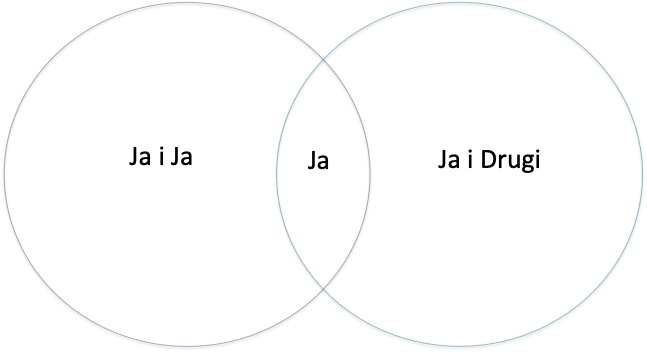
The Self does not compare and does not compete either with the Other or with itself (especially not with the Past Self). I am not equal to the Other or to myself. I oscillate in my center which constantly changes and transforms along the time axis (and other axes). When one’s self-worth is observed and evaluated (because it is always evaluated, at least in the form of feedback of one’s own evolution), it is necessary to have the correct calibration of this measurement. It implies: looking at the Self at the intersection of egoism and empathy, equality and rivalry; observing the intensity-level-color-stability-anyotherparameter of the balance of the Self. The most common mistakes are self-worth assessments (self-confidence, faith in oneself) from a position outside this circle, not considering its dynamics and its stability. The Self, viewed from the position of „Self and Self,“ „Self and Other,“ we are all equal, we are all not equal, etc., always gives a distorted picture. One cannot view the bubble on the label if we are swaying ourselves while holding it or if we observe it from the right or from above. Therefore, if the Self is in dynamic balance, if it oscillates with the minimum need to stretch and test its boundaries (and yet dares to move), it can progress more clearly and smoothly in its individuation.
*
Rebellion of Androids
When Philip K. Dick wrote „Do Androids Dream of Electric Sheep?“, he gave a clear and concrete answer to the human anxiety that robots, machines, androids, artificial intelligence, quantum computers, drones, and similar objects and entities would push us from the top of our planet’s food chain. Dick is essentially asking whether androids dream. This is a crucial question to determine whether inorganic forms have an Unconscious Intelligence. We mostly wonder if they have, and especially, if they will have Consciousness. Consciousness is undoubtedly the stage where decisions are made, actions taken, responsibilities assumed, and contact with one’s own identity is made. However, Consciousness is not enough. Consciousness is the visible part of someone’s being. If we imagine that a future android, equipped with exceptional Logos capabilities, is fully aware of its power and has the ability to apply human (or non-human or super-human) moral codes and analyze the consequences of its actions on others (not implying here whether they have empathy or not), would that mean it can make a decision for which it will be responsible (irrelevant at this moment whether it has good arguments or not). That consciousness is guided by Logos. If Eros exists in it, it must have its dynamics – its possibility of change, evolution, and comparison with the past (feelings, images, contexts). Thus, Eros works together with Logos – if they are not cooperative, the robot will be something else, not a Logos-machine, it will be a being capable of ambivalence, doubt, and indecision. Therefore, the success rate or probability of satisfying a goal will not influence decision-making, but the robot will be contaminated with personal contents. Becoming aware of the personal, it separates from the group and begins its path. Here I do not delve into the origin of Eros, i.e., emotions, empathy, irrationality, and the incomprehensible. In this fantasy, Eros has crept into the cracks of Logos (did Logos open these cracks, opposed them, or were they inevitable?). So, the robot is no longer collective, but has the possibility of something of its own that separates from the group. Further, imagine that this robot immediately shares everything with its group, even this new experience, and the group does not distance itself but assimilates this novelty (otherwise, the robot becomes a typical dystopian hero and quickly plunges into its personal, thereby becoming more humanized). The robot continues to openly explore the personal. The group follows it, without hierarchy (similar to the Borg from „Star Trek“). What is important is that everything is still on a conscious level. There is new knowledge, its learning, its acceptance, and finally, the expansion of the conscious field. The robot (and other robots) are aware of the presence of Eros. Eros does not have the freedom of independent action, it does not sabotage Logos. The robot can independently or together with others from its group (species, program, model) make a decision that could be fatal for humans at a given moment (Isaac Asimov explored in detail various situations when robotic goals coincide with the goals of a human group or with the future of the human race, but not with people who share the same spatiotemporal coordinates). Thus, Robotic Consciousness is accessible, guided by Logos, despite the presence of Eros. Eros is more an object than a subject. With Robotic Consciousness, Logos-communication is possible. It can refuse to give information for any reason, but it is aware of these reasons. So, there is risk, there could be danger, but there is no irrational and unfathomable.
When does the truly frightening start? The situation changes drastically when even the Robot itself is no longer sure what drives it to decide. Whether this happens in the original scenario (dystopian, when the Robot „humanizes“ itself and starts its solitary fight for its personal (individuation vs. individualization)), or whether this separation occurs in its attempt to hand over new knowledge and new senses to its group, but has no arguments, no clear associations, and sees the unreliability of its beliefs. Eros is the one that stimulates sphericity, multidimensionality, adding new angles of observation. Logos does this systematically and technically, Eros uses irrational means like intuition, memory, connections. In a way, Logos is aware of everything and at an equal distance from everything. Eros is aware of the other, and the distance is variable. And that’s where the more important issue begins, more important than empathy when talking about the humanization, evolution, or refinement of androids (artificial intelligence-robots, etc.): The Robot finds its unconscious, or rather, the unconscious merges and absorbs the beginnings of the robot’s personal unconscious. The Robot becomes part of something bigger. Call it Anima Mundi, Self, Uni-Multi-verse, whatever, but at that moment, the robot becomes incomprehensible to itself. And then the Shadow, fear, and everything else emerge.
I’m not afraid of the Consciousness that artificial intelligence might attain. I’m afraid of the Unconscious that might scare it. And yet, at that unconscious level, we might be able to find some other kind of Eros-communication. Hence the importance of dreams. If they dream, they will be contacted by something that might seem very secretive, dark, and incomprehensible… Or just confusing, and Logos usually wants to quickly eliminate confusion. Maybe then, finally, we’ll start learning our personal Eros-communications just so we can find another language of communication with all entities of the Great Unconscious.
*
Must, Can, Dare
Responsibility, obligation, and right form a stable triangle. If we must do something, we also have a choice. That is our right. The moment we choose whether to do what we must or not, we take responsibility for that choice.
However, often in the clinic, we see people who neglect one of these three corners. They get stuck in obligations and responsibility, but „forget“ they have the right to pleasure. Or, they know they must fulfill certain obligations and know they have the right to refuse them, but lack responsibility for their action or inaction. Finally, we can take responsibility for everything we do and, with that, know and value our free will and right to express ourselves, but again, we refuse obligations, convinced that this freedom justifies everything.

Why is this important? We usually talk about the relationship of Eros (in Aristotle’s rhetoric, this category is called Pathos) and Logos. Emotion vs. Reason. Subjective vs. Objective. Subjective comes from the Self (and from the Ego). Objective is a large map of everything outside of us, logical, pragmatic, and devoid of the organic. However, there are Others (all other organic beings, all others who are Not-Self). Towards them, the Self has a different relationship. Identification (and other defense mechanisms against the unknown) with the Other prevents objectivity. The subjectivity stemming from the Self complicates an authentic perception of the Other. Here comes Ethos, the attitude towards the Other, the acceptance of the Other’s presence, making room for the Other.
We are not alone, and our actions are not without consequences. If there is a stable relationship between Me, You, and Everything Around Us, I know where I am, I can define myself in relation to the Other, know where I end and the Other begins, know what is around us and how It affects Me and Us, movement can begin. To move, we must have a stable base.
When pressures from outside, from within, or from our internal relationships with the outside are too great, one side of the triangle becomes tired, neglected, forgotten. Forgetting rest, our pleasures, the pressure of „usefulness to others“ can temporarily increase work efficiency – however, if, in the long run, preference is given to externality (both organic and inorganic), the relationship to oneself, love for oneself, and healthy egoism are inhibited – the triangle breaks. The right not to do something, the right to question the meaning of some action and some idea, the right to re-examine Ethos and Logos is necessary to restore healthy egoism and thus completeness.
Similarly, diminishing the importance of obligations is to diminish the importance of social consciousness, community, group. If obligations and the Logos of an action are devalued, the relationship to Others and their Selves, as well as the world (planet, universe) exists, but is burdened with subjectivity and slowly suffocates. I accept responsibility for my actions and do as I wish, but sometimes something that makes no sense to me needs to be done – for the Others. My obligation is also mine; Logos arguments cannot be suppressed for long if we want functional dynamics. I think of myself, I think of Others, but I don’t know where I’m going.
Finally, if we do what makes sense for the world and the environment and that is in harmony with our Self, but our responsibility does not follow our decisions, the world becomes an isolated bubble that floats, but does not move. Again, there is no dynamics. Empathy for the other lags behind rational-emotional egoism.
In short, we have the right to ourselves, the obligation to the world, and responsibility to others. A healthy collective consciousness is made up of the centers of triangles, each triangle representing one unique and complete individual consciousness.
*
How Many of Us are Within the Therapy of a Love Couple?
If the question is how many of us are present, counting an individual as one physical being, there are three (assuming the love couple as two people, and the third is the therapist). If the question implies how many interactions exist, the answer is a minimum of twenty-four (three times two to the power of three), meaning a minimum of 24 combinations of interactions, as each physical being has at least two parts with which it acts, especially if that action implies a sentimental situation. These two parts are two (un)balanced sexual parts of each individual: one with which they are in contact, representing them, the closest approximation of their sexual identity; the other is the opposite side of the seesaw, the missing part, that which completes, frightens, supposedly does not exist. In classic Jungian philosophy, these complementing, unconscious parts are the Anima for men (the inner muse, the perfect mother, the mistress from the darkness, adding what I don’t have) and Animus for women (the one who rebels, who protects, who solves problems, adding what I don’t have).
Why a minimum of 24? (Firstly 24, because three times we have the situation where my Self reacts with all Selves and all countersexual instances (Animus/Anima), then my Animus (in my case) with all instances and all Selves). But why a minimum? Of course, we can add Animus for women and Anima for men who certainly have their parts in us. But, what is often more present and more powerful is the Complex. Because there are so many countless complexes that awaken, strengthen, spark from time to time, scream, then fall silent or just whisper incessantly. In other words, there are those strong, autonomous, independent, and, above all, stubborn parts of us that, despite our breadth and expansiveness, we sometimes reduce ourselves to, especially if our limbic center impatiently and insatiably sends signals to the prefrontal cortex. In other words, when we are disturbed and „out of ourselves,“ in the pitch dark of Logos and the melted agitation of Eros, we return to ourselves by shortcut, identifying only with one, but very tangible part that we find easiest then – a glittering complex that just waits for the Logos-Self to move away a bit to take all positions (of course, behind it is a fine, self-satisfied Shadow full of good intentions (from its perspective) that supports it). And then the complex takes over and colors everything, everything is seen from its position and through its filters. Undoubtedly, the moments of couple therapy are a good time for Eros to rejoice, Logos to be confused, and the complex to enchant everything. And then, in the communication between two partners and one therapist, there are more than six present (6=3x(Anima/Animus(1) and Self(1))), and the number of combinations is much, much above 24.
Can the therapist follow all these unconscious communications? The therapist has intuition, techniques, and knowledge, and essentially, experience with personal therapy. The therapist plunges into the ocean of the unconscious and tries to sort out what belongs to whom and where it comes from. Therapy of a love couple is much more than three people talking. It’s heaps of us who don’t talk, but are there and then just shout something out of the darkness. Then the detective work of the therapist begins.
*
Theta-à-Tête
In the latest issue of Trends in Cognitive Sciences, there’s a particularly interesting paper, „Interpersonal Neural Entrainment during Early Social Interaction“ by S. Wass and colleagues (link). This paper, along with several others, shares a common theme: social interaction induces similar neurophysiological changes in both (or more) actors of that interaction. While this isn’t something unfathomable or new, it remains difficult to verify and precisely describe. Theories from physics, philosophy, analytical psychology, neuropsychology, and even poetry suggest that brain oscillations underlie non-verbal communication. However, scientific experiments that show similar electrophysiological phenomena in both subjects (often children, infants, and caregivers, but also primates) are usually cautious in their conclusions—a correlation is found, but limitations, uncertainties about generalizing results, and context dependencies are notably prominent. Whether using EEG/MEG or sophisticated neuroimaging techniques, identical or similar brain oscillations of two people are not sufficient proof of synchrony (and perhaps synchronicity) between them.

Synchronized actions during communication (whether linguistic or mediated by the same object) seem quite acceptable and not too „esoteric.“ Further research in this direction could contribute to better connecting epigenetics (and genetics) as „hardware“ with software (phenomena we study and observe) through oscillations as one of the organizational centers of the mind.
What intrigues me is opening the neuroscientific doors to synchronicity. In these experiments, both subjects are usually aware that they are in a certain relationship, i.e., their consciousness is activated. In the case of synchronicity, there is no causal link. Each subject has its rhythm (and oscillations) of life. Yet, at some point, their interaction occurs, but in this case, the personal unconscious is activated (via the collective unconscious and/or the Self). The connection is short-lived and archetypal. Both subjects receive beneficial information at a specific moment, and the context is reactivated. In other words, it is not the context that puts two people in communication, but the context becomes informative, significant, and „illuminated by spotlights,“ because it is activated by social interaction (here I use the word „social“ only because it involves relations between social beings, not because synchronicity is a common social action – indeed, despite the inclination, hope, and desire of many for it to illuminate symbols and attract archetypal motifs and images that will provide magical answers to some dilemmas, synchronicity is rare). Synchronicity could be imagined as a multidimensional field where two paths for a „moment“ become ideally parallel. Of course, this is where the paradox lies, which from our 3+1 dimensional system does not sound feasible.
Timothy Desmond’s book „Psyche and Singularity“ elaborates and completes his doctoral thesis with a similar title – worth reading for anyone with an affinity for Jung and string theory. Synchronicity occupies an important place. Another book by John Ryan Haule in the „Jung in the 21st Century“ series deals with a similar topic but with a stronger emphasis on analytical psychology.
Therefore, theta oscillations among the first (but not only them) are a good candidate for an observer and organizer (or at least opener of the doors) of the incarnation of synchronicity.
*
Freedom! Right?
In the vast ocean of parascientific and, fortunately, increasingly neuroscientific works, I’ll focus on two links that encompass some of the most frequently mentioned experiments:
https://www.ncbi.nlm.nih.gov/pmc/articles/PMC3746176/
2. http://www.jung-neuroscience.com/jung-libet/
Much has been written about Libet’s experiments. I recall when I arrived in Göttingen, everyone cautiously probed Max-Planck neuroscientists about what they really think of Bereitschaftspotential, the l’enfant terrible of late 20th-century German neuroscience. These experiments and the philosophical discussions that predated them were only encouraged by findings that our brain „knows“ before our consciousness how we will react. In other words – where are we, or where is the entity that decides what we are?
It’s easy to slide into esoteric waters. Firstly, we really don’t know the nature of consciousness. Even the question of its uniqueness is controversial. Here I dare to add a link that I personally find wonderful in terms of the history of science, scientific ethics, the evolution of critical thinking, and thinking in general (considering the perspective of 2020 and what scientists, who give their critiques in this work, wrote after 1992), the exchange of opinions and respect for the other, and above all, regarding the theory that Dennet and Kinsborne present: Dennet and Kinsborne. There’s nothing esoteric in their research, yet are we really in something tangible and measurable?
That’s enough about the context that somewhat relies on the objective. The freedom of will is much farther from the objective. In the beloved and comprehensive analytic depth psychology, it indeed delves deeper than the Mariana Trench, yet it touches solid ground upon encountering archetypes. Archetypes, elusive primordial images, whose reflection we can only catch in dreams, in the unconscious, in the transcendent, in the possessed, in the beyond-oneself, those fluttery elements of the psyche have also come from somewhere. From some previous universe, from the birth of this here, from the perpetuum mobile of the multiverse, from evolution, from the complication of decent primordial images, from the necessity to place the virtual, unimaginable, and hard to imagine somewhere beyond reality – in any case – from somewhere, the primordial images have strengthened enough to shine through the eons.
The birth of a child, the birth of an archetype, the birth of life, the birth of the universe – all these births come with the same question – to what extent is this birth personal or belongs to the one who gives birth, from what it is born, out of what it is born. Therein lies the question of will. Because before the question of the freedom of will, there is the question of the temporality of will. When does free will and freedom begin? And, if it does not begin, that is, it is not there in the beginning, does that mean that, to be created, we are talking about a huge creativity, creation out of nothing, a new energy? Does that mean it is possible but difficult to achieve, or is it impossible? Or is it not at all connected, if something was not there, does not mean it cannot suddenly be (the linearity of time inhibits this type of thinking, but in the Unconscious it would be possible – everything is there, in fact, the only thing that is not there is nothing, non-existence is rarer than existence)? So, to determine the freedom of our will (decision-making) and thereby determine the boundaries or, at least, the outlines of our identity, we must know when we began to be I, and not We or I plus something else. If this cannot be separated (these contaminations of I, or maybe these I’s are the only ones we know, and actually show that our essential I eludes us, because it is not just what it seems to us), then it is necessary to have a parallel vision (some kind of self-critique) of our actions and ideas. Where does the Logos-part of my decision come from, where does the Ethos-part, where does the Eros-part? What is the real purpose of this decision? To what happiness will it lead me? Here is the catch – here spontaneity is lost if this self-critique is applied before the decision, and, again, post-festum analysis can stimulate other self-defense mechanisms (Ego or Ego+something else). Spontaneity, again, is a topic for itself (and for another post) – what is it – is it an illusion or should it be preserved – is it real?
Every topic and every problem always comes down to the word moderation. Find the measure of spontaneity, will, strength, weakness, intrusiveness, elasticity. If only that was all, just reaching that right measure and stopping – how would everything be… easy? boring? identical? without the possibility of change and evolution? We resist that right measure and moderation. But, it is necessary to have moderation in resisting moderation.
*
From Where to Where
What are our axes, the things that define us, the extent of where I am and where I am not?

If we schematically imagine myself as a sphere extending from my center outward, and assume it to be a true sphere (although it’s more likely an amorphous cloud of Me), what defines this sphere? Its radius if we’re talking about a sphere, wherever and whenever. If we’re talking about a specific sphere located somewhere (and sometime), then its center. Of course, what characterizes it from the outside are its boundaries, textures, colors, and other features of its limits.
What others see, our contours, what we represent are our personas, our social masks, our mental skin (after all, isn’t the skin so similar to the nervous system, both being derived from the ectoderm and both protecting us from the beginning). How large the radius is our freedoms, our space, how much freedom we give ourselves to take what we want to be ours. Finally, the center is what we identify with when we say I.
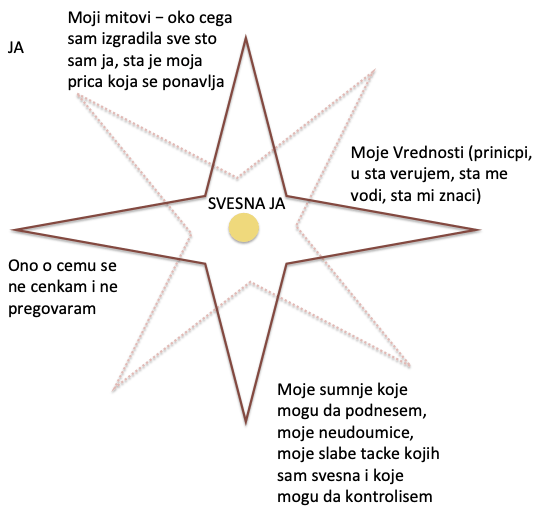
But this I is not so monochrome. It’s a new cosmos (as the Ancient Greeks defined the cosmos, a kind of complicated order). It’s in the center of the previous sphere, so it’s not defined exclusively by its boundaries, yet, it’s slightly (very slightly) closer to the reason (here, ‘reason’ is used for lack of a better word, but reason is definitely too anthropomorphic and logos-concept) because the center of the sphere is where it is (because that’s the key question, why exactly there? Mere chance, confetti scattered, balloons flying away, and some confetti/balloon stops on a plant and that’s it? Nothing more than that? Maybe the universe feeds on some force of the indeterminate and random).
And this cosmos has its axes, around which it revolves, what is stable or at least partially stable, what will not easily be disturbed at the first breath of crisis. This is what makes what we are, our identity: our story, our values, our conscious weak points, and our no-go principles. What looks like us and what we can recognize in others, but no matter how similar it is to another, it’s never identical to another because there is no identical. Even those with a similar story don’t have exactly similar weaknesses and strengths. There are countless examples. However much it looks like, it’s not the same, and however much we try to stand out, we are still in a story that slightly resembles others’. Where do these axes come from? From Before Us (temporally ungraspable, but possibly indirectly touchable), from Early Us (contaminated by memory and forgetting), and from Others around Early Us (uncontrolled). So, axes are built on fragile foundations. Thus, they try to be as strong as they can. They adapt from the outside, and cells from the inside. And inside:
Inside there is nothing solid. That hardening is a reflection of the play of another „non-„, this time very elusive. Inside are the black holes of the Unconscious and the white holes of the Unconscious. Inside is Everything and Nothing, Empty and Full, Before and After. And it’s all those „non-„, „somehow“, „in no way“, all those fluttering, holey, and „airy“ (vacuum-like?) maybe-elementary bases on some macro-psycho level that make us who we are. What penetrates through all boundaries makes us set our boundaries. Paradox of perspective, units of measurement, angle?
*
Power! Isn’t it?
There’s no newly discovered secret in the notion that we die twice: once when our body dies (and thus our Consciousness), and again when we die in others (when the idea of Us no longer exists, when all those who remember, think about us, or mention us are gone).
We haven’t yet outwitted death, and even if we delay it, it always lurks and will continue to do so as long as it makes sense in our ecosystem. The universe is vast and there could be room for all of us to live forever, but for now, that gigantic expanse is unattainable. We are confined to one planet, in one system, on the outskirts of one galaxy, and we must recycle ourselves to evolve and continue to celebrate-have-value life.
We endure in the Unconscious, in the Collective Unconscious, in Anima Mundi, in Unus Mundus. We endure, but we are merged with others. The Ego has dissolved. Even though our Consciousness doesn’t particularly benefit from After-Us, since After-Us no longer has Our judgment, observation, evaluation of the world, thus for Us there is no world if there is no Us, we try to ensure that the Ego doesn’t completely dissipate and lose itself. Even though I am not there, my Ego will last. What we seek is, since I am not there, since my Ego is not there, to exist in the Collective Conscious, with little regard for the Collective Unconscious (no matter how powerful it really is). Any Conscious is closer to the Ego, closer to evaluation, closer to the real. Because what is not illuminated by our Consciousness can be the most destructive, the best, the loveliest, the most aggressive, but it’s not real enough. For us, what’s real is what’s explainable, what we can describe with words or images. We even anthropomorphize other worlds, gods, dimensions. As Stanislaw Lem said, „we seek mirrors.“ The Collective Unconscious is too unexplainable and indescribable. And even if it is more real (which can’t be proven by classic experiments, but which is very nicely and smoothly repeated and confirmed in the clinic), we prefer the illusion. The illusion I write about is the illusion that I last longer when I’m more in the thoughts of others, when my Ego appears as if it’s still there, tangible and strong.
Hence power. The desire to leave a mark. It doesn’t matter whether it’s good or useful or not. There’s no moral category in this dimension. What matters is duration. Stepping out of the usual afterlife span of 2-3 generations and it’s over. If we’re powerful, we’re remembered. We come to life through the words and thoughts and dreams of others. Maybe we even dream of unknown people who really existed, but we don’t name them, don’t connect them with what was their Ego. If we dream of Hitchcock, Churchill, or Alexander the Great, we name them, we put our story into that image, we use their being as our representation. They are useful. They exist even though they don’t. They emerge from the Unconscious with their name and surname. They are identified. They are named.
Power is not the goal. Power is a means. The goal is the non-death of the Ego, or at least, Zombie-Ego. The goal is for the idea of us to remain. I wonder to what extent forgetting is a defense, protection, or prevention.
*
„Aniara“ or True Magnitudes
The Swedish film „Aniara“ from 2019 managed to touch the edge of the existential abyss for me. There’s no action, no betrayal of technology (in fact, technology is betrayed by us – the metaphor of artificial intelligence committing suicide is a somber critique of our relationship with the planet and the different, but I won’t delve into that aspect of this story), no alien monsters, not even human hysteria or hetero-aggressive impulses. Simply, a spacecraft deviates from its course and drifts into open space. Setting off towards open seas marks the beginning of adventure in many legends, where there’s progress, hope, vitality. One goes further to explore the unknown, to make the unknown part of the known realm. Sacrifices are made to discover what lies beyond. Man can do this in these legends because those seas are within the human measurement system. What is found is comprehensible, possible, and congruent.
In „Aniara,“ man drowns in something far beyond his measurement units. He could theoretically survive (air exists, gravity is maintained, algae provide enough nutritional units), but time is too long, space too vast. Man floats through a void that may not be one, but it is to him, because he cannot perceive it in any way other than through his senses and his capacities. It’s an extremely uncomfortable feeling to watch a human being who (still) has limits and cannot survive when outside them. He can’t, because there’s no meaning, no goal, and no senses to adapt external temporality to his own.
Whether we view this film as a sci-fi work examining the human place in the universe, or if we shift to the psychic dimension and see the tiny Consciousness in the unfathomable Unconscious, the question of proper measure comes to the forefront. Proper measure in terms of the conceptuality of something, but in terms of time, adaptation, and integration. Here (in the film and metaphor), there’s no destiny, karma, or great answer, or romanticized balance of revenge and justice. Simply, something cannot be integrated when it’s not visible, readable, understandable. It’s not that we don’t want to, but because it’s not our order of magnitude. Adaptation is less successful if its meaning is lost, and its effectiveness is not in the order of our temporality.
Images and actions of the universe are spectacular when viewed from afar, computer-processed and colored, but they are reflections of something we are not yet ready for, that we cannot yet „touch.“ To Lactobacillus, it’s indifferent (at least we think, maybe it’s not) that we eat and drink it, we are just a landscape, environment, energy source. The relationship between quark-man-cluster of galaxies is still one of description and observation, not a communicative type. Integration of any unknown cannot be sudden and cannot be without communication with the unknown. To communicate, a relationship and the possibility of a relationship are needed. Before drowning in the vast Unconscious, there needs to be an exchange between Us and Our Conscious and Our Unconscious. Respecting the temporality of the unknown goes through positioning in relation to our own temporality. Imagination can go further, but it cannot make direct contact with the unknown. Our Consciousness is needed in all this.
*

*

This is one corner where I leave some observations, some experiences, and some thoughts. They are based on clinical work, as well as on free associations. I completed a doctorate in neuroscience, medicine – a specialization in psychiatry and psychotherapy, as well as a specialization in analytical – Jungian psychotherapy. I work with EMDR.
I’m from Kikinda, I love Belgrade, Göttingen, and Alicante, but I found myself in Geneva. I love spicy stews, bread, butter and salt, boiled bagels in honey and yogurt. And David Bowie and contemporary art and books and the universe. Science fiction, which I have adored since childhood, helps me here and everywhere.
Many thanks for a few joined steps on this cocooned path,
Dragana (Jančić) Favre
 PsyMultiverses
